United Nations International Women's Day (IWD) March 8, 2026 Sor Veneranda Valdez Rotor, OFS*
Religious Beyond the Walls of Convent
Original Title: Keeper of Our Ancestral Home
 1. Sister Venie Brings in the Lighter Side of Life
2. Sister Venie Loves the Garden
3. "Nature, Nature on the Wall, A Beautiful Life
to Recall.”
4. Apo Resurreccion at Home
5. Anatomy of a Dream about Our Departed Love
6. Pilgrimage to the Holy Land
7. A Green World of Nature in Pastel
8. Find joy with a baby and bring back the joyful
years of life
9. "Simple may be my art, but it is true." - vvr
-------------------------------------------------------
* Secular Franciscan Order (Ordo Franciscanus Saecularis), an official, recognized religious order in the Catholic Church. Founded by St. Francis of Assisi over 800 years ago, it is designed for laypeople and secular clergy who live ordinary lives in the world rather than in a monastery or religious community. Wikipedia
"There is always the last of a distinct breed,"
"We are not alone. We may be of different races, but God has placed us so that we journey on the same path." (James Fenimore Cooper, The Last of the Mohicans.)

Rest in Peace, Beloved Sister Venie
"Love is a fruit in season at all times, and within reach of every hand."
- Saint Mother Teresa
1. Sister Venie Brings in the Lighter Side of Life

Sr Venie and niece Anna playfully mimic a windmill. "Be like the windmill
and be free of worries and cares in life, even only for a moment."
Bangui, Ilocos Norte


Manang Venie's last birthday at the age of 83 is celebrated
with love and thanksgiving with the family.

Rambutan grows on the backyard of the author's residence
in Don Antonio Heights 2, Quezon City. Sr Venie and cousin
Julie Rotor exchange pleasantries on gardening.

Mackie 3, with her yaya Gelyn and Lola Venie*
Love the word child for it never dies;it may sleep as we grow old;it wakes us up like The Little Prince,**when we're lost and troubled. ~
*Mackie is granddaughter of the author, Venie was his sister.
** The Little Prince novelette by Antoine de Saint-Exupéry


Sister Venie is always cheerful with relatives and guests whether at home
or on outings.


She enjoys company with her niece, Anna (left photo). She is Lola to Leo
and Mackie. Photos taken at our ancestral home in San Vicente.

With Bishop Bacani in a book fair on the 400th anniversary of UST.
With her are sister-in-law Cecille (right), and niece Anna (left).


Sister Venie shares some light moments with house guests
at our humble art gallery


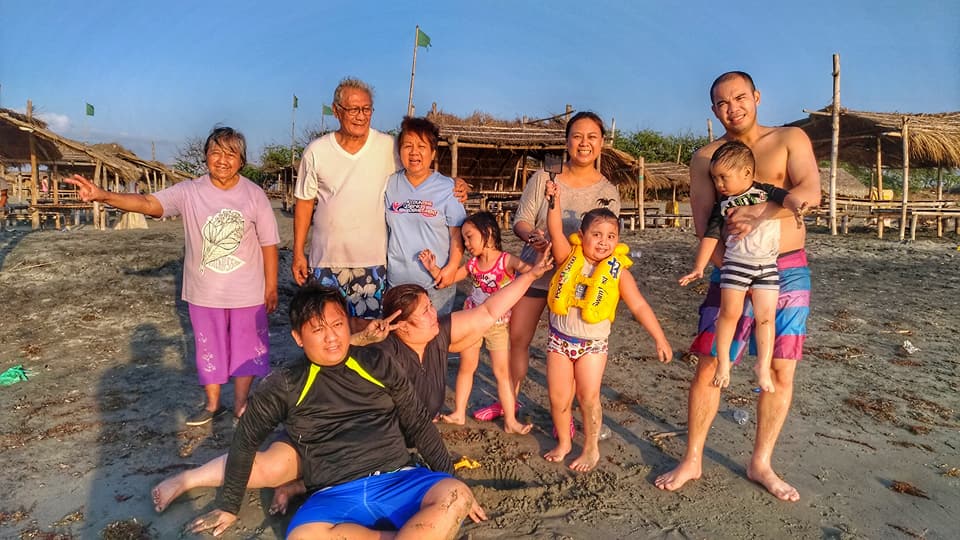
Family weekend at the beach


We conduct children's summer art workshop at home in San Vicente.


After-mass photos with our relatives and friends, San Vicente Diocesan Shrine


Left photo, our lifelong yaya, Basang (with white hair) - threshes local wheat harvest;
street view of our ancestral home.
2. Sister Venie Loves the Garden


Alukon or Himbaba-o is a favorite vegetable of Sister Venie
Deciduous Himbaba-o or Alukon (Ilk), on-the-spot pastel drawing by the author, La Union Botanical Garden, SFLU. Author's sister Venie, gathers staminate flowers of alukon at our home garden in San Vicente. Alukon is scientifically known as Broussonetia luzonica (Blanco), Family Moraceae. It is also referred to as Birch Flower.
What comes to mind painting or drawing a culinary subject, such as the alukon tree standing in a thicket on a hillside away from town? Imagine being a Survivor searching for any available food in the wild. Or Henry David Thoreau living alone by the Walden Pond. (And writing a treatise of man and society of this title)
It's a delicacy of the Ilocanos - alukonto the Tagalogs in Quezon - himbaba-oIt comes in other names in other places;its flowers cooked into diningding or stew,with kamote to thicken its soup - buridibud,and topped with broiled tilapia or hito. ~

Two-layer bunch of banana is indeed a bountiful harvest.

Meet me in the shade of trees,
by the waterfall and garden pond;
among loyal friends of nature,
where silence the sweetest sound.


Heritage trees for generations -
past, present, and future -
living monument of kinship,
bridge of memory and diary.

A bountiful harvest of rainwater cuts down water bill;
it is environment-friendly and a source of enjoyment.

3. "Nature, Nature on the Wall, A Beautiful Life to Recall.”
In loving memory of the late Venie V Rotor, ofs, author's sister
“Humans love the art of make-believe,Scenic Nature painted on the wall,Once empty and forgotten now alive,Bringing in friends to the call.” - avr

Sor Venie V Rotor and Ms Helen I Nolasco (in red) pose before a mural
painted by the author. Sor Venie was the author's sister, the eldest of
three siblings of the late Matias Rotor and Enriqueta Valdez..
“Sitting on the rock, reaching for the sky,All day if you wish with no one asking why.”

“Grace is something in the spirit to share,
That grows the more we love and care.”

Sor Veny left, leads house guest on a short walk at the botanical garden.
"What makes a house green
other than the color green;but a verdant garden scenehappy and healthy to live in."

Stairway connects art gallery and library.
"Stairway connectsthe past and the present,man and his Creator,events current and future,known and unknownnow and hereafter."

Sor Veny Rotor (right) explained to house guest some modern
paintings at the gallery, among them are her works.
Modern art:Impressionism to Surrealism,Dali, Matisse, Picasso to blame;Avant-garde and graffiti, the same;Please roll back to Realism.
Sor Venie V Rotor and Ms Helen I Nolasco (in red), house guest 2020Living with Nature Center Rotor ResidenceSan Vicente Ilocos Sur ~
4. Apo Resurreccion at Home
“Gaze at life in Me the second time”
Prayer is a universal element of Human Nature. It comes in many ways irrespective of creed and culture. It is ingrained in the rationality of the human being, emanating from a deep source which we cannot fully grasp. It is by believing in something beyond our comprehension that undermines our ignorance, arguably but true, as a unifying factor of humanity.

Sor Venie (foreground) led a short prayer before the
Resurrection at her family's residence,
Message of the Resurrection
"Apo Resureccion
How many times do we die and live again?When we fall down and rise,we fail and succeed,when we are blind and see,deaf and hear,sin and atone,hate and love,love and care,ad infinitum.""Touch Me now that I am risen,with your mind, heart and soul,for you have chosen the pathof life with Heaven your goal."- avr

Manang Venie (center) leads prayer
"Redeemer of our postmodern world,we come to You, our Recourseto find true peace and accordon life’s rugged course."- avr
“The great gift of Easter is hope - Christian hope which makes us have that confidence in God, in his ultimate triumph, and in his goodness and love, which nothing can shake.” - Basil C. Hume
Author's Note: Apo Resurreccion (Ilk) is a wooden icon of the resurrected Christ which has withstood the ravages of typhoons, earthquakes and the atrocities of the Second World War at the author's family residence. Prayers are offered by quests who visit the place, which is gradually being developed into a Living with Nature Center cum Botanical Garden, in San Vicente Ilocos Sur.
5. Anatomy of a Dream about Our Departed Love
Dr Abe V Rotor
It is remiss and folly of not showing true feelings to those we love, living or dead, all because “I am always busy”, and because there will be someday to make up for it. There are always reasons or alibis for failing to offer them prayers, to visit their graves, or just to make those who too, are close to them happy. Oh, there are many, many ways.

I went to bed very tired. For the whole day before my birthday I put on extra effort to finalize the manuscript of my forthcoming book which I was going to submit the following Monday. The title is Light from the Old Arch, a compilation of essays I wrote through the years.
Dad and my sister Venie or her renewal of her vow as Franciscan sister (Ordo Franciscanus Saecularis or OFS )
It was just past 10 in the evening and Cecille, my wife, who had gone to bed ahead of me stirred. “I’ll just check what we will have for breakfast. I’ll be back,” she said as I stretched my aching back and tired brain and apparently fell asleep.
Soon I found myself in complete darkness. I could not trace my way to switch on the lights and after several attempts locating it on the wall and under curtain, an inexplicable fear crept, a fear I had never experienced before. I was in a strange domain yet it had the features of my home. There was total darkness, total silence.
Dad died in 1981 at the age of 78. He died here in our residence at Lagro after battling with the complications of diabetes. We buried him at Himlayang Pilipino. Our oldest son, Pao who died at three, soon joined him in the same grave two years after.
Dad was deeply affected by my Mama’s death during the Second World War. My sister Veny was four then, and my brother Eugene was three. Dad suffered much - emotionally and physically - even after the four years of Japanese occupation. The war left our family and the country in ruins.
We continued to live in San Vicente which is adjacent to Vigan, the capital of Ilocos Sur. Dad confessed when we were already big that he feared so much we would not make it through in life. I know how extremely difficult it was even if dad owned farmlands and a neo-colonial house which my grandparents built in 1900. The three of us children knew little of the joys of childhood. My only uncle, Uncle Leo left dad to raised his own family in Pangasinan. He seldom visited us and spent time in our big house where he, like my dad, and their four siblings were born. Uncle Leo was the eldest and dad was the youngest. The rest of their siblings died at a very early age of smallpox which killed many people in Ilocos.

Center: Basang, my auntie-yaya for life; right, my sister, Venie.


Basang my auntie and yaya took care of me from the time my mother died. I was less than two years old then. She never left us even when I came to Manila for my studies. She died three years after dad had gone. Manang Venie called me to come home when Basang died. We buried her in the town cemetery close to our departed relatives. Just before she died she gave me an antique narra aparador which I now use in keeping my personal things. In our dialect, she said, “This is the only thing I can give you.”
“You have given me everything,” I said.
Going back to the incident of October 21, I called dad three times, then called Basang once. It was a call apparently in fear. I felt helpless and lost. I froze. I could not move. I could not shout. And when I knew no help would come, I struggled. I succeeded in moving my fingers, my toes, until I was free.
Cecille had returned to our bedroom. “Why, you are pale and perspiring? What happened?" she asked, perplexed. She fetched me a glass of water.
“Was I shouting?” I asked automatically. “No,” she said calmly.
“I was dreaming,” I said and told her the whole story.
Anatomy of a Dream
Dreams are visions of the unconscious part of our brain. That is why they occur in our sleep, when we are not aware of things the way we perceive them with our senses. Dreams are not fashioned by rational thoughts and actions, and therefore we have no power to decide and to act according to that decision. We are entirely under the control of our unconscious mind.
“Even when we are deeply asleep the psyche is still actively producing dreams,” says Carl Jung. “We may not always be aware of these activities, any more than we are aware of our physiological activities, but this does not mean they are not taking place.”
According to Jung we remember only a few of our dreams, yet recent evidences suggest that we dream continuously throughout the night. There in our unconscious mind our psyche is very much alive, performing psychological work such as perceiving, remembering, thinking, feeling, wishing, willing, attending and striving – just as breathing, digesting and perspiring are physiological activities.
But can we choose psychic values? According to Jung, when a high value is placed upon an idea or feeling it means that this idea or feeling exerts considerable force in influencing and directing one’s behavior. A person may place a high value on beauty. Another on power. Or knowledge. On the other hand, there are those who place a high value on wealth, even on sex and vices. These create the themes of our dreams.
This is the realm of our unconscious mind. This is where Carl Jung parted way from his friend Sigmund Freud’s as he blazed the trail of the psychology of the unconscious, which led to applied psychology - psychiatry. We are governed not only by our conscious mind. We are actually governed in a much deeper and wider sense than we ever think. As we feed the unconscious with conscious thoughts and experiences, so the unconscious feeds the conscious mind. And this cycle goes on throughout everyone’s life, starting in the womb.
Even when we were children, the mind did not lose the information it received. They were deposited. First in the conscious, then deposited in the unconscious part of our brain, which are saved like in the computer. Now, the information is ready at hand to be retrieved. Touch the key and the info comes out on the screen – the screen of our consciousness.
How will this affect our present mind now that we are older? Jung said that the previous information serves as archetype. To better understand how this archetype works in relation to what we think at present, here is an example.
Suppose here is a person who happened to be a witness of a murder with his own eyes when he was still a small child. When he sees a suspicious person, the image of the murderer he saw many years ago flashes. It is the archetype coming alive.
Or take another example. A kindly gentleman comes and asks for a favor. We size him up in relation to people who have the characteristics this man possesses. If our experiences are agreeable, it is likely that we going to entertain this person.
The images of people, places and events are fashioned in many ways by archetypes. Unlike the computer, the mind spontaneously brings out the archetype that the brain appropriately needs at that moment. This is the basis of many of our decisions – and prejudices.
Through dreams the loaded unconscious finds relief. Information flows out in the form of dreams. Dreams may be happy or sad, fearful or pleasant. Or at intervals of moods and settings and characters, as if information keeps on flowing out. Nature has given us a safety valve to maintain our rationality and to release us from the prison walls of memory. Thus the other safety valve is forgetfulness.
Psychiatry is based on this principle. Lying on a couch the patient unloads his burden, fears, and uncertainties. He releases the pressure. Through this process he reaches a state of catharsis. He is relieved. He can now sleep. He can now work again.
People who cannot attain catharsis may suffer of psychiatric problems and may resort to drugs. Do you often wonder why people resort to drugs? Why there are more and more people who are addicted to drugs and alcohol?
Why, many people try to “escape” reality?
October 21 is a memorable day for me. By reading this story one is led to think that something supernatural controlled the event and situation. I told Cecille, “Dad and Basang came.”
“Let’s pray for them,” she answered and made the sign of the cross.
I know they did not come; I went to them. It was a special day, my special day.
I realized my fault which lays not so much in not remembering them often, but I have ceased to see them as the models that shaped my life. That was too long ago. I no longer see the lessons I learned from them that are still relevant to my present life. I do not call them anymore in the midst of my problems. I have grown up. I do not seek their intercession and guidance anymore.
Dreams are visions of the unconscious part of our brain. That is why they occur in our sleep, when we are not aware of things the way we perceive them with our senses. Dreams are not fashioned by rational thoughts and actions, and therefore we have no power to decide and to act according to that decision. We are entirely under the control of our unconscious mind.
“Even when we are deeply asleep the psyche is still actively producing dreams,” says Carl Jung. “We may not always be aware of these activities, any more than we are aware of our physiological activities, but this does not mean they are not taking place.”
According to Jung we remember only a few of our dreams, yet recent evidences suggest that we dream continuously throughout the night. There in our unconscious mind our psyche is very much alive, performing psychological work such as perceiving, remembering, thinking, feeling, wishing, willing, attending and striving – just as breathing, digesting and perspiring are physiological activities.
But can we choose psychic values? According to Jung, when a high value is placed upon an idea or feeling it means that this idea or feeling exerts considerable force in influencing and directing one’s behavior. A person may place a high value on beauty. Another on power. Or knowledge. On the other hand, there are those who place a high value on wealth, even on sex and vices. These create the themes of our dreams.
This is the realm of our unconscious mind. This is where Carl Jung parted way from his friend Sigmund Freud’s as he blazed the trail of the psychology of the unconscious, which led to applied psychology - psychiatry. We are governed not only by our conscious mind. We are actually governed in a much deeper and wider sense than we ever think. As we feed the unconscious with conscious thoughts and experiences, so the unconscious feeds the conscious mind. And this cycle goes on throughout everyone’s life, starting in the womb.
Even when we were children, the mind did not lose the information it received. They were deposited. First in the conscious, then deposited in the unconscious part of our brain, which are saved like in the computer. Now, the information is ready at hand to be retrieved. Touch the key and the info comes out on the screen – the screen of our consciousness.
How will this affect our present mind now that we are older? Jung said that the previous information serves as archetype. To better understand how this archetype works in relation to what we think at present, here is an example.
Suppose here is a person who happened to be a witness of a murder with his own eyes when he was still a small child. When he sees a suspicious person, the image of the murderer he saw many years ago flashes. It is the archetype coming alive.
Or take another example. A kindly gentleman comes and asks for a favor. We size him up in relation to people who have the characteristics this man possesses. If our experiences are agreeable, it is likely that we going to entertain this person.
The images of people, places and events are fashioned in many ways by archetypes. Unlike the computer, the mind spontaneously brings out the archetype that the brain appropriately needs at that moment. This is the basis of many of our decisions – and prejudices.
Through dreams the loaded unconscious finds relief. Information flows out in the form of dreams. Dreams may be happy or sad, fearful or pleasant. Or at intervals of moods and settings and characters, as if information keeps on flowing out. Nature has given us a safety valve to maintain our rationality and to release us from the prison walls of memory. Thus the other safety valve is forgetfulness.
Psychiatry is based on this principle. Lying on a couch the patient unloads his burden, fears, and uncertainties. He releases the pressure. Through this process he reaches a state of catharsis. He is relieved. He can now sleep. He can now work again.
People who cannot attain catharsis may suffer of psychiatric problems and may resort to drugs. Do you often wonder why people resort to drugs? Why there are more and more people who are addicted to drugs and alcohol?
Why, many people try to “escape” reality?
October 21 is a memorable day for me. By reading this story one is led to think that something supernatural controlled the event and situation. I told Cecille, “Dad and Basang came.”
“Let’s pray for them,” she answered and made the sign of the cross.
I know they did not come; I went to them. It was a special day, my special day.
I realized my fault which lays not so much in not remembering them often, but I have ceased to see them as the models that shaped my life. That was too long ago. I no longer see the lessons I learned from them that are still relevant to my present life. I do not call them anymore in the midst of my problems. I have grown up. I do not seek their intercession and guidance anymore.

Time has changed, and change has polarized our worlds. So with values of old and of the present world. The generation gap syndrome is creeping fast, more so with my own children who too, will have a world of their own in the near future.
There in the dark I called Dad and Basang, their names clear and loud, but my voice just faded without answer, not even its own echo. It was eerie and mysterious. The unconscious was swelling and it found an exit in the dark, psychic energy released in dream. And there as I called them, I realized I was the one who is lost
– and found myself again.
6. Pilgrimage to the Holy Land

Pilgrimage to the Holy Land is her greatest dream-come-true.

I treasure this souvenir cap from Jordan, my sister gave me.
Jordan is the third country she visited in a group itinerary.


Sister Venie (left) poses before Sea of Galilee in Israel, and the Giza
Pyramid of Egypt, with Leo Carlo and Lorraine in a group tour.


Christianity and Islam - two great religions of the world -
are one in these photos.
7. A Green World of Nature in Pastel


"Rest is not idleness, and to lie sometimes on the grass under trees on a summer's day, listening to the murmur of the water, or watching the clouds float across the sky, is by no means a waste of time." - John Lubbock ~


Pastel Drawings of Sis Venie V Rotor
“Away, away, from men and towns,
To the wild wood and the downs, —
To the silent wilderness,
Where the soul need not repress its music.”
—Percy Bysshe Shelley

A basketful of oranges
"Love is a fruit in season at all times, and within reach of every hand."
- Saint Mother Teresa

Flow gently under the bridge
“Love is the bridge that joins all the worlds together.” – Frederick Lenz

Green turtles
8. Find joy with a baby and bring back
the joyful years of life
Dr Abe V Rotor
Mackie 3, with her yaya Gelyn and Lola Veny*
Love the word child for it never dies;it may sleep as we grow old;it wakes us up like The Little Prince,**when we're lost and troubled. ~
*Mackie is granddaughter of the author, Veny was his sister.
** The Little Prince novelette by Antoine de Saint-Exupéry
9. "Simple may be my art, but it is true." - vvr
Paintings by Veny V Rotor, ofs

Nymphaea rising from a pond
“Art washes away from the soul the dust of everyday life.”
- Pablo Picasso
“I dream of painting and then I paint my dream.”
– Vincent Van Gogh

An array of roses
“Everything has its beauty, but not everyone sees it.”
– Andy Warhol.

A rare fruit
“Art is never finished, only abandoned.”
– Leonardo Da Vinci.
“If you ask me what I came to do in this world, I, an artist,
will answer you: I am here to live out loud.” – Émile Zola.
United Nations International Women's Day (IWD) March 8, 2026 Veneranda Valdez Rotor, OFS
Religious Beyond the Walls of Convent
Original Title: Keeper of Our Ancestral Home
Sister Venie Brings in the Lighter Side of Life
Be like the windmill and be free of worries and cares in life, even only
for a moment. Bangui, Ilocos Norte
Sister Veneranda Valdez Rotor was the eldest of three siblings of the late Matias Rotor and Enriqueta Valdez. She is remembered for her contributions to the preservation of their ancestral home in San Vicente, Ilocos Sur, and her role as a keeper of the family's heritage. Her works and contributions have been recognized in various contexts, highlighting her significance in the community and her dedication to preserving the natural environment and cultural traditions. Internet


No comments:
Post a Comment