Friday, October 31, 2025

We are Living in Parallel Worlds

                 We are Living in Parallel Worlds 

Can a person simultaneously exist in two - or more - separate places or occasions? 

Dr Abe V Rotor 

"Sir, I saw you at the Cultural Center yesterday," Ellen greeted me that Monday. "You were in barong talking with guests during the cocktail."  

Honestly I wasn't.  I wasn't even aware of the occasion. Politely I replied, "It must have been another person."

"Kayo po, sir.  Sigurandong sigurado ako." (It was you, sir. I am very sure.)

Ellen has known me for  twelve years as a professor, she was secretary to the college president at SPQU. 

Well, the matter just died naturally.  Such friendly gesture strengthens camaraderie, and builds quaintness in the workplace.   

So you think you saw a friend walking. In the church a devotee has a familiar profile. You call the name of someone in the crowd. He doesn't respond.  You think he snubbed you. You say that's my former teacher in high school. My classmate in college.

There is something that tells you about a particular person.  He becomes an instant acquaintance. Or it may turn out to be the opposite.  Then you start trying to remember where both of you must have met before. You can't recall. Then in your respite you suddenly remember. But now, doubt shrouds your memory.  Strange. 

Or it could be unmistakably a true experience, yet leaves you  doubting 
at the end.

One time when I was in high school I saw my dad praying in our church.  It was an ordinary morning and it was a custom to pay a visit even only for a short prayer, instead of just passing by. Dad was in deep prayer. He was near the altar. I left him and walked home.

I was surprised to see him meet me at our gate. I was dumbfounded.  

"Were you in church, dad?" 

"No, I'm on my way, son." He looked back and added, "Don't forget to feed the chickens."

Is it possible that a person may exist in two - or more - separate places or occasions at the same time?

Who was the person Ellen saw was me?   Who was the person whom I believed was my dad in the church that morning?  ~

Don’t Fall into the Modus Operandi of Opportunists and Rogues

 Don’t Fall into the Modus Operandi  of Opportunists and Rogues

A friendly reminder for the Holiday Season 
Dr Abe V Rotor 

Beware. Don’t fall victim to impostors, opportunists and rogues. These are ten tips to protect yourself and other people.


1. Have presence of mind always.
2. Don’t be too confident and trusting.
3. Avoid unlikely places and hour of the day.
4. It is good to be with somebody or group you know.
5. Distance yourself from suspecting characters.
6. Dress simply and leave your valuables at home.
7. Screen and limit access of personal information about you.
8. Be prepared for contingencies. Be security-conscious always.
9. Keep emergency phone numbers and addresses ready at fingertips.
10. Attend seminars and workshops on safety and security.

I am writing this article from fresh memory of an incident in which I am a victim. I must admit I violated Rules 1, 2, 3 and 7 in the above list.

First I was too trusting and confident in welcoming a “new found relative” – one Mario B. Rotor, incoming president of “The Leagues of Young Educators of Regions I and II.” (See hand written note of the impostor.) Through phone call, my wife endorsed this person to see me at UST where I was holding classes. (He had introduced himself on the phone, first to my daughter, then to my wife, picking up information in the process.)

Second, with this added information beefing up his readings and researches about me, he was ready to meet me finally – “his successful ‘uncle’ whom he had been longing to meet personally.” When I met him he practically knew me from head to foot, giving me a genuine impression about him as a new found nephew. I remember Mark Twain’s “Tom Sawyer” and “Huckleberry Finn”. Quite similar to the story of the swindlers in these novels, he started greeting me “uncle”, with music in his voice and familiarity in ambiance.

The third rule I broke is that I was totally unsuspecting. And this is when opportunists strike. He came on a Saturday, just after noon time, met me at the entrance of the graduate school, greeted the security guard and everyone else, with profuse courtesy. I led him to my classroom where I was going to give final examination. He waited until I finished giving the instruction and questionnaire. I entertained him at the corridor.

“Thank you for accepting our invitation to be our inducting officer and guest of honor,” he said, handing me the invitation, which has yet to be printed. “I’ll come back to give you the final copy, with your permission to print your name.” He told me how happy our relatives in the province are about me, that he is thankful to auntie (my wife) for arranging for this meeting.

“Why it’s an honor!” I answered. Who would not like to meet friends from both the Ilocos and Cagayan Valley where I was assigned for many years when I was regional director of then National Grains Authority. “I am sorry for the short notice,” he said. It will be at the National Defense College Auditorium, Camp Aguinaldo, at 6:30 p.m. Sunday, which means the following day.

Now here is the climax of the modus operandi. I offered him even only the cost of my food in the affair. He refused. “You are my guest,” he insisted. “Just donate a trophy,” he said. “Or the cost of it,” which I gave. He told me he had to rush to Manila Bulletin. “I’ll see you there, uncle,” he said and left.

There was no induction ceremony, and the phone number he left is the operator’s at Camp Aguinaldo. I came to know it only after he had left. When I reached home my wife and daughter exclaimed, “We thought he is the son of Vicente, your cousin. His name is Mario B. Rotor, a teacher.”

Except for his extreme feminine nature – bodily and by his voice – he could pass for a polished conversationalist, quick in wit and in scribbling notes. He spoke Ilocano perfectly with proper intonation. We talked in pure Ilocano throughout. He is around 5’ 4”, slim, kayumanggi, stoops a little, shoulders are rather high, and has rather sharp eyes, bony checks and prominent jaw, nose and ears (typical features of Rotors and Valdezes, so I thought). I was looking at my uncle Manuel and Ismael in their younger days, except that he could be mistaken for a woman by his voice, even on the phone. (He called up UST twice, I received the second.)

I am relating this story to warn potential victims of this impostor. What if the victim is not in his home ground? Or a neophyte in the city? His original plan according to my wife was to invite me outside. He suggested a fast food store near Dapitan, or anywhere outside UST.

Reading the Person through Handwriting Analysis

As I went over the notes this impostor wrote, I wondered if handwriting analysis or graphology can really tell the true character of a person, and thus tell us whether to avoid or welcome him, more so to be properly warned. I know that graphology is among the tools used in the recruitment process administered by certain companies in the US and Europe, but is it sufficient to give us a keyhole view of hidden motives, other general personality characteristics?

It is interesting to note the following features I observed on the impostor’s handwriting which are as follows: (See reproduction)

1. His writing lies perfectly in between lines, the words rarely touching the lower or upper bars. (Sign of independence, cleverness, non-conformist)

2. Heavy writing. You can feel the back of the paper like Braille (serious, intense, violent tendency, risk taker).

3. Loops of letters f, g, p, y vary. A large loop is a sign of openness; while tight and sharp pointed loops show the opposite character. Lack of “tail” after each word means an inward, silent character, but the sharp and deep downward strokes (f, p, t, l, I) show emotional intensity.

4. Ambivalence is also shown by the inconsistent writing pattern, and inconsistent type and size of letters. There are letters, which cannot be immediately deciphered, or are missing. (Dr. Jekyll and Mr. Hyde syndrome)

5. The dot of letter i, lies too far towards the right. No dot is exactly above the letter i. The letter t lacks the usual cross line at the top; instead it is cut at the middle either by a short dash or line that connects the nearby letter. Note wide spaces between words, large margins, and empty lines. (procrastination, loafer, tamad)

6. Writing has a feminist touch, which explain his personality.

I have always been fascinated by graphology since college days and through books in the library and bookstores I have learned a number of basic signs associated with talents, tendencies, etc. I must admit that as a field in psychology, graphology faces many views and controversies (like Freudian and Jungian approaches in psychology), but with computers today, this new science can be developed into a potent tool in personality analysis. I remember our teachers in elementary and high school who used to remind us in class that handwriting is the mirror of ourselves.

A Plea for Help as Modus Operandi

I lived at Don Antonio Height 2 at our family residence way back in the seventies when the area was still sparsely populated. One late evening I was awakened by a pleading sound, and when I looked from the veranda I saw a man apparently bleeding from wounds, leaning under a street lamp across our house. He was groaning and repeatedly pleading, “Dalhin ninyo ako sa ospital,” (Take me to the hospital.)

Our neighbor was also alerted. As we had coded security communication, we cautiously observed the “victim”. We sensed something wrong. Apparently he was only acting. When he saw that we were armed and did not open our gates, he started walking away. There at the nearest curb he joined his companions, a jeepload of tough guys, apparently hold uppers.

After the incident the whole neighborhood arrived at a theory that the “wounded” person acted as a decoy. In the process of being helped, his companions rush in, and declare a hold up. This “pasok bahay” modus operandi is not new and has been modified into other varieties, such as “akyat bahay”. In this case the gang takes advantage of houses when the residents are on vacation.

This mutual defense strategy proved to be an effective deterrent of a would-be crime. You can modify this according to your situation. One is by having coded night light or alarm. The rule is that, “Do not lift the drawbridge or open the fort gate,” so to speak, if you are living in a pioneer territory.

Be Sure Your Car Doors are Locked

My cousin had a co-teacher at Ramon Magsaysay High School Manila who fought a hold upper. She showed me both her hands bearing the scars of multiple wounds from knife. “My husband was also hurt,” she said. “Thanks God we are still alive.”

This is her story. Every morning the husband drives Remy, my cousin’s co-teacher, to Ramon Magsaysay before proceeding to his office. He would pick her up in the afternoon. For years this became a routine.

One morning while waiting for the green light at an intersection along Quezon Avenue, an unsuspecting man passing as a pedestrian suddenly opened the car’s rear door and occupied the backseat. With a fan knife he declared a holdup. Resisting the threat, the husband fought. The wife tried to help the husband. The struggle attracted passersby and pedestrians. The hold upper escaped, leaving the wounded couple that was immediately brought to the hospital.

Lesson: Be sure to lock all doors of your car. Roll up the windows to a level no one from outside can unlock and open the doors. When parking, leave the car immediately after locking the doors. Be sure to put on the wheel or engine lock. Don’t linger around, more so stay inside and sleep while the aircon is on. You are an easy target of hold uppers.

When opening your garage when going out specially in the early morning, and upon arriving in the evening, look around first for any suspicious people around. My friend, director Ruel Montenegro, lost his GSR Lancer this way. His driver did not resist the hold upper who simply took the car from the garage. It was never found.

What rules did the couple violate? First, they were not security-conscious. And second, they lacked the presence of mind at that time. This is often the case when we are preoccupied with routine activities. Again, as in my case they were too trusting and confident no one would harm them. In this civilized world we are still living in a jungle – a jungle made by man himself. ~

Thursday, October 30, 2025

Are you living a simple life? Evaluate yourself.

  Are you living a simple life? Evaluate yourself.

"Simplicity is the peak of civilization." – Jessie Sampter

Dr Abe V Rotor

A happy family reunion

Check if you are practicing each of the following: There can be no step-by-step guide to simplifying your life. However, these are important reminders. Do these apply to you?

1. Make a list of your top 4-5 important things.
2. Evaluate your commitments.
3. Evaluate your time.
4. Simplify work tasks.
5. Learn to say no.

6. Make a Most Important Tasks (MITs) list each day.
7. Spend time alone.
8. Go for quality, not quantity.
9. Indulge in productive hobby, like home gardening.
10. Create an easy-to-maintain home.

11. Carry less stuff.
12. Simplify your budget.
13. Leave space around things in your day.
14. Live closer to work/school.
15. Always ask: Will this simplify my life?

16. Limit your communications.
17. Get rid of what you don’t need.
18. Get rid of the big items.
19. Clean /Edit your rooms.
20. Limit your buying habits.

21. Spend time with people you love.
22. Eat slowly.
23. Streamline your life.
24. Learn to live frugally.
25. Learn what “enough” is.

26. Eat healthy.
27. Exercise.
28. Declutter before organizing.
29. Find inner simplicity.
30. Find a creative outlet for self-expression.

RATING:
26 – 30 You are a model of Simple Living, an apostle.
21 – 25 You are appreciated by people around you. You are happy and they are happy, too.
16 – 20 You live moderately – know how to adjust, if there’s too much or too little.
15 and below You are not living a simple life. Simplify your life style. Get advice from parents, model teachers, your family doctor, spiritual adviser, reliable community leaders.  Read more about this topic.  Search the Internet.   

Lesson on former Paaralang Bayan sa Himpapawid (People's School on Air) 738 DZRB-AM 8 to 9 evening class, Monday to Friday (Philippines)

Acknowledgment: Thanks to Zen Habits. Simple Living Manifesto: 72 Ideas to Simplify Your Life. Every Wednesday is Simplicity Day on Zen Habits.

Wednesday, October 29, 2025

Friendly Insects

 Friendly Insects

Nest of Green Tree Ants (Oecephala smaragdina); biologist
examines colony
 range and distribution.

Dell H. Grecia*
Columnist, Backyard Ventures
Women’s Journal


Before you grab the fly swatter or reach for the can of Baygon or Raid, think of creepy crawlies as part of Nature’s healing system. Here, read on and learn why some insects are here to stay.

Like herbal plants, some insects possess their own medicinal value. Or so says out friend, Dr. Abe V. Rotor of the University of Santo Tomas and St. Paul University, Quezon City.

Bee sting, for example, cures arthritis and rheumatism. In fact, the number of doctors and clinics that use bee venom as an alternative medicine is increasing in the United States and other parts of the world.

The treatment is as simple as introducing the excited bee over the affected area, say, the knee or elbow. By holding the struggling bee with forceps, its posterior needle is aimed at the infected area. Once the needle is deeply embedded, the bee is removed. In the process, the sting with the attached poison sac is torn off, resulting in the insect’s death. (This is the same reason a male bee dies after mating with the potential queen during nuptial flight). The poison sac contracts rhythmically, as more poison flows into the affected muscles and nerves.

A. The Mealy Bug

The mealy bug (Dactylopius coccus), which produces cochineal, is another insect that has medicinal value. It is presently cultured commercially in the Honduras, Canary Island, Mexico, Peru and Spain.

Extensively used as dye, cochineal was later discovered to possess properties that allay pain. It is reported to be effective as well against whooping cough and neuralgia.

B. Fly Maggots vs. Deep-seated Wounds

During the First-World War, relates Dr. Rotor, a certain Dr. W. S. Baer noticed that wounds of soldiers who had been lying on the battlefield for hours did not develop infections such as osteomyelitis, as compared with wounds treated and dressed promptly after they were inflicted.

The reason: the older wounds were found to be infested with maggots. These maggots are larvae of flies; commonly houseflies and the blue bottle flies. The adult flies can detect the smell of blood. They deposit their eggs around the wound, anticipating that their larvae are assured of food provided by the injured tissues.

This led to the practice of rearing maggots under sterile conditions and introducing these surgically clean maggots into wounds to eat the microscopic particles to putrefied flesh and bone. The practice, however, ended with the introduction of modern drugs and surgery. To show how effective this practice was, a survey revealed that 92 percent of 600 physicians who had used this treatment reported favorably about it.

A renowned researcher, Dr. William Robinson, was able to isolate a substance from the secretion of the maggots which he believed to have a healing effect on infected wounds, acting like antibiotics. This material – allantoin - soon became commercially available, as its importance began to be recognized.

Allantoin is a harmless, odorless, stainless, painless, and inexpensive lotion which, when applied to chronic ulcers, burns, and similar pus-forming wounds, stimulates local- rather than general- granulation. Thus, it is of special value in treating deep wounds such as bone marrow infection, where the internal part of the wound must be healed first.

Allantoin solutions cannot be as efficient as using living maggots in the treatment of bone infections, however. This is because the maggots actually eat out the necrotic tissues and kill the pus-forming bacteria by digesting them. In the process, the maggots continuously secrete minute quantities of allantoin in their excreta to the very depth of the wound, especially where the use of surgical instrument is limited if not dangerous.

With the advent of computers and other gadgets, modern medicine (except, perhaps, in very remote situations) has finally shelved the practice of using maggots on wounds, and it is likely to remain there.

C. Cantharidin: A Cure-All Drug and Aphrodisiac

Dr. Rotor explains that Dr. Rufino Gapuz, also a professor, discussed in his class a way to harness and calm down a cow that is in heat so that she can be brought to the corral for breeding. This was in the sixties, when artificial insemination was something new in animal science.

There is an injection that comes from the blister beetle, the so-called Spanish fly or Lytta vasicatoria. This insect occurs in abundance in France and Spain, a relative of the American blister beetle.

The beetle carries in its body cantharidin. It was used as folk medicine during the 19th century for all sorts of ailments and also much as an aphrodisiac. At present, it is used in treating certain diseases of the urinogenital system and in an animal breeding.

D. Ant Secretion

With the decline in the effectiveness of antibiotics as a result of increasing resistance of pathogen, says Dr. Rotor, the search for more potent ones has widened into various fields, which today include plants, fungi, and protists - monerans notwithstanding.

One potential source of antibiotics is the green tree ant, a member of the large order of insects Hymenoptera to which bees and wasps belong. Like their relatives, the green tree ants - locally known as hantik (Oecephala smaragdina) - live in colonies. This social behavior enables them to grow in numbers of hundreds or thousands in a single colony, which can remain active for a long time. Other than its reported antibiotic property, the leaf nest of the green tree ant relieves inflammation when bandaged on the affected area.

According to Walter Linsenmaier, the green tree ant is famed as a weaver ant, not on account of its architecture that consists merely of a pile of leaves pulled together, but because of their method of working. When fastening two somewhat separated leaves together, these ants line up on the edge of one of them, holding onto it with legs stretched full length behind them and, working together, pull up the other leaf with their mandibles.

Meanwhile, other ants, with the spinning larvae in their mouths, weave the leaves together. If the distance between leaves is too great for an ant to bridge the gap, the ants form ladders; these not only make it possible to pull the leaves closer together, but also serve as a bridge of the weavers. The larvae secretion may be extended inward to strengthen earlier ties and provide lining to the brood. It is this secretion that reportedly is an effective remedy against wound infection and inflammation.

E. New Frontiers

Dr. Rotor has listed down some new frontiers in the insect world as cures to various pathogens, to wit:

• Anti-venom and poison antidotes are derived from Hymenopterans. Many victims die of insect bite every year that there is a need to develop a ready source of anti-venom vaccine and antidote. Can insect venom also apply to other kinds of poisoning?

• The secret of hibernation among insects can serve as a model for cryonics science in humans. To cross the vast space in future interplanetary travel, man will have to defy time and aging. One means is through planned hibernation.

• Parthenogenesis is an unusual reproduction of immature insects without the benefit of sexual reproduction. Could this “virgin birth” apply to higher animals and humans? When threatened by lack of food and inclement weather conditions, aphids reproduce even before reaching full maturity and without the involvement of gametes.

• Insects that are highly resistant to putrefaction such as among Dipterans may be the key to cancer prevention and treatment. Blue bottle fly maggots can survive acidity up to 10 percent. Hence, they are found to breed in vinegar and fish sauce substrate without apparent harmful effect to the process and end products.

• The burning and obnoxious secretions of certain insects, particularly Hemipterans, have yet to be developed as repellant against other pests.

• In the case fireflies and glow worms, the substance luciferin emits virtually 100-percent light without emission of heat. This substance has many possible uses in industry and medicine as tracer.

• The high protein content of certain insects like termites, silk worm larvae, and grasshoppers (three to four times higher than beef, milk and eggs) has great promise in the development of high-value food. Protein capsules, for example, can be made convenient for those who lead busy lives.

• Chitin of insects is the envy of plastic manufacturers. It is much stronger, yet very much lighter. Its many uses include the control of nematodes using chitin preparations. Chinese doctors recommend insect exoskeleton as a remedy for a hundred and one ailments.

Dr. Rotor concludes that insects, the most numerous and oldest of all animals on earth, have reasons for their existence. Although they are generally regarded as notorious destroyers, the truth is that our well-being hinges much on their presence and persistence. They are part of Nature’s healing system. ~
-------------
* In memory of the late Dell H Grecia, journalist, environmentalist and friend.

Monday, October 27, 2025

Art Evolution Experimental Paintings in 10 Fields (Article in Progress)

   Art Evolution 

Experimental Paintings in 10 Fields
Paintings by Dr Abe V Rotor
Living With Nature Center
San Vicente, Ilocos Sur 

School children come to me for art's sake. 
     "Lolo, what projects can we make?" 
It's the idea that stirs their imagination
     into many ways of art expression.

Part 1 - Art with Shells

Shells collection into work of art against a marine mural.  

Arrange and mount on a base,  
now a table decor, a receptacle 
of things you love and praise;
truly it's an art-to-craft version,  
both aesthetics and function.  

Marine specimens into Artwork   

Paint a sea floor background as base.
Spread out shells and corals freely.
Let your guests touch them and study,
with guidance, and care just in case.         
          
Part 2 - Relief Painting
 
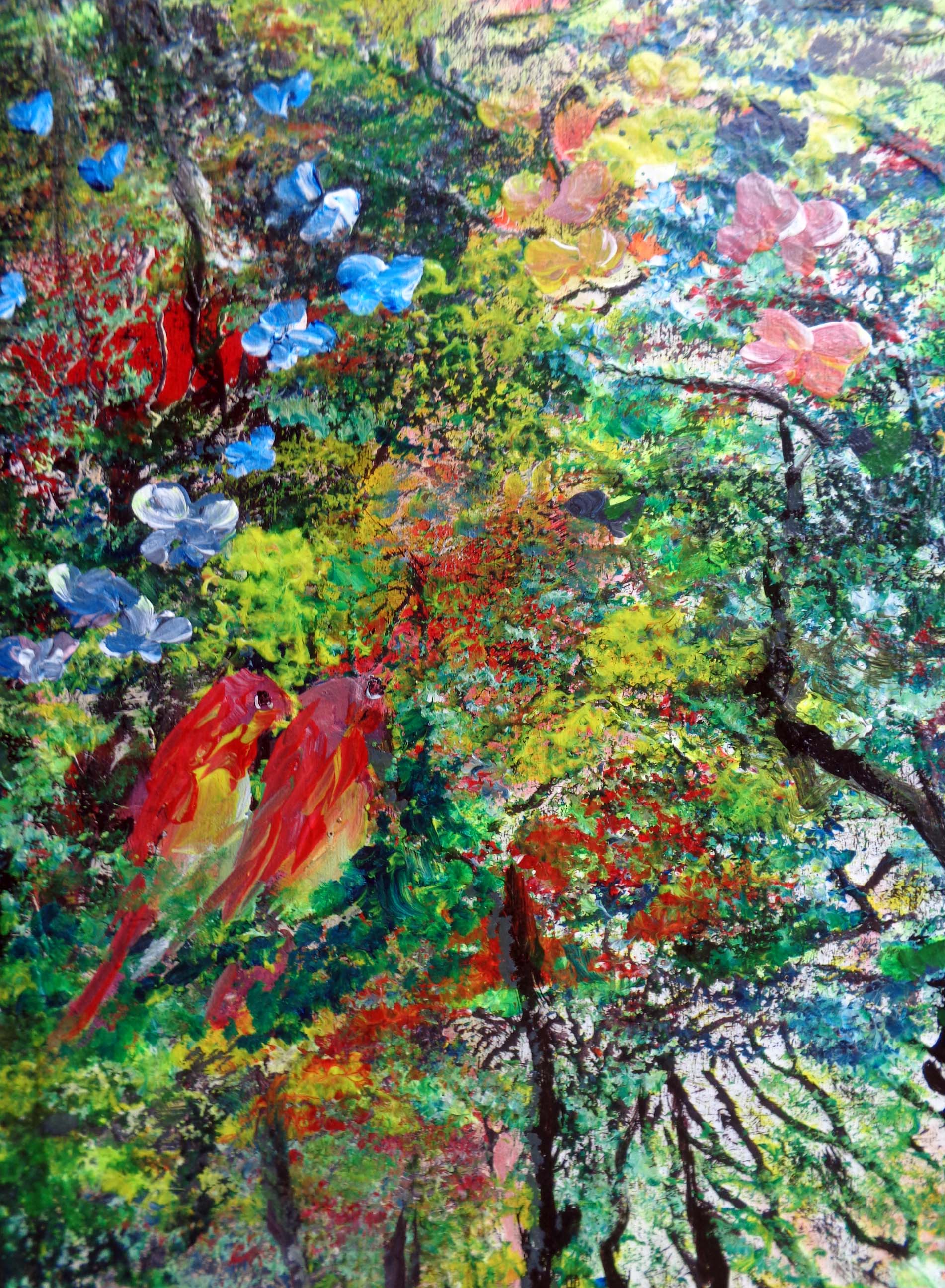
Birds in the trees

It's painting and sculpture combined,
     with three-dimensional effect;
let thick paint harden on wood palette;
     it's indeed a unique school project.

Pangea, the proto-continent

Like jigsaw puzzle land masses do fit,
through continental drift, scientists say;
Pangea, once the proto-continent split
into seven continents we know today.

                        Part 3 - Imprint on Ceramic Painting 

"E tu Brute?" 
Assassination of Julius Caesar on the "Ides of March". 

Art digs into history, stirs imagination;
the dying Caesar begging his friend; 
a final stab, scene in symbolic action,
brings the story to a sad end.
                              
                           Part 4 - Two-Side Painting
Painting with Two Faces AVR 2024


Part 5 - Fungus Painting 
Fungal mycelia* etching appears like integral part of a wall mural.

Wonder, what is unwanted and destructive,
in art may be beautiful and attractive.  

* Main body of a fungus, consisting of a network of thread-like filaments called hyphae.

Part 6 - Termite Nest Chandelier

  
Two-face chandelier made of wood leftover of termites. 

Chandelier with two faces:
on one, unspoiled nature,
the other, abused, abandoned;
Janus - god man praises.

Part 7 - Plastic Furniture Painting

Green table set painted by the author  

                       Part 8 - Geologic Specimens Painting

Left, rock fragments emitted by Mt Pinatubo's eruption.
Right, rock canon ball shaped and polished by running stream.

Part 9 - Herbarium Specimens Painting 


Part 10 - Neo-Pointillism Painting


Halloween: "Above me rises a dead tree."

"Above me rises a dead tree."
Dr Abe V Rotor

"We make up horrors to help us cope with the real ones." - Stephen King

Lady devotee Angie Tobias turns her attention to Mother Nature in the 
midst of today's massive destruction of the environment symbolized 
by this driftwood artwork made by the author for Lent 2024.

When the sky is gray and red in sorrow,
     the fields bare and dry all around,  
the sun beats hard on ev'ry levee and furrow;
     I wonder where I am and bound.

No shade to find comfort even for a while, 
     save a tree standing on a hill,
where some birds briefly rest and again fly,
     leaving me empty at the scene.   

I look up and wonder, "Is this Golgotha?"
     No sound, no breeze, but eerie
like I were in the heart of the Sahara;
     above me rises a dead tree. ~

Standing skeleton of mahogany (Swietenia macrophylla).
Lagro, QC, photo by the author, circa 1994

I have lost you forever,
Now a silhouette in the sky,
Spreading a gospel to remember,
For the mindless passerby.

You have lived half of your life,
Yet fullest at the Throne;
Earning it well with strife,
Where every seed is grown.

The birds now a flock,
The child a man;
You bid them all the luck,
And now they are gone.

In youth you sheltered me,
A thought I can't be free,
I atone for your brevity,
With a thousand and one tree.

           - AV Rotor, Light in the Woods 1994

"The universe is full of magical things patiently waiting for your wits to grow sharper." - Eden Phillpotts

Sunday, October 26, 2025

The Friendly Silvery Hornworm

                      The Friendly Silvery Hornworm 

Dr Abe V Rotor

Green Hornworm, caterpillar of the tobacco moth, Manduca sexta,

A farmhand I was a child, and I remember,
my friends in nature i treated with pride;
flying, crawling in the ambiance of summer;
and I would playfully give them a ride.

 
 Silvery tobacco hornworm glistens in waning sunlight.

You glisten like metal in camouflage, 
feigning dead, wittingly hard to judge.

* Green horned caterpillar moth, Manduca sexta, commonly known as tobacco hornworm. It is related to the tomato hornworm, Manduca quinquemaculata.

Capture Spontaneous Joy through the Lens

Capture Spontaneous Joy through the Lens

Capture that deep sense of delight, well-being, and contentment 
with the camera.

"Joy is a choice.
Joy is contagious."

 Dr Abe V Rotor

Make-believe waterfall wall mural by the author

When was the last time I smiled at myself?
For the things I do are measured for others,
for goodness' sake and not just for myself.
Let me be alone once in a while, my brothers!
  
Senior citizens at Rizal's garden shrine at author's hometown.

   Heroes don't retire, their deeds live on;
if retirement is a goal, we are wrong.

Tree hugging releases stress, connects us with Nature.

Hans Selye, the tension guru, has for us a gift:
live with just enough stress to be challenged;
too much of it pushes you beyond your limit,
unhappy, sad, until you fall off your bench.  

Echoes on the wall, neighborhood kids pose before a wall mural, QC

Echoes on the wall,
    of lilting children, of rustling trees,
    of distant thunder, of passing breeze.

Siesta beside a wall mural painted by the author, QC

At peace with the world
     in happy childhood,
     in air castle and dream,
     in quiet and solitude,
     beside a running stream. ~