Friday, October 31, 2025

We are Living in Parallel Worlds

                 We are Living in Parallel Worlds 

Can a person simultaneously exist in two - or more - separate places or occasions? 

Dr Abe V Rotor 

"Sir, I saw you at the Cultural Center yesterday," Ellen greeted me that Monday. "You were in barong talking with guests during the cocktail."  

Honestly I wasn't.  I wasn't even aware of the occasion. Politely I replied, "It must have been another person."

"Kayo po, sir.  Sigurandong sigurado ako." (It was you, sir. I am very sure.)

Ellen has known me for  twelve years as a professor, she was secretary to the college president at SPQU. 

Well, the matter just died naturally.  Such friendly gesture strengthens camaraderie, and builds quaintness in the workplace.   

So you think you saw a friend walking. In the church a devotee has a familiar profile. You call the name of someone in the crowd. He doesn't respond.  You think he snubbed you. You say that's my former teacher in high school. My classmate in college.

There is something that tells you about a particular person.  He becomes an instant acquaintance. Or it may turn out to be the opposite.  Then you start trying to remember where both of you must have met before. You can't recall. Then in your respite you suddenly remember. But now, doubt shrouds your memory.  Strange. 

Or it could be unmistakably a true experience, yet leaves you  doubting 
at the end.

One time when I was in high school I saw my dad praying in our church.  It was an ordinary morning and it was a custom to pay a visit even only for a short prayer, instead of just passing by. Dad was in deep prayer. He was near the altar. I left him and walked home.

I was surprised to see him meet me at our gate. I was dumbfounded.  

"Were you in church, dad?" 

"No, I'm on my way, son." He looked back and added, "Don't forget to feed the chickens."

Is it possible that a person may exist in two - or more - separate places or occasions at the same time?

Who was the person Ellen saw was me?   Who was the person whom I believed was my dad in the church that morning?  ~

Don’t Fall into the Modus Operandi of Opportunists and Rogues

 Don’t Fall into the Modus Operandi  of Opportunists and Rogues

A friendly reminder for the Holiday Season 
Dr Abe V Rotor 

Beware. Don’t fall victim to impostors, opportunists and rogues. These are ten tips to protect yourself and other people.


1. Have presence of mind always.
2. Don’t be too confident and trusting.
3. Avoid unlikely places and hour of the day.
4. It is good to be with somebody or group you know.
5. Distance yourself from suspecting characters.
6. Dress simply and leave your valuables at home.
7. Screen and limit access of personal information about you.
8. Be prepared for contingencies. Be security-conscious always.
9. Keep emergency phone numbers and addresses ready at fingertips.
10. Attend seminars and workshops on safety and security.

I am writing this article from fresh memory of an incident in which I am a victim. I must admit I violated Rules 1, 2, 3 and 7 in the above list.

First I was too trusting and confident in welcoming a “new found relative” – one Mario B. Rotor, incoming president of “The Leagues of Young Educators of Regions I and II.” (See hand written note of the impostor.) Through phone call, my wife endorsed this person to see me at UST where I was holding classes. (He had introduced himself on the phone, first to my daughter, then to my wife, picking up information in the process.)

Second, with this added information beefing up his readings and researches about me, he was ready to meet me finally – “his successful ‘uncle’ whom he had been longing to meet personally.” When I met him he practically knew me from head to foot, giving me a genuine impression about him as a new found nephew. I remember Mark Twain’s “Tom Sawyer” and “Huckleberry Finn”. Quite similar to the story of the swindlers in these novels, he started greeting me “uncle”, with music in his voice and familiarity in ambiance.

The third rule I broke is that I was totally unsuspecting. And this is when opportunists strike. He came on a Saturday, just after noon time, met me at the entrance of the graduate school, greeted the security guard and everyone else, with profuse courtesy. I led him to my classroom where I was going to give final examination. He waited until I finished giving the instruction and questionnaire. I entertained him at the corridor.

“Thank you for accepting our invitation to be our inducting officer and guest of honor,” he said, handing me the invitation, which has yet to be printed. “I’ll come back to give you the final copy, with your permission to print your name.” He told me how happy our relatives in the province are about me, that he is thankful to auntie (my wife) for arranging for this meeting.

“Why it’s an honor!” I answered. Who would not like to meet friends from both the Ilocos and Cagayan Valley where I was assigned for many years when I was regional director of then National Grains Authority. “I am sorry for the short notice,” he said. It will be at the National Defense College Auditorium, Camp Aguinaldo, at 6:30 p.m. Sunday, which means the following day.

Now here is the climax of the modus operandi. I offered him even only the cost of my food in the affair. He refused. “You are my guest,” he insisted. “Just donate a trophy,” he said. “Or the cost of it,” which I gave. He told me he had to rush to Manila Bulletin. “I’ll see you there, uncle,” he said and left.

There was no induction ceremony, and the phone number he left is the operator’s at Camp Aguinaldo. I came to know it only after he had left. When I reached home my wife and daughter exclaimed, “We thought he is the son of Vicente, your cousin. His name is Mario B. Rotor, a teacher.”

Except for his extreme feminine nature – bodily and by his voice – he could pass for a polished conversationalist, quick in wit and in scribbling notes. He spoke Ilocano perfectly with proper intonation. We talked in pure Ilocano throughout. He is around 5’ 4”, slim, kayumanggi, stoops a little, shoulders are rather high, and has rather sharp eyes, bony checks and prominent jaw, nose and ears (typical features of Rotors and Valdezes, so I thought). I was looking at my uncle Manuel and Ismael in their younger days, except that he could be mistaken for a woman by his voice, even on the phone. (He called up UST twice, I received the second.)

I am relating this story to warn potential victims of this impostor. What if the victim is not in his home ground? Or a neophyte in the city? His original plan according to my wife was to invite me outside. He suggested a fast food store near Dapitan, or anywhere outside UST.

Reading the Person through Handwriting Analysis

As I went over the notes this impostor wrote, I wondered if handwriting analysis or graphology can really tell the true character of a person, and thus tell us whether to avoid or welcome him, more so to be properly warned. I know that graphology is among the tools used in the recruitment process administered by certain companies in the US and Europe, but is it sufficient to give us a keyhole view of hidden motives, other general personality characteristics?

It is interesting to note the following features I observed on the impostor’s handwriting which are as follows: (See reproduction)

1. His writing lies perfectly in between lines, the words rarely touching the lower or upper bars. (Sign of independence, cleverness, non-conformist)

2. Heavy writing. You can feel the back of the paper like Braille (serious, intense, violent tendency, risk taker).

3. Loops of letters f, g, p, y vary. A large loop is a sign of openness; while tight and sharp pointed loops show the opposite character. Lack of “tail” after each word means an inward, silent character, but the sharp and deep downward strokes (f, p, t, l, I) show emotional intensity.

4. Ambivalence is also shown by the inconsistent writing pattern, and inconsistent type and size of letters. There are letters, which cannot be immediately deciphered, or are missing. (Dr. Jekyll and Mr. Hyde syndrome)

5. The dot of letter i, lies too far towards the right. No dot is exactly above the letter i. The letter t lacks the usual cross line at the top; instead it is cut at the middle either by a short dash or line that connects the nearby letter. Note wide spaces between words, large margins, and empty lines. (procrastination, loafer, tamad)

6. Writing has a feminist touch, which explain his personality.

I have always been fascinated by graphology since college days and through books in the library and bookstores I have learned a number of basic signs associated with talents, tendencies, etc. I must admit that as a field in psychology, graphology faces many views and controversies (like Freudian and Jungian approaches in psychology), but with computers today, this new science can be developed into a potent tool in personality analysis. I remember our teachers in elementary and high school who used to remind us in class that handwriting is the mirror of ourselves.

A Plea for Help as Modus Operandi

I lived at Don Antonio Height 2 at our family residence way back in the seventies when the area was still sparsely populated. One late evening I was awakened by a pleading sound, and when I looked from the veranda I saw a man apparently bleeding from wounds, leaning under a street lamp across our house. He was groaning and repeatedly pleading, “Dalhin ninyo ako sa ospital,” (Take me to the hospital.)

Our neighbor was also alerted. As we had coded security communication, we cautiously observed the “victim”. We sensed something wrong. Apparently he was only acting. When he saw that we were armed and did not open our gates, he started walking away. There at the nearest curb he joined his companions, a jeepload of tough guys, apparently hold uppers.

After the incident the whole neighborhood arrived at a theory that the “wounded” person acted as a decoy. In the process of being helped, his companions rush in, and declare a hold up. This “pasok bahay” modus operandi is not new and has been modified into other varieties, such as “akyat bahay”. In this case the gang takes advantage of houses when the residents are on vacation.

This mutual defense strategy proved to be an effective deterrent of a would-be crime. You can modify this according to your situation. One is by having coded night light or alarm. The rule is that, “Do not lift the drawbridge or open the fort gate,” so to speak, if you are living in a pioneer territory.

Be Sure Your Car Doors are Locked

My cousin had a co-teacher at Ramon Magsaysay High School Manila who fought a hold upper. She showed me both her hands bearing the scars of multiple wounds from knife. “My husband was also hurt,” she said. “Thanks God we are still alive.”

This is her story. Every morning the husband drives Remy, my cousin’s co-teacher, to Ramon Magsaysay before proceeding to his office. He would pick her up in the afternoon. For years this became a routine.

One morning while waiting for the green light at an intersection along Quezon Avenue, an unsuspecting man passing as a pedestrian suddenly opened the car’s rear door and occupied the backseat. With a fan knife he declared a holdup. Resisting the threat, the husband fought. The wife tried to help the husband. The struggle attracted passersby and pedestrians. The hold upper escaped, leaving the wounded couple that was immediately brought to the hospital.

Lesson: Be sure to lock all doors of your car. Roll up the windows to a level no one from outside can unlock and open the doors. When parking, leave the car immediately after locking the doors. Be sure to put on the wheel or engine lock. Don’t linger around, more so stay inside and sleep while the aircon is on. You are an easy target of hold uppers.

When opening your garage when going out specially in the early morning, and upon arriving in the evening, look around first for any suspicious people around. My friend, director Ruel Montenegro, lost his GSR Lancer this way. His driver did not resist the hold upper who simply took the car from the garage. It was never found.

What rules did the couple violate? First, they were not security-conscious. And second, they lacked the presence of mind at that time. This is often the case when we are preoccupied with routine activities. Again, as in my case they were too trusting and confident no one would harm them. In this civilized world we are still living in a jungle – a jungle made by man himself. ~

Thursday, October 30, 2025

Autumn in Paintings, Verses and Songs

Autumn in Paintings, Verses and Songs

Dr Abe V Rotor

 
 A Walk in the Woods in Autumn acrylic by AVR

The Woods in Autumn acrylic by AVR

Autumn Moods

Meditate at sunrise
In kaleidoscope of colors
Weaving through the mist,
With whispers of devotion.

Take a book and flip the pages,
Slowly with intent feelings,
As the early breeze brushes
Your forehead and brawn.

Or walk down the lane
Trodden only by the unseen;
Before the season is over,
Let each one praise Nature.

Autumn Leaves in acrylic by AVR

Autumn Leaves 1

The falling leaves
Drift by my window
The falling leaves
Of red and gold

I see your lips
The summer kisses
The sunburned hands
I used to hold

Since you went away
The days grow long
And soon I'll hear
Old winter's song

But I miss you most of all
My darling
When autumn leaves
Start to fall

Since you went away
The days grow long
And soon I'll hear
Old winter's song

But I miss you most of all
My darling
When autumn leaves
Start to fall.

Autumn Leaves 2

The falling leaves drift by the window
The autumn leaves of red and gold
I see your lips, the summer kisses
The sun-burned hands I used to hold

Since you went away the days grow long
And soon I'll hear old winter's song
But I miss you most of all my darling
When autumn leaves start to fall

C'est une chanson, qui nous ressemble
Toi tu m'aimais et je t'aimais
Nous vivions tous, les deux ensemble
Toi que m'aimais moi qui t'aimais
Mais la vie sépare ceux qui s'aiment
Tout doucement sans faire de bruit
Et la mer efface sur le sable les pas des amants désunis

"Autumn Leaves" is a much-recorded popular song. Originally it was a 1945 French song "Les feuilles mortes" (literally "The Dead Leaves") with music by Hungarian-French composer Joseph Kosma and lyrics by poet Jacques Prevert the Hungarian title is "Hulló levelek" (Falling Leaves). Yves Montand (with Irene Joachim) introduced "Les feuilles mortes" in 1946 in the film Les Portes de la Nuit. The American songwriter Johnny Mercer wrote English lyrics in 1947 and Jo Stafford was among the first to perform this version. "Autumn Leaves" became a pop standard and a jazz standard in both languages, both as an instrumental and with a singer. Popularized by world famous singers like Frank Sinatra, and Nat King Cole.

Wednesday, October 29, 2025

The Return of the Balloon Frog Tukak Bat'og (With in situ photos by the author at the Living with Nature garden December 25, 2025)

The Return of the Balloon Frog Tukak Bat'og

What changed the thinking of the world - a revolution in our concept of survival - is that all livings are interconnected and that the world is one systemic order, that the survival of one spells the survival of all creatures and the preservation of the integrity of the biosphere and therefore of Planet Earth, and that there is no living thing that is too small to be insignificant or useless.

Dr Abe V Rotor


The first time I saw tukak bat’og was when I was a young farmhand. Its name is familiar because bat’og, battog or battobattog, in Ilocano means pot bellied. At that time anyone who exhibited a bulging waistline was associated with this amphibian. But there were very few of this kind then. The war had just ended and people had to work hard.

Hardship tightens the belt automatically, but peacetime and the Good Life opens a new war - the “battle of the bulge.” Today two out of five Americans are obese and Europeans are not far behind. Asians are following the same trend, as more and more people have changed to the Western lifestyle that accompanies overweight condition, whether one is male or female.

But actually Bat’og is all air. It’s like balloon short of taking off. But once it wedges itself in its tight abode not even bird or snake can dislodge it. Not only that. It feigns dead and its attacker would simply walk away to find a live and kicking prey.

Nature’s sweet lies are tools of survival. When it faces danger Bat’og engulfs air and becomes pressurized and distended, reducing the size of its head and appendages to appear like mere rudiments. And with its coloration that blends with the surroundings, and its body spots becoming monstrous eyes, who would dare to attack this master of camouflage.

Not enough to drive away its foe, Bat’og uses another strategy by producing deep booming sounds coming from its hollow body as resonator. I remember the story of Monico and the Giant by Camilo Osias when I was in the grades. The cruel giant got scared and rushed out of his dark hiding when Monico boomed like Bat’og . Actually it was the unique design of the cave’s chamber that created the special sound effect and ventriloquism. The vaults of old churches were similarly designed this way so that the faithful can clearly hear the sermon.

The exhausted Bat’og deflates and returns to its chores, feeding, roaming around and calling for mate – and rain, so old folks say. Well, frogs become noisy when it rains. Biologically, egg laying is induced by rain. Eggs are fertilized in water and hatched into tadpoles that live in water until they become frogs. Bat’og has relatives that live in trees and their tadpoles inhabit trapped water in the axils of bromeliads, bananas and palms. Or it could be a pool inside the hollow of a tree.

After I left the farm for my studies in Manila, I never saw any Tukak Bat’og again. Only a trace of that childhood memory was left of this enigmatic creature.

Then one day, in my disbelief Bat’og resurrected! For a long time it has long been in the requiem list of species, ironically even before it was accorded scientific details of its existence. Well, there are living things that may not even reach the first rung of the research ladder, either they are insignificant or new to science. Who would take a look at Bat’og?

I believe a lot of people now do. People have become environment-conscious after the publication of Silent Spring by Rachel Carson, the emergence of Greenpeace movement, and birth of "heroes for the environment". Who is not aware now of global warming, especially after viewing Al Gore's documentary film, An Inconvenient Truth? Who have not experienced calamities brought about by our changing climate?

What changed the thinking of the world - a revolution in our concept of survival - is that all livings are interconnected and that the world is one systemic order, that the survival of one spells the survival of all creatures and the preservation of the integrity of the biosphere and therefore of Planet Earth, and that there is no living thing that is too small to be insignificant or useless.

Of all places I found Bat’og one early morning in my residence in Quezon City. I would say it instead found me. There in my backyard, ensconced in a gaping crack in the soil covered with a thick layer of dead leaves lay my long lost friend - very much alive.

Hello! And it looked at me motionless with steady eyes. It was aestivating, a state of turpor, which is a biological phenomenon for survival in dry and hot summer, the counterpart of hibernation when organisms sleep in winter and wait for the coming of spring. My friend was waiting nature's clock to signal the Habagat to bring rain from across the Pacific come June to September, a condition necessary for its amphibious life.

Slowly I lifted my friend and cradled it of sort on my palm. And we rolled time back fifty years ago. And before any question was asked, it was already answered. It is like that when two old friends meet after a long time. I remember when journalist Stanley found the great explorer Dr. David Livingstone in the heart of Africa in the 19th century, Stanley simply greeted, "Dr. Livingstone, I presume?" and the old man lifted his hat and gave Stanley a firm handshake. This became one of the most famous meetings in the world.

You see an event earns a place in history, or in the heart, when it permeates into the primordial reason of existence, which is Reverence of Life.

Reverence – this is the principal bond between man and nature. It is more than friendship. It is the also the bonds of the trilogies of human society – equality, fraternity and liberty. It is the bridge of all relationships in the complex web and pyramid of life. It towers over equations and formulas in science. It links earth and heaven, in fact the whole universe – and finally, the bridge of understanding between creature and Creator.

Bat’og is back. How easy it is to understand a creature however small it is, if it is your friend. Yet how difficult it is to define the role of a friend. The fox in Antoine de Saint-Exupery’ novel, The Little Prince, warned the little prince, “If you tame me you are responsible to me.” The little prince simply touched the wild beast.

Taming is the ultimate submission to humility. And the greater a person who humbles himself, the truer a friend he is.

How do we relate this principle to our being the only rational creature? The dominant species over millions of species? The God-anointed guardian of the Earth? The custodian of creation?

Allow me to have some time with my long lost friend. Either one of us is the Prodigal Son, but that does not matter now. Let me join Darwin and Linnaeus and Deogracias Villadolid et al.

Dr Deogracias Villadolid, foremost Filipino biologist. Professor and adviser of the author.

That was a long time ago by the pond that had dried in summer. As a kid on the farm I have known the ways of my friend. Bat’og would stake its prey - termites, ants, beetles and other insects. Like all frogs – and toads – the adults and tadpoles are important in controlling pests and diseases.

One of its relatives belonging to genus Kaloula was found to subsist mainly on hoppers and beetles that destroy rice, including leafhoppers that transmit tungro, a viral disease of rice that may lead to total crop failure. Such insectivorous habit though is universal to amphibians, reptiles, birds and other organisms. If only we can protect these Nature’s biological agents we would not be using chemicals on the farm and home, chemicals that pollutes the environment and destroys wildlife.

Bat'og and its kind protect man from hunger and disease. They are an important link in the food chain. No pond or ricefield or forest or grassland is without frogs. There would be no herons and snakes and hawks and eagles. No biological laboratory is without the frog as a blue print of human anatomy. And The Frog and the Princess would certainly vanish in the imagination of children.

Bat’og is a survivor of chemical genocide. It is the timely age of enlightenment of people returning to natural food and the spread of environmental consciousness on all walks of life and ages that came to its rescue in the last minute. So with many threatened species.

Who does not rejoice at finding again native kuhol, martiniko, ulang and gurami in the rice field? Oriole, pandangera, tarat and pipit in the trees? Tarsier, mouse deer and pangolin in the wild? And the return of ipil-ipil, kamagong and narra in the forest? And of course, Haribon the symbol of Philippine wildlife and biodiversity.

It is indeed a challenge for us to practice being the Good Shepherd, but this time it is not only a lost lamb that we have to save, it’s the whole flock.

Tukak Bat’og symbolizes the victory of Nature. But Nature’s victory does not mean man’s defeat; rather it is man’s submission and obedience to Nature’s laws and rules and therefore, the restoration of order on Planet Earth - our only spaceship on which we journey into the vastness of the universe and the unknown. ~

 
In situ photos by the author at the Living with Nature garden December 25, 2025
--------------------------
Reference 
Don’t Cut the Trees, Don’t
Copyright 2010 Abercio V Rotor and University of Santo Tomas

Monday, October 27, 2025

Art Evolution Experimental Paintings in 10 Fields (Article in Progress)

   Art Evolution 

Experimental Paintings in 10 Fields
Paintings by Dr Abe V Rotor
Living With Nature Center
San Vicente, Ilocos Sur 

School children come to me for art's sake. 
     "Lolo, what projects can we make?" 
It's the idea that stirs their imagination
     into many ways of art expression.

Part 1 - Art with Shells

Shells collection into work of art against a marine mural.  

Arrange and mount on a base,  
now a table decor, a receptacle 
of things you love and praise;
truly it's an art-to-craft version,  
both aesthetics and function.  

Marine specimens into Artwork   

Paint a sea floor background as base.
Spread out shells and corals freely.
Let your guests touch them and study,
with guidance, and care just in case.         
          
Part 2 - Relief Painting
 
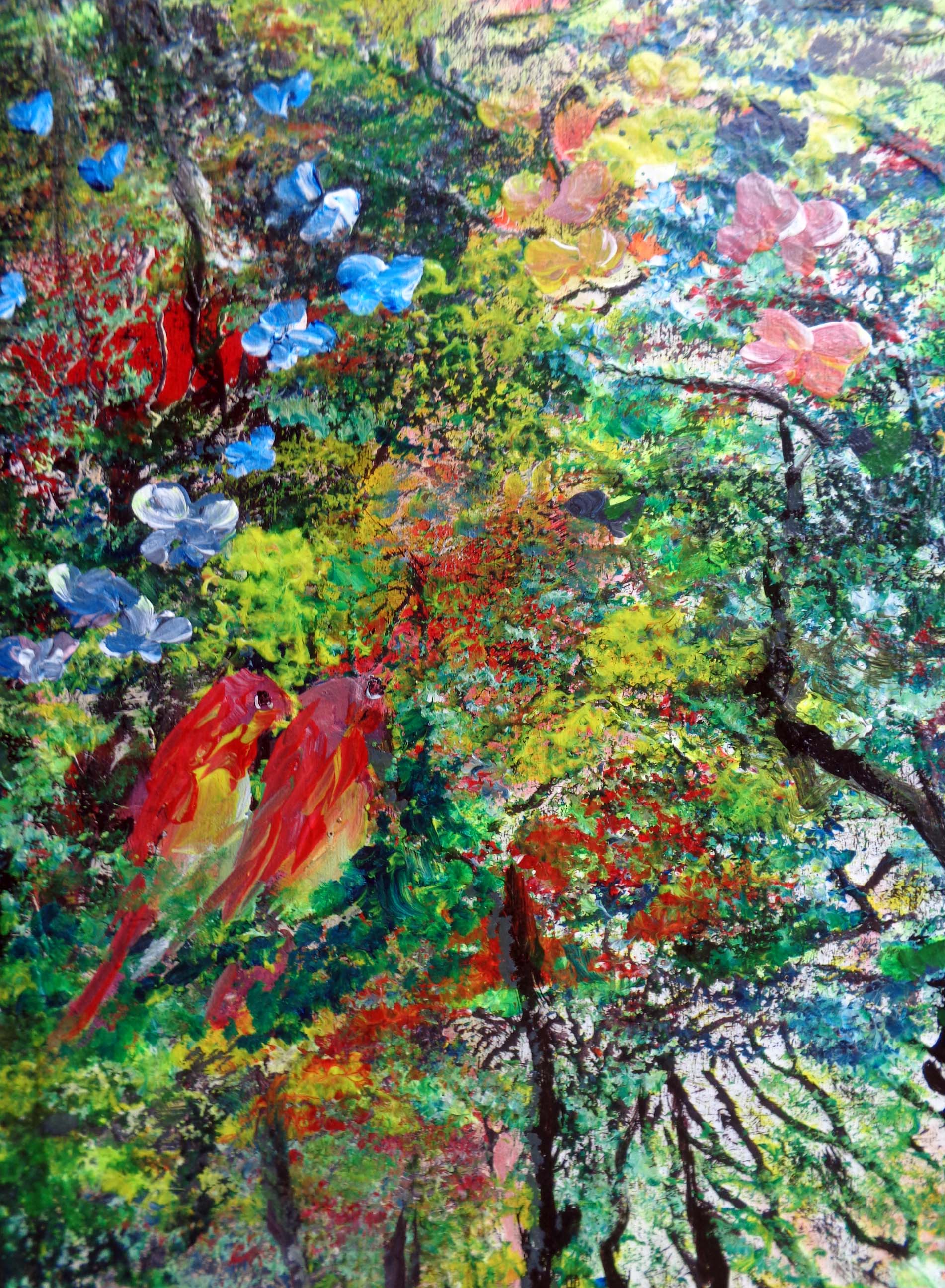
Birds in the trees

It's painting and sculpture combined,
     with three-dimensional effect;
let thick paint harden on wood palette;
     it's indeed a unique school project.

Pangea, the proto-continent

Like jigsaw puzzle land masses do fit,
through continental drift, scientists say;
Pangea, once the proto-continent split
into seven continents we know today.

                        Part 3 - Imprint on Ceramic Painting 

"E tu Brute?" 
Assassination of Julius Caesar on the "Ides of March". 

Art digs into history, stirs imagination;
the dying Caesar begging his friend; 
a final stab, scene in symbolic action,
brings the story to a sad end.
                              
                           Part 4 - Two-Side Painting
Painting with Two Faces AVR 2024


Part 5 - Fungus Painting 
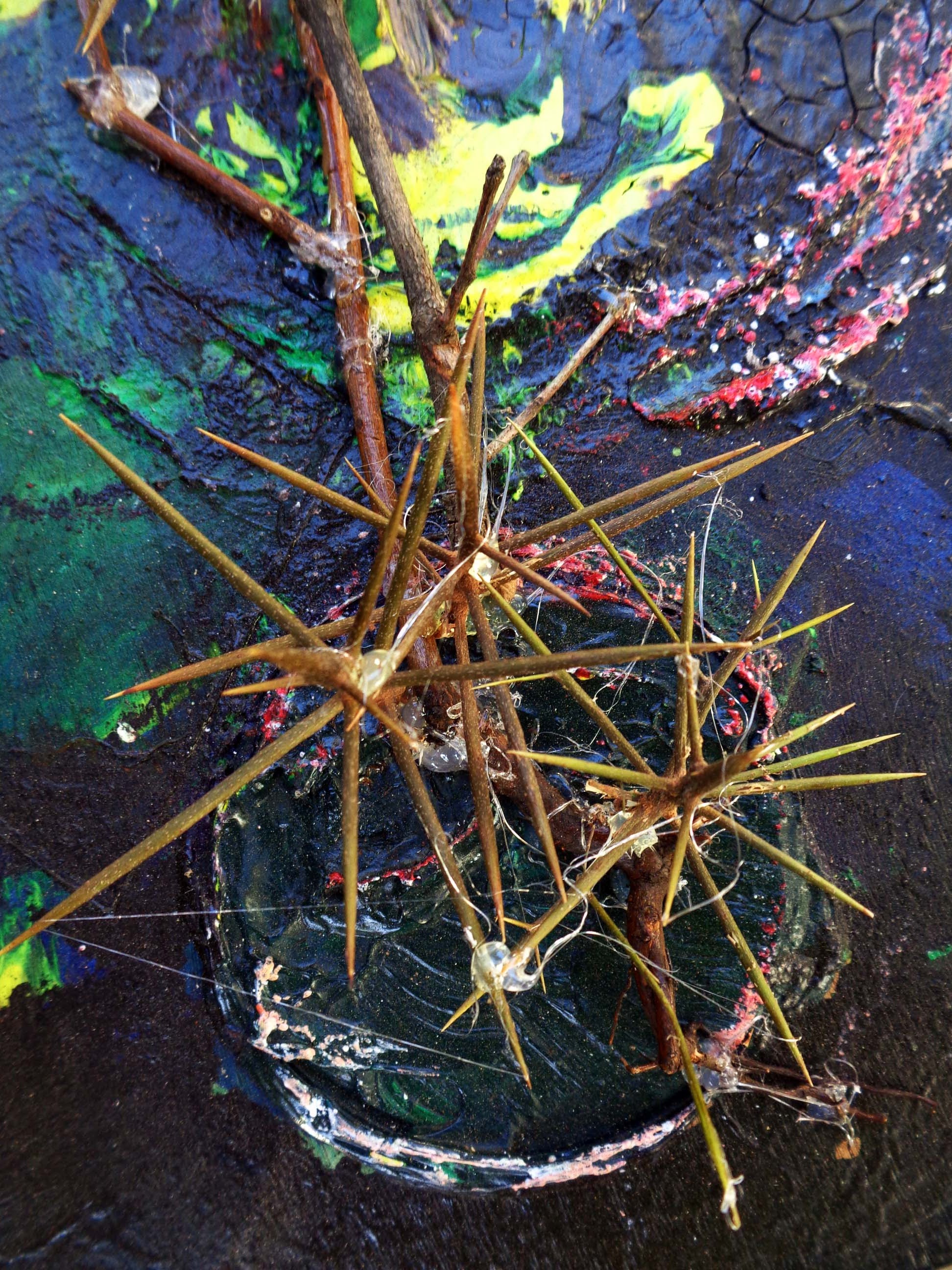
Fungal mycelia* etching appears like integral part of a wall mural.

Wonder, what is unwanted and destructive,
in art may be beautiful and attractive.  

* Main body of a fungus, consisting of a network of thread-like filaments called hyphae.

Part 6 - Termite Nest Chandelier

  
Two-face chandelier made of wood leftover of termites. 

Chandelier with two faces:
on one, unspoiled nature,
the other, abused, abandoned;
Janus - god man praises.

Part 7 - Plastic Furniture Painting

Green table set painted by the author  

                       Part 8 - Geologic Specimens Painting

Left, rock fragments emitted by Mt Pinatubo's eruption.
Right, rock canon ball shaped and polished by running stream.

Part 9 - Herbarium Specimens Painting 


Part 10 - Neo-Pointillism Painting


Halloween: "Above me rises a dead tree."

"Above me rises a dead tree."
Dr Abe V Rotor

"We make up horrors to help us cope with the real ones." - Stephen King

Lady devotee Angie Tobias turns her attention to Mother Nature in the 
midst of today's massive destruction of the environment symbolized 
by this driftwood artwork made by the author for Lent 2024.

When the sky is gray and red in sorrow,
     the fields bare and dry all around,  
the sun beats hard on ev'ry levee and furrow;
     I wonder where I am and bound.

No shade to find comfort even for a while, 
     save a tree standing on a hill,
where some birds briefly rest and again fly,
     leaving me empty at the scene.   

I look up and wonder, "Is this Golgotha?"
     No sound, no breeze, but eerie
like I were in the heart of the Sahara;
     above me rises a dead tree. ~

Standing skeleton of mahogany (Swietenia macrophylla).
Lagro, QC, photo by the author, circa 1994

I have lost you forever,
Now a silhouette in the sky,
Spreading a gospel to remember,
For the mindless passerby.

You have lived half of your life,
Yet fullest at the Throne;
Earning it well with strife,
Where every seed is grown.

The birds now a flock,
The child a man;
You bid them all the luck,
And now they are gone.

In youth you sheltered me,
A thought I can't be free,
I atone for your brevity,
With a thousand and one tree.

           - AV Rotor, Light in the Woods 1994

"The universe is full of magical things patiently waiting for your wits to grow sharper." - Eden Phillpotts

Sunday, October 26, 2025

The Friendly Silvery Hornworm

                      The Friendly Silvery Hornworm 

Dr Abe V Rotor

Green Hornworm, caterpillar of the tobacco moth, Manduca sexta,

A farmhand I was a child, and I remember,
my friends in nature i treated with pride;
flying, crawling in the ambiance of summer;
and I would playfully give them a ride.

 
 Silvery tobacco hornworm glistens in waning sunlight.

You glisten like metal in camouflage, 
feigning dead, wittingly hard to judge.

* Green horned caterpillar moth, Manduca sexta, commonly known as tobacco hornworm. It is related to the tomato hornworm, Manduca quinquemaculata.