Saturday, December 31, 2022

Thursday, December 29, 2022
Composite Wall Mural Landscapes
Composite Wall Mural Landscapes*
Paintings by Dr Abe V Rotor
at his residence in San Vicente, Ilocos Sur
Nature, so vast, so encompassing, so varied;
I can capture only a part of you with paint brush,
within the walls of my mind, or on the open field,
but a grain of sand, however big, is my canvas.


Primeval Landscape
"Schools always appeared to me like a prison, and never could I make up my mind to stay there, not even for four hours a day, when the sunshine was inviting, the sea smooth, and when it was joy to run about the cliffs in the free air, or to paddle in the water." — Claude Monet


"Now and then a creature appears, real or in the mind,
Indeed rich is an artist's sense of imagination,
each stroke of the brush shaping its form or hiding
it, like in the wild, lurking and ready for action." - avr
“Wilderness without wildlife is just scenery.” ~ Lois Crisler.


"Wildlife is something which man cannot construct. Once it is gone,
it is gone forever." - Joy Adamson.


*I am like a waterfall – wild and free."
“I love nature, I love the landscape, because it is so sincere. It never cheats me.
It never jests. It is cheerfully, musically earnest. I lie and relie on the earth.” -
- Henry David Thoreau.


"The real wealth of the Nation lies in the resources of the earth - soil, water, forests, minerals, and wildlife." - Rachel Carson.

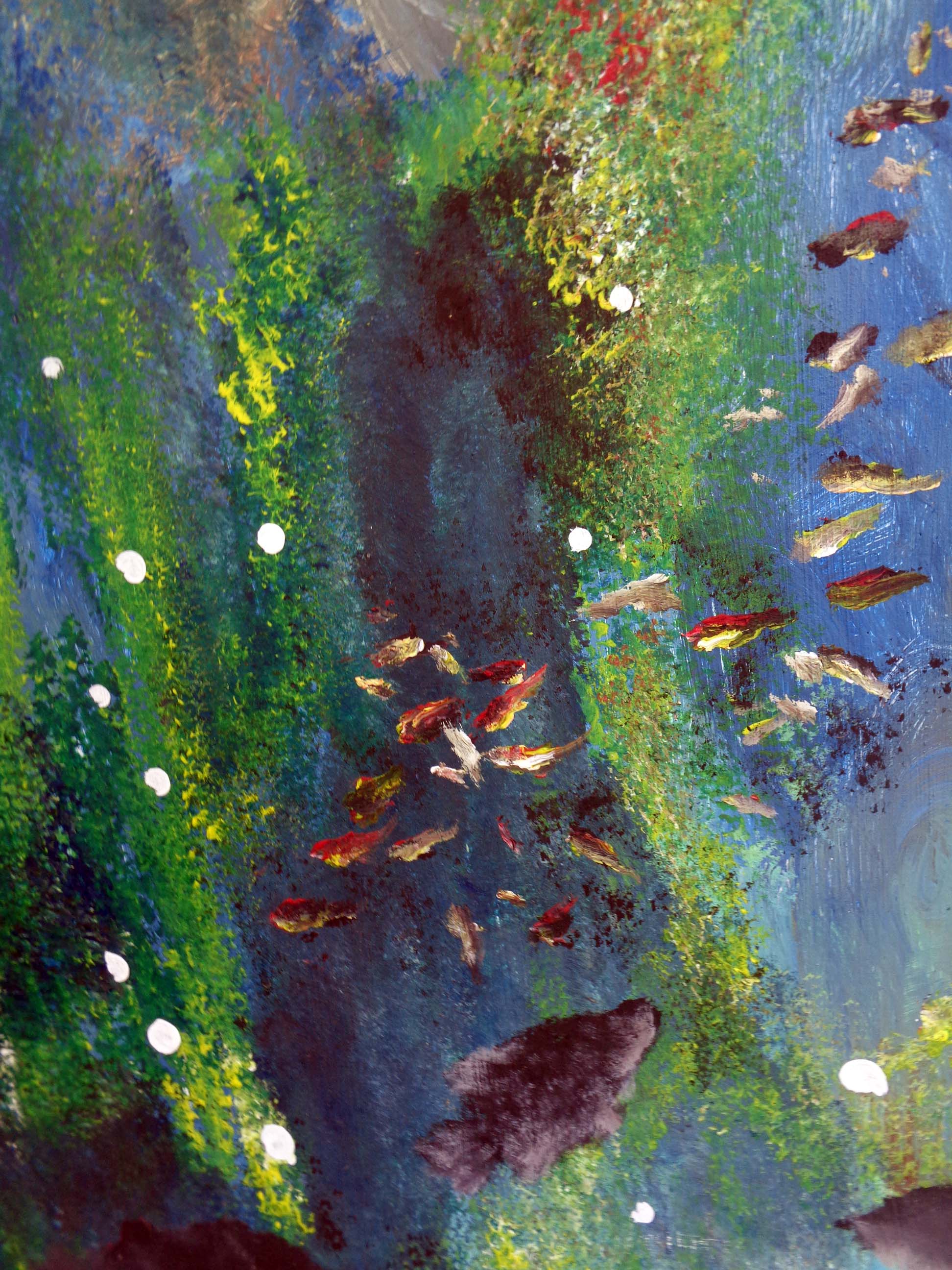
The sea, once it casts its spell, holds one in its net of wonder forever.”
- Jacques Yves Cousteau


"When the green woods laugh with the voice of joy, And the dimpling stream runs laughing by; When the air does laugh with our merry wit, And the green hill laughs
with the noise of it." - William Blake


A brooding bird, its nest by an idle waterfall in summer,
“The soul of a landscape, the spirits of the elements, the genius of every
place will be revealed to a loving view of nature.” - Karl Jaspers


Nature speaks and sings among the rocks,
through the trees, creatures seen and unseen;
when in complete silence you hear her more
in the heart and spirit, and in dream. - avr
“Just let go – and fall like a little waterfall.” – Bob Ross
"If life were predictable it would cease to be life, and be without flavor."
- Eleanor Roosevelt


My sight fading in the night regains at dawn
how misty the valley may be;
it's a cycle of surrender, peace and renewal;
and a prayer of thanks to Thee.
"The greatest glory in living lies not in never falling, but in rising every time we fall." -Nelson Mandela
"


"Like a river, life doesn't flow backwards, more so with the waterfall.”
"If you look at what you have in life, you'll always have more. If you look at what you don't have in life, you'll never have enough." - Oprah Winfrey

Strange face appears on the rock by a waterfall
"Who is guiding me paint may be a tale of spirituality,
but I could feel it, I'm not alone, it's a sacred story." - avr
* These scenes, among others, may be viewed at the author's residence in San Vicente, Ilocos Sur, Heritage Zone of the North (RA 11645). They are a part of Living with Nature Center cum family museum and reading center, art gallery and botanical garden.
Guava, the Wonder Tree
Guava, the Wonder Tree
By Dr. Abe V. Rotor
If there is another wonder of the world, it is the guava.

Picking guava on the tree, a childhood adventure (Internet photo)
Here is for the Book of Guinness Record. Have you heard the guava tree talk, laugh and shout, sing beautifully or grunt, make echolocation signals? Its branches bend without wind, the trunk sways at 9.0 intensity, leaves fall as confetti.
Parents know where to find their children, and fetch them from their perch in the tree for their siesta or class. At once the tree falls silent, but the doldrums reigns briefly. Soon the children are back to their bailiwick tree.
Take the backseat London Bridge, Golden Gate or Eiffel Tower. The guava tree can bend and touch the ground, and become upright again – not once, not twice but many times in its lifetime. And every branch equally obliges to the 180-degree weight and pull of children. No wonder the best spinning top and the best frame for slingshot are made from guava wood, and is perfect "Y", too.
It is a living Christmas tree, sort of. Birds come frequently. The perperoka and panal - migratory birds from the North, come with the Amihan and eat on the berries, while combing the place of worms, and gleaning on anything left by harvesters. The pandangera bird (fan-tailed) dances on the branches, while the house sparrow perches, picking ripe fruits and some crawlers. And if you wake up very early, meet the butterflies and bees gathering nectar and pollen from the flowers. Take a deep breathe of the morning air spiced with the fragrance of both flowers and ripe fruits.
And the tree has eyes. True. Round and luminescent in the dark, mingle with the fireflies and the stars – and a waning moon. It is romantic, scary, sacred. Fruit bats come at night and pick the ripe fruits. Rodents and wild pigs scavenge at night. Moths and skippers, relatives of the butterfly, are nocturnal in their search for food and mate. Old folks would warn us kids never to go near the tree at night. In my career as biologist I had the experience to see in the middle of a field guava trees lighted with fireflies. This scene was in Sablayan in Mindoro island. What a sight - Christmas in another time and in another place. What a magnificent sight!
Would a child go hungry where guava trees abound? I don’t think so. Because the fruits are packed with sugar, vitamins and minerals. The fruits are made into jelly, pickled and cooked as vegetable. It is perfect for sinigang. Have you heard of guava wine? It is the most aromatic of all table wines made from tropical fruits, and it displays a rare pinkish glow. Nutritionists say guava is rich in Vitamin C, richer than most fruits, local and imported. I came to learn later of the cancer-preventing substance derived from Psidium guajava,its scientific name, and its miraculous healing attributes.
Name the ailments commonly encountered, and the guava offers a dozen home remedies. Chew the tops and make a poultice to relieve toothache. The village dentist tells you to first make a poultice the size of a marble, then after he has extracted your tooth, he tells you to seal the wound with it to prevent bleeding and infection. Pronto you can go back to your usual chore.
Guava stem is the first toothbrush, try it. Soften the smaller end and you can also use it as toothpick. This is practical when traveling in a remote rural area. Chew a leaf or two for astringent and tooth paste. Crushed leaves serve as aromatherapy, a new term for an old remedy. And for an unconscious person, burn some dried leaves, fan the smoke toward the patient while pressing his large toe with your thumb nail. The patient senses both pain and smoke and soon takes a deep breathe - another, and another, until he gets enough oxygen and he wakes up.
Decoction of guava leaves for bath is practical in eliminating body odor. Guava soap is effective against skin disorders like pimples and eczema. With this knowledge my daughter Anna Christina formulated an oitment from guava as her college thesis. It is an all-natural antibacterial formula of the plant’s anti-inflammatory and therapeutically active properties against wounds or burns. Extract from the leaves contains 5 to 10 percent tannin, and fixed oils that have antibacterial and inhibitory effect against harmful microorganisms.
When I was a kid my auntie-yaya would gather succulent green guava fruits as remedy for LBM. Tannin regulates the digestive enzymes and stabilizes the digestive flora. She would also make guava leaf tea as a follow-up treatment.
As an offshoot of all these experiences, I asked my students to look into the potential value of guava seeds. The seeds contain 14 percent oil, 15 percent proteins, and 13 percent starch. And study also the bark and leaves in the development of drugs against diarrhea, and as astringent.
At one time I was isolating yeasts that occur in nature which I needed in preparing bubod – yeasts complex for basi wine fermentation, I stumbled upon two kinds of yeasts -Saccharomyces elipsoides and Brettanomyces. The second, I discovered is the secret of French wine quality. This French yeast resides in our home yard, in the flower of the native guava! Later I found out with the help of Food Development Center of the National Food Authority the same yeast naturally occurs in the flowers of macopa (Eugenia jambalana) and duhat (Syzygium cumini), both are members of the guava family - Myrtaceae.
---------------------------------------------------------------------------------------------------------------------
Guava is the tree of happy childhood. The tree bears fruits and children. Look at all the children climbing, swinging on its branches, some armed with bamboo poles, others with small stones, still others with slingshots aiming at one thing: the ripe fruits on the tree. The tree builds sweet childhood memories.
--------------------------------------------------------------------------------------------------------------------
The guava seed is an example of Nature’s way of breaking dormancy of seeds and enhancing their dissemination. Dormancy is a temporary delay for seeds to germinate, which may last for a few days to several years. This is important as a survival mechanism of plants. Guava seeds are not destroyed by gastric juice and peristalsis of the digestive system of animals – cold or warm blooded - because of their very thick and hard pericarp. This biological property ensures the species to colonize a new land.
You can’t crack guava seeds. If you do, especially with a decayed tooth you’ll end up going to your dentist. Oh, how I would wince and hold on anything. Either the old tooth is forced out of its place or the seed has lodged in the cavity.
Old folks also believe that guava seeds can cause appendicitis. Well, its seed is too large to enter this rudimentary organ. I believe though that it is its abrasive nature that makes way for the bacteria to enter and cause infection. And subsequently inflammation. Well, if this is true, then it’s a risk one takes in eating guava. You really can’t remove all the seeds, and if you succeed you take away the fun and quaintness of eating this berry.
We have introduced foreign varieties of guava which really don’t grow into a tree. The fruits are very much bigger, but far from being as sweet as those of our native variety. In a few years the guapple, as it is called, becomes senile and die, while the native guava lasts for a lifetime, and longer.
Today when I see children climbing guava trees it reminds me of my childhood. It reminds me of its many friends – birds, ground fowls like ducks, chicken, bato-bato, goats and self-supporting native pigs. I imagine butterflies, dragonflies and Drosophila flies attracted by the ripening fruit. And frogs and toads patiently waiting for these flies to become their prey. Finches and sparrows, the quick and dainty La Golondrina (swift), the pandangera, panal and perperroka – I miss them.
Yes, the fruit bats, they are the source of children’s stories, among them is about clumsy bats dropping their load of ripe fruits accidentally falling of rooftops. In the dead of the night what would you imagine? “It’s the manananggal! (female half-bodied vampire).” Our folks at home would even make their voice tremble. And we would cling to each other in bed we kids of our time. Our elders take advantage of the situation and whisper, “If you don’t sleep, it will come back.”
Parents know where to find their children, and fetch them from their perch in the tree for their siesta or class. At once the tree falls silent, but the doldrums reigns briefly. Soon the children are back to their bailiwick tree.
Take the backseat London Bridge, Golden Gate or Eiffel Tower. The guava tree can bend and touch the ground, and become upright again – not once, not twice but many times in its lifetime. And every branch equally obliges to the 180-degree weight and pull of children. No wonder the best spinning top and the best frame for slingshot are made from guava wood, and is perfect "Y", too.
It is a living Christmas tree, sort of. Birds come frequently. The perperoka and panal - migratory birds from the North, come with the Amihan and eat on the berries, while combing the place of worms, and gleaning on anything left by harvesters. The pandangera bird (fan-tailed) dances on the branches, while the house sparrow perches, picking ripe fruits and some crawlers. And if you wake up very early, meet the butterflies and bees gathering nectar and pollen from the flowers. Take a deep breathe of the morning air spiced with the fragrance of both flowers and ripe fruits.
And the tree has eyes. True. Round and luminescent in the dark, mingle with the fireflies and the stars – and a waning moon. It is romantic, scary, sacred. Fruit bats come at night and pick the ripe fruits. Rodents and wild pigs scavenge at night. Moths and skippers, relatives of the butterfly, are nocturnal in their search for food and mate. Old folks would warn us kids never to go near the tree at night. In my career as biologist I had the experience to see in the middle of a field guava trees lighted with fireflies. This scene was in Sablayan in Mindoro island. What a sight - Christmas in another time and in another place. What a magnificent sight!


Would a child go hungry where guava trees abound? I don’t think so. Because the fruits are packed with sugar, vitamins and minerals. The fruits are made into jelly, pickled and cooked as vegetable. It is perfect for sinigang. Have you heard of guava wine? It is the most aromatic of all table wines made from tropical fruits, and it displays a rare pinkish glow. Nutritionists say guava is rich in Vitamin C, richer than most fruits, local and imported. I came to learn later of the cancer-preventing substance derived from Psidium guajava,its scientific name, and its miraculous healing attributes.
Name the ailments commonly encountered, and the guava offers a dozen home remedies. Chew the tops and make a poultice to relieve toothache. The village dentist tells you to first make a poultice the size of a marble, then after he has extracted your tooth, he tells you to seal the wound with it to prevent bleeding and infection. Pronto you can go back to your usual chore.
Guava stem is the first toothbrush, try it. Soften the smaller end and you can also use it as toothpick. This is practical when traveling in a remote rural area. Chew a leaf or two for astringent and tooth paste. Crushed leaves serve as aromatherapy, a new term for an old remedy. And for an unconscious person, burn some dried leaves, fan the smoke toward the patient while pressing his large toe with your thumb nail. The patient senses both pain and smoke and soon takes a deep breathe - another, and another, until he gets enough oxygen and he wakes up.
Decoction of guava leaves for bath is practical in eliminating body odor. Guava soap is effective against skin disorders like pimples and eczema. With this knowledge my daughter Anna Christina formulated an oitment from guava as her college thesis. It is an all-natural antibacterial formula of the plant’s anti-inflammatory and therapeutically active properties against wounds or burns. Extract from the leaves contains 5 to 10 percent tannin, and fixed oils that have antibacterial and inhibitory effect against harmful microorganisms.
When I was a kid my auntie-yaya would gather succulent green guava fruits as remedy for LBM. Tannin regulates the digestive enzymes and stabilizes the digestive flora. She would also make guava leaf tea as a follow-up treatment.
As an offshoot of all these experiences, I asked my students to look into the potential value of guava seeds. The seeds contain 14 percent oil, 15 percent proteins, and 13 percent starch. And study also the bark and leaves in the development of drugs against diarrhea, and as astringent.
At one time I was isolating yeasts that occur in nature which I needed in preparing bubod – yeasts complex for basi wine fermentation, I stumbled upon two kinds of yeasts -Saccharomyces elipsoides and Brettanomyces. The second, I discovered is the secret of French wine quality. This French yeast resides in our home yard, in the flower of the native guava! Later I found out with the help of Food Development Center of the National Food Authority the same yeast naturally occurs in the flowers of macopa (Eugenia jambalana) and duhat (Syzygium cumini), both are members of the guava family - Myrtaceae.
---------------------------------------------------------------------------------------------------------------------
Guava is the tree of happy childhood. The tree bears fruits and children. Look at all the children climbing, swinging on its branches, some armed with bamboo poles, others with small stones, still others with slingshots aiming at one thing: the ripe fruits on the tree. The tree builds sweet childhood memories.
--------------------------------------------------------------------------------------------------------------------
The guava seed is an example of Nature’s way of breaking dormancy of seeds and enhancing their dissemination. Dormancy is a temporary delay for seeds to germinate, which may last for a few days to several years. This is important as a survival mechanism of plants. Guava seeds are not destroyed by gastric juice and peristalsis of the digestive system of animals – cold or warm blooded - because of their very thick and hard pericarp. This biological property ensures the species to colonize a new land.
You can’t crack guava seeds. If you do, especially with a decayed tooth you’ll end up going to your dentist. Oh, how I would wince and hold on anything. Either the old tooth is forced out of its place or the seed has lodged in the cavity.
Old folks also believe that guava seeds can cause appendicitis. Well, its seed is too large to enter this rudimentary organ. I believe though that it is its abrasive nature that makes way for the bacteria to enter and cause infection. And subsequently inflammation. Well, if this is true, then it’s a risk one takes in eating guava. You really can’t remove all the seeds, and if you succeed you take away the fun and quaintness of eating this berry.
We have introduced foreign varieties of guava which really don’t grow into a tree. The fruits are very much bigger, but far from being as sweet as those of our native variety. In a few years the guapple, as it is called, becomes senile and die, while the native guava lasts for a lifetime, and longer.
Yes, the fruit bats, they are the source of children’s stories, among them is about clumsy bats dropping their load of ripe fruits accidentally falling of rooftops. In the dead of the night what would you imagine? “It’s the manananggal! (female half-bodied vampire).” Our folks at home would even make their voice tremble. And we would cling to each other in bed we kids of our time. Our elders take advantage of the situation and whisper, “If you don’t sleep, it will come back.”
In the morning who would care about the manananggal? Or seeds causing appendicitis? Or the danger of falling from the tree. Or chased by a wild boar? Or challenged by a billy goat or a brooding hen? As usual we would search for ripe berries and have our fill. Then we would hurry down and run to relieve ourselves, too loaded we simply take comfort in some nearby thickets. In time guava trees would be growing this these spots.
Children would be climbing these trees, having their fill of the fruits, and joyous in the adventure of childhood, making the guava tree the greatest wonder of the world. ~
Children would be climbing these trees, having their fill of the fruits, and joyous in the adventure of childhood, making the guava tree the greatest wonder of the world. ~
Wednesday, December 28, 2022
Landscapes - Bridge of Nature and Human, Reality and Fantasy
Landscapes - Bridge of Nature and Human,
Reality and Fantasy
Dr Abe V Rotor

The Forest is a Natural Beauty in acrylic by the author , 2015
"I love the tranquility I feel each time I step into the forest. The forest has a calming and therapeutic effect on me. I enjoy listening to its music – the chirping of the birds, the trickling of water from the leaves, the sound of flowing streams..." - Tan Ee Long, The Forest is a Natural Beauty

Clouds Over the Mountain in acrylic by the author 2020
“The air up there in the clouds is very pure and fine, bracing and delicious. And why shouldn’t it be?- it is the same the angels breathe.” - Mark Twain

The Rock in the Sea, in acrylic by the author, c 2005
"Think how we sailed up-wind, the brineTasting of daphne, the enormous waveThundering in the water cave—Thunder in stone..."Archibald MacLeish, “The Rock in the Sea”

A Field of Wild Lilies in acrylic by the author, 2015
A lily of a day
Is fairer far in May,
Although it fall and die that night,
It was the plant and flower of light.
In small proportions we just beauties see,
And in short measures life may perfect be.
- Ben Jonson
Is fairer far in May,
Although it fall and die that night,
It was the plant and flower of light.
In small proportions we just beauties see,
And in short measures life may perfect be.
- Ben Jonson

Walden Pond in acrylic as envisioned by Anna Christina Rotor,
then in the grade school, circa 1995.
"Where have all the trees and the pristine waters gone?"
“I find it wholesome to be alone the greater part of the time. To be in company, even with the best, is soon wearisome and dissipating. I love to be alone. I never found the companion that was so companionable as solitude.” ― Henry David Thoreau, Walden ~
"Sea on the Wall" Forever. The Old Man and the Sea
"Sea on the Wall" Forever
Mural inspired by Ernest Hemingway's Pulitzer Prize novel,
The Old Man and the Sea
Mural by Dr Abe V Rotor

I love to paint the sea, the seawhen I was young,as young today in my memory,and after I'm gone.

"Sea on the Wall" Mural detail, A V Rotor 2015 at author's residence
in Lagro QC (30ft x 15ft)
The Old Man and the Sea
By Ernest Hemingway

Everything about him was old except his eyes, and they were the same color as the sea and were cheerful and undefeated.
“Every day is a new day. It is better to be lucky. But I would rather be exact. Then when luck comes you are ready.”
“But man is not made for defeat. A man can be destroyed but not defeated.”
“Let him think that I am more man than I am and I will be so.”
“Why do old men wake so early? Is it to have one longer day?”
The thousand times he had proved it meant nothing. Now he was proving it again.

He no longer dreamed of storms, nor of women, nor of great occurrences, nor of great fish, nor fights, nor contests of strength, nor of his wife. He only dreamed of places now and of the lions on the beach. They played like young cats in the dusk and he loved them as he loved the boy.
“I may not be as strong as I think, but I know many tricks and I have resolution.”
“If the others heard me talking out loud they would think that I am crazy. But since I am not crazy, I do not care.”

You did not kill the fish only to keep alive and to sell for food, he thought. You killed him for pride and because you are a fisherman. You loved him when he was alive and you loved him after. If you love him, it is not a sin to kill him. Or is it more? ~
Monday, December 26, 2022
Research is ... with emphasis in the field of communication
Research is ... with emphasis in the field of communication
Dr Abe V Rotor
Former Professor, Faculty of Arts and Letters
University of Santo Tomas
 1. Research is… a historical and comparative study of People, Media and Power, referring to the role of media in people’s revolution such as People’s Power at Edsa, Arab Spring in the Middle East, Occupy Wall Street in the US, and similar contemporary mass uprisings - not to mention, their precursor of French Revolution, and our own struggle of Independence during Rizal’s time.
2. Research is … tracing the “Theories of the Press” (Authoritarian, Libertarian, Social Responsibility, Soviet-Totalitarian, and the latest - Development Communication), how they evolved into dominant movements, and ultimately analyzing their role in shaping our society and our world.
3. Research is … inquiring into Culture and Values, national and universal in a fast changing world as people move from rural to urban centers, cities bursting at the seams, so to speak, and modern living shifting to post modernism.
4. Research is … looking into participatory journalism, and investigative journalism, their increasing importance as tools in carving out excesses and abuses of power on one hand, and anarchy on the other, in pursuit of a peaceful, orderly, and progressive life.
5. Research is … examining and evaluating the modern tools of communication, from print to multimedia, with the vast application of cyber technology and network that can reach the far ends of the earth, carrying information, entertainment, education, heretofore abreast and encompassing.
6. Research is … looking into the flaws of media, violation of the Code of Ethics and Human Rights, and offering corrective measure and setting directions of responsibility and accountability of media practitioners.
7. Research is … investigating the root cause of libel cases, and other media violations, legal and moral, and how these can be avoided through legislation and implementation.
8. Research is … determines what kind of research must be given importance and priority, where developing countries such as ours should aim at applied or functional research, rather than basic research which is expensive and fundamentally - but not functionally and directly - useful.
9. Research is … studying the effective means of distance learning or teaching through media (university without walls, e-learning) whereby students can obtain their education with affordable cost without leaving their home-base and workplace, thus enabling a country to provide mass quality education to its population.
10. Research is … determining the scope and limits of Press Freedom vis-avis Human Rights and state security, among other considerations.
11. Research is … looking into the role of media in crisis situation, on the battle front, or war zones, and under conditions where the media is placed in perilous and sensitive situation.
12. Research is … finding out the effectiveness of many learning instruments such as Paaralang Bayan sa Himpapawid (People’s School on Air); Laedza Batani (Let’s wake up!), Sokhothai Thammathirat Open University or STOU (Thailand), Kibbutz (Israel) and commune schools, outreach programs, rural immersion, barefoot doctors, school in Blog, and others.
 13. Research is … finding out the complementary role of media in the implementation of the new general education under the K to 12 Program, catalyzing the program’s objectives and goals.
14. Research is … preparing the student in working for his thesis (Bachelor’s and Masteral), and dissertation (doctoral), and guiding him in the actual performance of his study.
15. Research is … critiquing Advertisements and Promotions of products and services in order to guide both producer and the public to uphold dignity and decency, and exercise prudence and responsibility in not only on the merits of products, but their educational aspects as well.
16. Research is … consolidating, interpreting and writing implementation guides of laws and rules – international and local – governing media, these include Copyright Laws, the Constitution, Code of Ethics, and those that govern Press Councils, Journalist Associations, Press Conventions.
17. Research is …guiding students in choosing their topics based on practicability (cost, time frame, facility), especially in the research proper, which comprise the methodology, analysis and interpretation of data and findings, conclusion, and finally in drawing out recommendations regarding the findings.
18. Research is … guiding students in the publication of the results of their research in Journals, books, TV and radio broadcast, on the Internet, and in local publications for the information of the grassroots.
19. Research is … linking laboratory findings and field application, technology with enterprise, thus establishing a system whereby findings are brought to people’s use, and therefore contributory to growth and development.
20. Research is … never static, exclusive, and academy-centered; neither a monopoly of a few, and that as the prime mover of invention and discovery, it must address itself to the needs of a a progressive, sustainable society.~
Saturday, December 24, 2022
Dr Jose P Rizal: Man for All Seasons and Humanity
Dr Jose P Rizal: Man for All Seasons and Humanity
Dr Jose P Rizal
Man for All Seasons and Humanity
Dedicated to our country's National Hero, born June 19, 1861, and whose martyrdom on December 30, 1896 ignited a revolution against Spain leading to Philippine Independence.
Rizal as a student in Europe; right, most popular portrait, in official documents and books; Rizal, had he reached 90. Acknowledgment: Mr. Philip Cabrera, son of the artist; and the National Historical Institute.


This article serves as a reference to students taking the Rizal Course, a three-unit subject in college.
Dr Abe V Rotor
Former Professor, Rizal Course, UST and SPUQC
The following article about Dr Jose Rizal is widely circulated on the Internet in celebration of Rizal Day which is observed every 30th day of December, the day he was executed in Bagumbayan by Spanish authorities, 126 years ago. To preserve the originality of the report, I am presenting it the same way it is found on the Internet and as written by two sources of information, for which I express my indebtedness and gratitude. Rizal as the Father of Filipino Nationalism (Manila: Bureau of printing, 1941), pp.3-4.; and Rizal's Concept of World Brotherhood, 1958, pp.48-60. The intention of printing this article about Dr. Rizal, is to provide a fresh perspective about him and his teachings - and principally for the cause for which he gave his life - a cause which we would like to review in the light of present problems and challenges. - AVR
TRIVIA: Complete name of Jose Rizal: José Protasio Rizal Mercado y Alonso Realonda
The Philippine national hero, Jose Rizal, has his own views and concepts about Global Fellowship which is synonymous to "Internationalism", "Worldwide Brotherhood", "International Alliance", and "Global Fellowship of Humankind". The following concepts are taken from Rizal's own words, speeches, literature, and careful analysis of his personal history and works.
"It is not what your country can do for you, but it is what you can do for your country." - Rizal
Factors that shaped Rizal
Among the factors that shaped Jose Rizal as a person:
1. Racial origin: Rizal descended from the Malay race and also genetically inherited the mixed Ilocano and Pangasinan bloodline of his mother. He also has Chinese and Spanish lineage.
2. Faith (religion): Christianity also shaped Rizal's way of thinking. He was born, baptized, and raised as a Roman Catholic.
3. His being a reader of books: He read many manuscripts, books, and other publications printed in various languages.
4. His being a linguist: His knowledge of different languages apart from his own. He can speak and understand 22 languages.
5. His voyages: He was able to befriend foreigners from the various nations that he was able to visit.
Rizal's ideas about "Brotherhood" (Fellowship)
These are Rizal's ideas about the subject of having a fellowship or brotherhood of humankind:
1. Education: The proper upbringing and education of children and daughter in order for them to prevent the same fate and suffering experienced by the uneducated and ignorant fellowmen under the rule of the Spaniards.
2. Faith or religion: The belief in only one God. The existence of different religions should not be the cause of misunderstandings. Instead, this existence of many religions should be used to attain unity and freedom. There should be deep respect to every individual's faith; the beliefs that one had become accustomed to and was brought up with since childhood.
3. Fellowman: It is important for one person to have a friend (fellow) and the establishment of an acquaintance with fellow human beings. (It is also important) to recognize the equality of rights of every fellow human being regardless of differences in beliefs and social status.
Rizal's efforts to promote a "Global Fellowship"
Rizal promoted global fellowship through the following:
a. Formation of organizations: Included here are known scholars and scientists recognized as the International Association of Filipinologists.
b. Friendship: In every journey, he was able to meet and befriend foreigners who sympathize with the experiences and events occurring in the Philippines.
c. Maintenance of communication: Before and during his exile at Dapitan, Rizal was able to keep in touch with his friends located in different parts of the world. He was also able to exchange opinions, writings and even specimens which he then studied and examined.
d. Joining organizations: Rizal believed in the goals of organizations that are related to the achievement of unity and freedom of humankind. He always had the time and opportunity to join into organizations.
Basis of "Worldwide Brotherhood" (Worldwide Fellowship)
These are the basis of the above ideas, which were then taken from Rizal's opinions found in his own writings and speeches which intend to establish unity, harmony, alliance and bonding among nations: The fundamental cause or reason for having the absence of human rights is eradicated through the establishment of unity.
One of Rizal's wishes is the presence of equal rights, justice, dignity, and peace. The basis for the unity of mankind is religion and the "Lord of Creations"; because a mutual alliance that yearns to provide a large scope of respect in human faith is needed, despite of our differences in race, education, and age. One of the negative effects of colonialism is racial discrimination. The presence of a worldwide alliance intends to eradicate any form of discrimination based on race, status in life, or religion.
Rizal wishes Peace to become an instrument that will stop the colonialism (colonization) of nations. This is also one of Rizal's concerns related to the "mutual understanding" expected from Spain but also from other countries. Similar to Rizal's protest against the public presentation (the use as exhibits) of the Igorots in Madrid in 1887 which, according to him, caused anger and misunderstanding from people who believed in the importance of one's race.
Hindrances towards the achievement of a "Worldwide Brotherhood"
However, Rizal also knew that there are hindrances in achieving such a worldwide fellowship: Change and harmony can be achieved through the presence of unity among fellowmen (which is) the belief in one's rights, dignity, human worth, and in the equality of rights between genders and among nations.
From one of the speeches of Rizal:
“The Philippines will remain one with Spain if the laws are observed and carried out (in the Philippines), if the Philippine civilization is "given life" (enlivened), and if human rights will be respected and will be provided without any tarnish and forms of deceitfulness. ”
Rizal's words revealed the hindrances against an aspired unity of humankind:
1. The absence of human rights.
2. Wrong beliefs in the implementation of agreements.
3. Taking advantage of other people.
4. Ignoring (not willing to hear) the wishes of the people.
5. Racial discrimination.
Excerpt from one of Rizal's letter to a friend:

“ If Spain does not wish to be a friend or brother to the Philippines, strongly the Philippines does not wish to be either. What is requested are kindness, the much-awaited justice, and not pity from Spain. If the conquering of a nation will result to its hardship, it is better to leave it and grant it its independence. ”
This letter presents Rizal's desire and anticipated friendship between Spain and the Philippines, but one which is based on equality of rights.

Translation:
"What? Does no Caesar, does no Achilles appear on your stage now,Not an Andromache e'en, not an Orestes, my friend?""No! there is naught to be seen there but parsons, and syndics of commerce,Secretaries perchance, ensigns, and majors of horse.""But, my good friend, pray tell me, what can such people e'er meet withThat can be truly great? - what that is great can they do?"- Friedrich Schiller, "Shakespeare's Ghost," translated by John Bowring
 Translation:
TO MY COUNTRY
Recorded in the history of human suffering are cancers of such malignant character that even minor contact aggravates them, endangering overwhelming pain. How often, in the midst of modern civilizations have I wanted to bring you into the discussion, sometimes to recall these memories, sometimes to compare you to other countries, so often that your beloved image became to me like a social cancer.
Therefore, because I desire your good health, which is indeed all of ours, and because I seek better stewardship for you, I will do with you what the ancients did with their infirmed: they placed them on the steps of their temples so that each in his own way could invoke a divinity that might offer a cure.
With that in mind, I will try to reproduce your current condition faithfully, without prejudice; I will lift the veil hiding your ills, and sacrifice everything to truth, even my own pride, since, as your son, I, too, suffer your defects and shortcomings.~
-----Anecdotes about Rizal
Acknowledgement: Internet
1. One day, intending to cross Laguna de Bay, the boy Rizal rode on a boat. While in the middle of the lake, he accidentally dropped one of his slippers into the rough waters. The slipper was immediately swept away by the swift strong currents. Do you know what he did? He intentionally dropped the other slipper into the water. When somebody asked why he did such a thing, he remarked, "A slipper would be useless without its mate".
 Artist's interpretation on Rizal on his way to execution at Bagumbayan. Note lively gait and stride, and apparently jovial conversation with the escorting military officer. It was reported by an attending doctor that Rizal's pulse rate was normal even as he faced the firing squad.


Acknowledgement: Internet
1. One day, intending to cross Laguna de Bay, the boy Rizal rode on a boat. While in the middle of the lake, he accidentally dropped one of his slippers into the rough waters. The slipper was immediately swept away by the swift strong currents. Do you know what he did? He intentionally dropped the other slipper into the water. When somebody asked why he did such a thing, he remarked, "A slipper would be useless without its mate".
2. It was Jose Rizal's Mother who told him about the story of the moth. One night, her mother noticed that Rizal was not paying anymore attention to what she is saying. As she was staring at Rizal, he then was staring at the moth flying around the lamp. She then told Rizal about the story related to it.
There was a Mother and son Moth flying around the light of a candle. The Mother moth told her son not to go near the light because that was a fire and it could kill him easily. The son agreed. But he thought to himself that his mother was selfish because she doesn't want him to experience the kind of warmth that the light had given her. Then the son moth flew nearer. Soon, the wind blew the light of the candle and it reached the wings of the son moth and he died.
Rizal's mother told him that if the son moth only listened to what his Mother said, then he wouldn't be killed by that fire.
Rizal's mother told him that if the son moth only listened to what his Mother said, then he wouldn't be killed by that fire.
Rizal must have remembered his mother's anecdote that night a moth visited him in Fort Santiago where he awaited his execution the following morning. He must have thought of the moth dying for his country's freedom. It died for a cause. It is the way martyrs die.
Documents of the Declaration of Philippine Independence on June 1, 1898 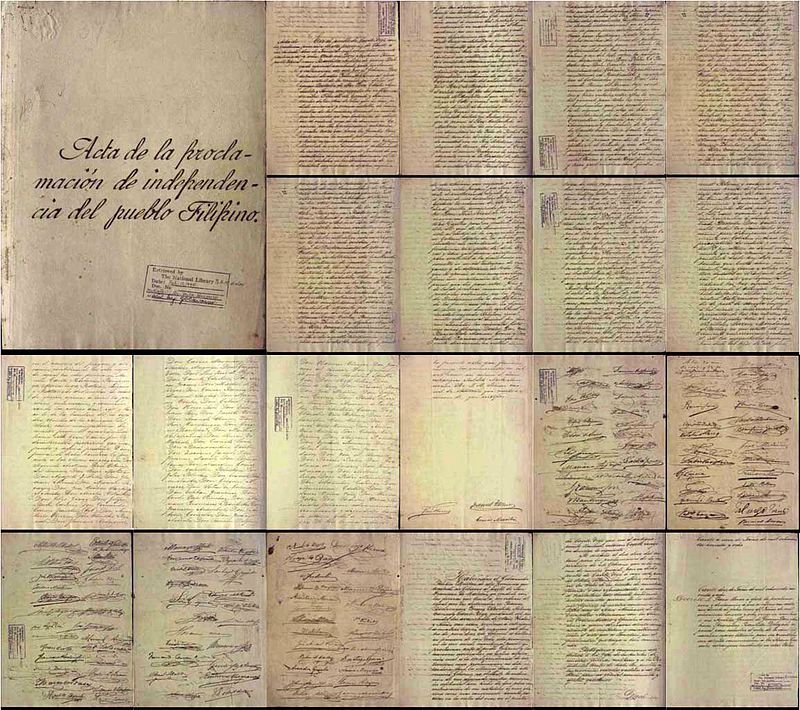
 Artist's interpretation on Rizal on his way to execution at Bagumbayan. Note lively gait and stride, and apparently jovial conversation with the escorting military officer. It was reported by an attending doctor that Rizal's pulse rate was normal even as he faced the firing squad.
Rizal as a Zoologist
As a zoologist, Rizal discovered living organisms unnamed in his time, such as a flying (gliding) lizard (Draco Rizali), Harlequin Tree Frog (Racophorus Rizali), among others, named after him.


Acknowledgement: Internet
Subscribe to:
Comments (Atom)