Thursday, December 31, 2020

" Chicks emerge from under a brooding hen."

"Chicks emerge from under a brooding hen." 
Dr Abe V Rotor

     Sweet sound breaks the calm morning air,
  peaceful and happy in a country fair.
 the newly hatched chicks meet the world,
a mystery of life many times told.

Chicks emerge from under a brooding hen at home. 
Living with Nature Center, San Vicente, Ilocos Sur. 
Unedited photos by the author. 

"The hen symbolizes motherhood - love and care for her brood -
with perseverance until her offspring becomes independent." - avr  

Evolving Art (ad infinitum)

Evolving Art 
(ad infinitum) 

Art works, verses and lines by Dr Abe V Rotor 

Splash Painting

Who needs brush and canvas?
Only colors, if you must.
On the floor, just splash, splash,
to create stained glass! 

Noah's Black Dove 

I found a fossil entombed,
   of a story in driftwood. 

  
Duck Head  Figurine
 
Once hunted on water and in air,
now figurine, a grim reminder.   


Broken Jar  Alive

A lease for life indeed
through art we bid;
talent put to the test
at its very best.
 
Driftwood trophy

Why gold or silver a trophy:
why not remnant of a tree,
 shells forgotten and empty,
to wake us up to reality?
 
 
Driftwood Table Decor

Wasteland in the hall,
  a dreaded scene,
   aftermath of the Fall, 
of man's first Sin. ~


Tuesday, December 29, 2020

Ring of Fire

Ring of Fire 

Dr Abe V Rotor


Ring of Fire in acrylic, AVRotor 2016

Besieged by advancing culture, 
a forest once sacred and pristine,
falls into the evil hands of man - 
and man loses to his old sin. ~   

Monday, December 28, 2020

Hilarion Riotoc Lazo - the last actor-playwright of Ilocano Zarzuela ( San Vicente IS Series)

 San Vicente IS Series:

  Hilarion Riotoc Lazo - the last actor-playwright of Ilocano Zarzuela 

Dr Abe V Rotor*
Living with Nature School on Blog 


Laring R Lazo and cast in one of the last zarzuela presentations. 

When I started to write about Laring, as he is fondly called on or off the stage, I thought of an all time famous line of Shakespeare.  

“All the world’s a stage, and all the people merely players…” 

It is true, all of us are actors in our own rights, and may I say, playwrights too, because we cannot truly be ourselves without the script we make from our own thoughts and ideas, our imaginations and experiences. And from our interactions with people and society.

But there are those whose talent brings to stage the drama people look up to, drama that makes us laugh and cry, enlightens us of our burden, rekindles hope, encourages us to meet the challenges of life.  Or merely keeps our faith alive and respects our personal values.  But the most important qualification a playwright has, I believe, is his ability to unite us as one humanity. 

Manong Laring (address as courtesy to one who is older) is a natural player on stage - actor, director, musician, setup artist, and all that a play needs on stage, that thinking loud of these many requirements would send an ordinary person to simply be part of the audience.  

He knew well the amphitheater of the Greeks which the Romans modified into public forum, and later simplified as entablado - a plaza stage which was brought to the Philippines during the Spanish conquest. 

Here on the entablado generations of Filipinos witnessed many and varied presentations from official functions of government to public entertainment. Two forms of stage drama became institutions during the 400-year of Spanish rule - extending to post American era.  They remained all-time favorites during fiestas: the zarzuela and the comedia (moro-moro).

I grew up near the entablado, a stone's throw from our house. Adjacent to it is the 17th century church, the municipio the seat of local government, and the palengke (Aztec term for market). The plaza was a wide open space for games like sipa, kite flying, procession and parade..

The entablado was integrated into the system and culture. It was designed for governance, through people's participation. Thus the zarzuela is a drama of, for and by the people. Themes like romance, triumph and tragedy, comical and musical, became part of people's lives so that even those from far flung barrios would come on foot or cart pulled by bullock not only to watch the plays but to celebrate with the occasion. It could be the Cenaculo or Passion of Christ, it could be comedia, a regular presentation on the feast day of San Vicente de Ferrer, the town's patron saint. The comedia reinforces Christianity (though not conducive to ecumenism). The theme of the musical farce revolves on the victory (always) of the Holy Crusade over the Moors during the Dark Ages in Europe. 

Manong Laring and I belong to the generation that still carried the influence of Renaissance Europe in spite of the 50-year American Commonwealth rule that followed, and four years of Japanese Occupation. The Philippines now independent, was as young as our generation. It was fragile. While fledgling as a new nation, the world entered into the so-called Cold War, polarizing nations into two opposing ideologies, we on the American side while China and other Asian neighbors joined communist USSR.  The war was to last until 1989, after nearly 45 years. .   

Whatever happened to the entablado at the crossroad of change?

Rapid change followed, steered by breakthroughs in science and technology with man landing on the moon, the arrival of computer age, and the breaking of the code of life?

We can only imagine what drama would be most appropriate to show on stage. The shrinking of the world, so to speak, became conducive to exodus to cities and migration from underdeveloped to industrialized countries. On the other hand, inequity of wealth distribution has created extreme economic conditions particularly on the grassroots.  

I am presenting these historical events in the light of the rise and fall of the zarzuela and other forms of art - and all fields of human endeavor, for that matter. A social scientist once said that periodicity is a phenomenon humanity has no control of time, space, and events. Change is gaining accelerated momentum. We are now living in postmodernism, literally living tomorrow today.

Manong Laring now lives in New York with his family. In his recent visit I requested for an interview and permission to play on my radio program one of his zarzuela recordings - Perlas II (photo). 

It is nostalgic to reminisce the good old days of the zarzuela, in its entire splendor on the last Tuesday of April, the town fiesta of San Vicente.  Maestro Selmo Pelayre would be conducting the orchestra, with Laring as the principal character on stage. Fredelito Lazo, a classmate of mine and a prominent Ilocano writer, would be on the assist, as well.  So with a host of local talents.  I am reminded of the young playwright Pierre Gringore of Victor Hugo's The Hunchback of Notre Dame, who tried to bring dignity to the art; and Severino Reyes' (Lola Basyang) Walang Sugat  designed to outwit American propaganda during the Commonwealth era.  So with Nick Joaquin's Portrait of the Filipino, with its nationalistic fervor. 

I did some research why the zarzuela is among the most loved and enduring forms of art, we classify today as performing art. All over the world the zarzuela and its variants dominated the stage for centuries.  Europe is the progenitor of the play, it raised it to the highest level of art, developing new movements with the opera, concert, dance and other choreographic presentations. Stage play was used as well in propaganda and campaign. The theater in America gave rise to Hollywood. Rural development through extension, adopts stage play as tool of extension. Laedza Batanini of Botswana is a world model in rural development.       

Singular indeed is the whole cast's greatest hour. There is a bit of Euripides, pioneer playwright of ancient Greco-Roman times' tales and legends, counterpart of Homer's epics - Iliad and the Odessey. There is a bit of Shakespeare the classicist and most influential dramatist, as much a myth as a man. His characters are timeless archetypes that influence us all to this day - Romeo, Juliet, Macbeth, Hamlet, Othello are among his greatest works. His plays have become a part of the world’s collective consciousness.

There is a bit of the Russian Anton Chekhov, who epitomized the stream-of-consciousness style that inspired James Joyce and other modernists in the literary arts like Elia Kazan, and Ernest Hemingway. There is a bit of Eugene O'Neill, whose sense of despair could be likened to that of Edgar Allan Poe. There is a bit of Arthur Miler dubbed the last great practitioner of the American Stage, a carryover of American colonialism. 

And contemporarily, there is a bit of Tennessee Williams dramatizing his life and family, in relating tragic relationships, dysfunctional families, and brought us a world so real that reflects modern society. And there's a bit of Bertolt Brecht. When you see his play or movie, you leave the place wanting to change your life.

The essence of the zarzuela is very much alive. Today it lives on the screen, more than on stage. It has found the home a stage through the television and computer. The essence of traditional drama is preserved in documentaries, and made popular through telenobela, and brought down to young audiences through cartoon characters and animations. 

And with today's social media, “All the world’s a stage, and all the people merely players…” gives everyone the chance and opportunity to play his or her best.  But the world continues to search for an actor-playwright like Manong Laring, whose drama doesn't only make Shakespeare smile, but the whole humanity proud. ~
    

Stage scenes of zarzuela performed in different places and of different genres. 

Lesson on former Paaralang Bayan sa Himpapawid (People's School-on-Air)  Dr Abe V Rotor and Ms Melly C Tenorio 738 DZRB AM Band, 8 to 9 evening class Monday to Friday.
* Philippine Literature Today by A V Rotor and K Molina-Doria  2015 C and E Publishing Inc., Chapter 7 p 155, under pen name Crisostomo "Jun" Rojas

Friday, December 25, 2020

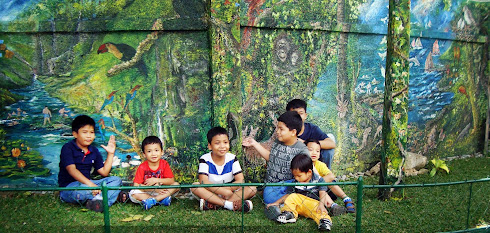
Children of Nature

Children of Nature
Dr Abe V Rotor
Wall mural by the author in his residence in Lagro QC, Metro Manila


Neighborhood kids at Greater Lagro QC take time out to play and
pose before a wall mural of nature painted by the author.

I'm among these kids, three generations after;
what secret has Nature to break the boundary
of space and hold back the hands of time,
and save the happy childhood in memory? ~

Echoes of Childhood

Echoes of Childhood

Dr Abe V Rotor 


The Uplands, wall mural author's residence San Vicente, Ilocos Sur

Whispers and footsteps on the hall and wall,
Greet a stormy morning; candles flickered, 
Sheltered by warm and toughened hands, 
Leading the young ones to their classroom. 

And courtesies were the smile of familiarity: 
Heads moved to acknowledge, to recollect
Old memories coming fresh and nostalgic, 
Of those who once passed through the portals. 

Memories about a child becoming man, 

Men’s wanderings, and man’s return to reality; 
When with age, he looks back at the ideal, 
Not in its pursuit but for treasured peace. 

Whispers and footsteps on the hall and wall, 
Echoes, sweet echoes, perhaps music to a child 
On some strong shoulder lifts a heavy eyelid; 
A curtain falls, a new chapter begins. ~ 

Reflection in Painting

Reflection in Painting
Painting by Leo Carlo R Rotor
Poem by Abe V Rotor


Reflection - two faces in one,
    in one’s mind and heart;
of the past and the present,
    prelude to all art.
   
Reflection - the self and the other
    fellow, foe or friend;
in war and peace, want and plenty,
    humbles at the end.

Reflection - The Prince and the Pauper,
    and The Little Prince;
Les Miserables, Christmas Carol,
    one’s my life ever since. ~

Monday, December 21, 2020

Common Denominator of Science and Art

Common Denominator of Science and Art
Dr Abe V Rotor

Common Denominator in Science and Art in acrylic by the author 

  
Details showing unity of theme.

Darwinian or Lamarkian, scientists still in debate,
     the ultimate end though is one and the same:
species in dynamic change towards homeostasis,
     evolution is science and art, battle and game. 

Friday, December 18, 2020

PHOTO ESSAY: Where has the true owl gone?

Where has the true owl gone?
Dr Abe V Rotor

 Interpret this scenery in essay or poetry, or both,
and share it in your class in biology and humanities.

 
Author in Brisbane, Australia 

Tuesday, December 15, 2020

Onset of Autumn

 Onset of Autumn
Dr Abe V Rotor
Onset of Autumn in acrylic by A V Rotor 

The leaves are still green but autumn is here,
litter on the forest floor turns red and yellow,
and cracks and tickles under my feet bare.
Oh, how seasons change pure and mellow!   

Thursday, December 10, 2020

Plants at the Living with Nature Center Botanical Garden

Plants at the Living with Nature Center  
 List of plants in their common and scientific names, and family.  
Dr Abe V Rotor

 
Anahaw -  Saribus rotundifolius - Caryophyllaceae 

1.  Achiote or Annatto – Bixa orellana - Bixaceae

2.     Alagaw – Premna odorata - Lamiaceae

3.     Anahaw -  Saribus rotundifolius - Caryophyllaceae 

4.     Apatot – Morinda littoralis/citrifolia - Rubiaceae

5.     Arios – Podocarpus costalis - Gymnospermae

6.     Balete - Ficus benjamina - Moraceae

7.     Bird’s Nest fern – Asplenium nidus - Aspleniaceae

8.     Bougainvillea – Bougainvillea spectabilis Nyctaginaceae

9.     Bromeliad – Portea   spp - Bromeliaceae

10. Caballero plant – Caesalpinia pulcherrima - Fabaceae

11. Caimito – Crysophyllum cainito - Sapotaceeae    

12. Calamansi – Citrus macrocarpa - Rutaceae

13. Chico – Achras (Sapodilla) zapota - Sapotaceae

14. Chinese Bamboo – Bambusa multiplex - Poaceae

15. Coconut – Cocos nucifera - Arecaceae

16. Creeping Fig – Ficus pumila - Moraceae 

17. Cyperus – C. papyrus Cyperaceae

18. Dalandan – Citrus decumana - Rutaceae

19.  Duhat – Syzygium cumini – Myrtaceae

20.  False Bird of Paradise – Heliconia psittacorum – Heliconiaceae

21. Giant Bamboo – Dedrocalamus giganteus - Poaceae

22. Giant Thorny Bamboo – Bambusa bambos Poaceae

23. Aplas - Ficus hawili - Moraceae

24. Kalachuchi – Plumeria rubra/ P alba   Apocynaceae

25. Ilang-ilang – Cananga odorata - Annonaceae

26. Makopa – Eugenia jambalana - Myrtaceae

27.  Mayana - Coleus blumei - Lamiaceae

28.  Red Anthurium – A. andraeanum - Araceae   

29.  Sanggumay – Dendrobium anosmum Orchidaceae

Sorosoro or Karimbuaya

30.  Bromeliad – Guzmania spp. Bromeliaceae

31.  Gumamela – Hibiscus rosa-sinensis Malvaceae

32.  Maguey – Agave cantala – Asparagaceae (sub-F Agavoideae)

33.    Mahogany - Swietinia macrophylla - Meliaceae

34. Strangler’s Fig (balete) Ficus benjamina - Moraceae

35. Molave – Vitex parviflora  - Verbenaceae

36. Narra – Pterocarpus indicus - Dipterocarpaceae

37. White Lauan – Shorea contorta - Dipterocarpaceae

38. Bitaog - Calophyllum inophyllum– Calophyllaceae

39.   Bikal Bamboo – Schizostachyum dielsianum - Poaceae

40.   Staghorn Fern – Platycerium bifurcatum - Polypodiaceae

41. Oak fern – Gymnocarpium dryopteris - Cystopteridaceae

42. Balimbing – Averrhoa bilimbi -Oxalidaceae  

43.   Tubang Bakod – Jatropha curcas - Euphorbiaceae

44. Jatropha (coral plant) – Jatropha podagrica/multifida - Euphorbiaceae

45. Castor bean – Ricinus communis - Euphorbiacae  

46. Calamansi – Citrus microcarpa - Rutaceae

47. Sampalok – Tamarindus indica – Ceasalpiniaceae

48. Banaba – Lagerstroemia speciosa - Lythraceae

49. Golden Shower – Cassia fistula - Fabaceae

50. Lobster’s Claw plant – Heliconia rostata - Heliconiaceae

51. Soro-soro – Euphorbia neriifolia - Euphorbiaceae

52. Buntot Tigre – Cordyline roxburghiana - Agaveceae 

53. Barbados Cherry – Malphighia emarginata

54. Kamachili – Pithecolobium dulce - Fabaceae

55. Pandakaki – Tabernaemontana pandakaqui - Apocynaceae

56. Pandan – Pandanus amaryllifolius - Pandanaceae

57. Mahogany – Swietenia macrophylla - Meliaceae

58. Maiden Hair Fern – Adriatum raddianum - Pteridaceae

59. Lantana plant – Lantana camara - Verbenaceae

60. Nangka – Artocarpus heterophyllus - Moraceae

61.   Philodendron – P. melanochrysum

62.   Indian Mast Tree – Polyalthia longifolia

63. Fishtail palm – Caryota mitis - Arecaceae

64. Shanghai Beauty – Jatropha integerrima - Euphorbiaceae

65. Selaginella – S, lepidophylla/braunii - Selaginellaceae

66. Tsaang Gubat – Ehretia microphylla - Boraginaceae 

67. Manga – Mangifera indica - Anacardiaceae

68. Mulberry – Morus nigra - Moraceae  

69. Yellow Bell – Tecoma stans – Bignoniaceae family

70. Kamias – Averrhoa bilimbi - Oxalidaceae

71.   Forget-Me-Not – Myosotis scorpioides - Boraginaceae

72.   Rambutan – Nephelium lappaceaum  - Sapindaceae

73. Bromeliad – Portea   spp - Bromeliaceae

74. Sisal – Agave sisalana - Agavaceae

75. Thorns of Christ plant – Euphorbia milii - Euphorbiaceae

76. Mickey Mouse plant – Ochna serrulate Ochnaceae

77. Lagundi – Vitex negundo Verbenaceae

                                  Croton (Codiaum variegatum)


78.   Lotus – Nelumbium nelumbo Nelumbonaceae 

79.   Nymphaea – Nymphaea alba/ colorata - Nymphaeaceae

80. Santol – Sandoricum koetjape - Meliaceae

81. Tibig – Ficus nota - Moraceae

82. Fortune plant – Dracaena sanderiana - Asparagaceae
83. Gummamela - Hibiscus rosa-sinensis - Malvaceae
84. Palmera – Borassus flabellifer - Araceae
85. Talisay (Lugo’) – Terminalia catappa - Combretaceae ~