Sunday, October 26, 2025

Capture Spontaneous Joy through the Lens

Capture Spontaneous Joy through the Lens

Capture that deep sense of delight, well-being, and contentment 
with the camera.

"Joy is a choice.
Joy is contagious."

 Dr Abe V Rotor

Make-believe waterfall wall mural by the author

When was the last time I smiled at myself?
For the things I do are measured for others,
for goodness' sake and not just for myself.
Let me be alone once in a while, my brothers!
  
Senior citizens at Rizal's garden shrine at author's hometown.

   Heroes don't retire, their deeds live on;
if retirement is a goal, we are wrong.

Tree hugging releases stress, connects us with Nature.

Hans Selye, the tension guru, has for us a gift:
live with just enough stress to be challenged;
too much of it pushes you beyond your limit,
unhappy, sad, until you fall off your bench.  

Echoes on the wall, neighborhood kids pose before a wall mural, QC

Echoes on the wall,
    of lilting children, of rustling trees,
    of distant thunder, of passing breeze.

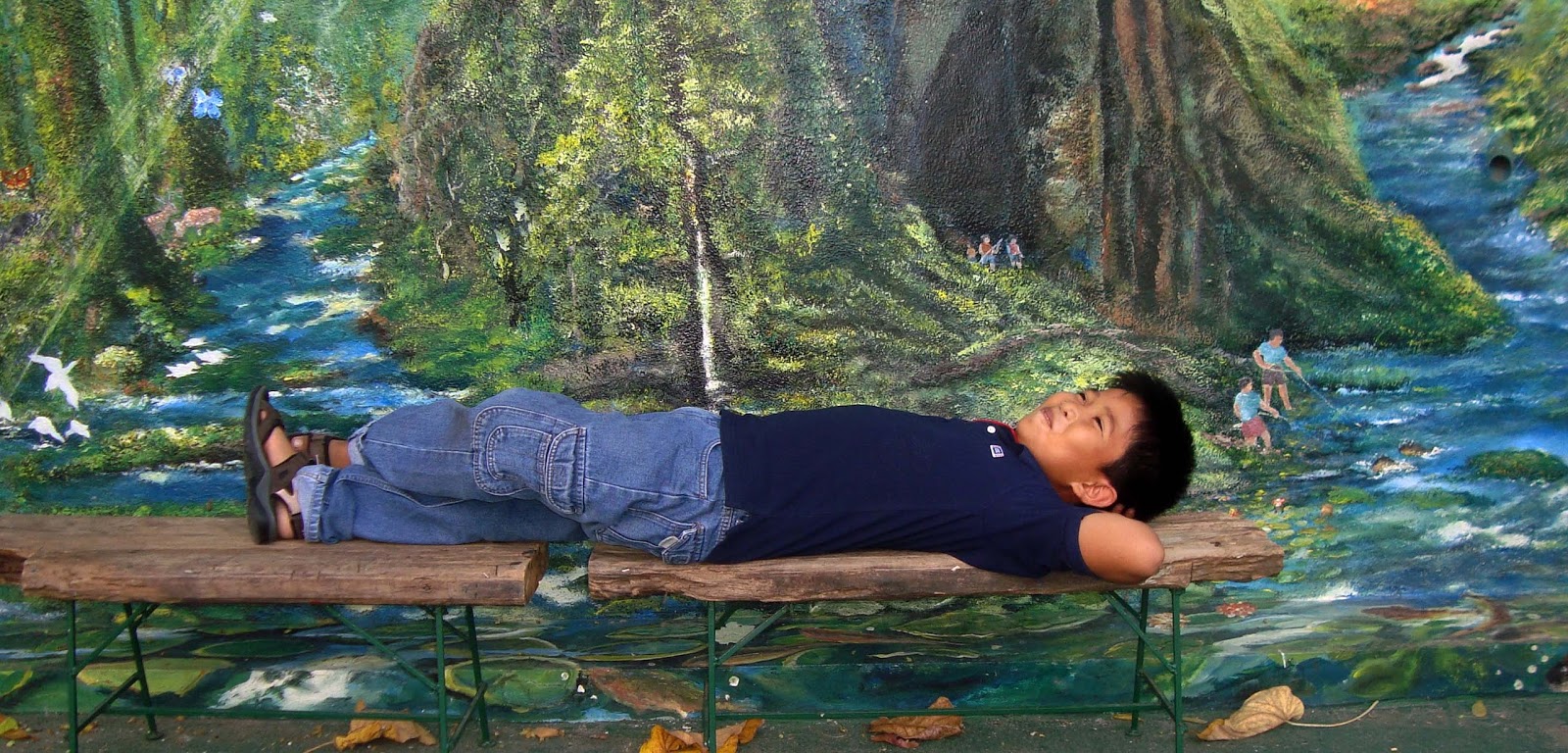
Siesta beside a wall mural painted by the author, QC

At peace with the world
     in happy childhood,
     in air castle and dream,
     in quiet and solitude,
     beside a running stream. ~

Jared and the Wild Bean A modern version of "Jack and the Beanstalk"

Jared and the Wild Bean
A modern version of "Jack and the Beanstalk"

Dr Abe V Rotor
On the the slopes of the Andes mountains, lived a family of indigenous origin. People would describe the region as "far from civilization," as if only those living in town are regarded civilized. 

A modern day Jared, the boy scholar who popularized the wild bean. Wild Lima Beans or patani (Phaseolus lunatus) was first domesticated by the natives living on the Andes mountain of Peru some 2,000 years BC.
  
There was this boy, the only child of that family who wished to live in town.  "No, you are a stranger there." his parents would say.  "Beside it is very expensive to live in town." For indeed up on the slope, everything is free that land, water and air can give. And there is peace and quiet no town can provide.  

Until one day the boy stumbled on a kind of plant that grows up on trees. There it bore pods, plenty of them, green when young and on maturity split open and spill the seeds to the ground. The seeds germinate and produce more pods the following season. The family soon learned to cook it as part of their diet, specially when there was little food around.  
Then a year came when the rains did not arrive as people expected.  It was due to the effects of El Niño - a period of drought that starts at the lower part of Peru.  

The boy's parents by experience knew the grave consequence.  Even if you have money you cannot buy anything.  So people looked for alternative food. On hearing this the boy brought the wild beans to town. At first people did not know what it was, until they learned how good it is to eat the beans with their own recipes.   

Secretly the boy brought more of his secret beans. And he made a lot of money. 

After the great drought which lasted for three years, the boy left the slopes to live in town. His parents followed to live with him. 

People wondered where the bean that saved them from hunger came from. The search was far and wide but to no avail.  

Until a boy scholar was able to trace the trail leading to the upper slopes of the Andes. There in a clearing among trees he saw the secret bean, a liana with pods dangling from the trees it made into its own trellis. Jared, the boy scholar took some mature seeds and studied them in school. 

He popularized the bean we know it today as Phaseolus lunatus, or Lima bean, after the capital of Peru. And lunatus for its moon-shape seeds.  Its native name patani survives to this day to places it was introduced which includes the Philippines.   

As to the boy who brought the wild bean downtown, no one had ever heard of him again. But the people in town remembered him whenever the cyclical El Niño struck. 

And Jared, the boy scholar? The one who tamed the wild bean. To them it's a fairy tale. 
  
NOTE: Today, Lima bean is one of the important legumes in the world. It is a good source of dietary fiber, and a virtually fat-free source of high quality protein. It contains both soluble fiber, which helps regulate blood sugar levels and lowers cholesterol, and insoluble fiber, which aids in the prevention of constipation, digestive disorders, irritable bowel syndrome and diverticulitis. Like other legumes Lima beans harbor symbiotic bacteria called Rhizobia within the nodules clinging on their roots.  These bacteria convert N2 or free Nitrogen into Nitrates (NO3). Nitrates combine with other elements to form compounds needed by plants and other organisms. 

A Halloween Story “To Heaven and Back"

A Halloween Story
“To Heaven and Back"

Remembering the good old days and thanking people for all the good things they did, is perhaps the best offering one can give to someone who had "died, and came back." 
Dr Abe V Rotor

Towards the Light, Concept of the way to Heaven based on Christian teaching.
On-the-spot painting by the author at the Sacred Heart Novitiate, Novaliches QC

This is a true story - the story of Auntie Dorotea who went to heaven and returned for a second life.
 
This is not an unusual story.  Many people I am close with have a story to tell about close encounter with death.

How close is this encounter? It is leaving the world of the living and going to the world of the spirits, of the saints and angels for those who led a life worthy of a place in heaven. In the process the traveler encounters a mysterious scenery, a realm strangely beautiful.  The spirits are simply suspended in place, they appear weightless, and have no mass at all.  Angelic notes pipe through the calm and fades out into the din. There are no boundaries, Nothing moves except the travelers, in slow animated pace, all toward the source of light. They are all in white, flowing white. They seem not to know each other as they traveled on the long, long road. 

Finally Auntie Doting reached the source of light.   It is a kingdom different from any kingdom. She saw her son who died when he was a young boy. She saw uncle, her husband.  She recognized others, relatives, friends, neighbors. But they simply look at each other. And nothing more.

"Did you see my mom?" I ventured to asked.  To which she readily answered, yes. I felt happy mom is in heaven, even if I knew by religious belief.  

I allowed her to enumerate all acquaintances she saw in her sojourn. I was expecting a very important name. My father’s.

She paused and thought deeply. "No, I can't recall," she said. She was drawing in the air  with her fingers.an imaginary map.

"Try to remember, Auntie," I pleaded. 

Silence. 

Auntie Doting and my dad were partners in business for years in Ilocos. When I went to college in Manila Dad entrusted me under her guidance, together with my two cousins who were then high school teachers. Had it not been for them I would not have made it to what I am today. I was a wartime baby, and mom died when I was two. Dad never recovered his health although he lived to a ripe age. 

As a farmhand I used to tell dad, "I can't leave you alone, I can help you manage the farm." Dad would just remain silent. Dad graduated from De Paul University in Chicago during the Great Depression. He was among the bona fide balikbayan.  He returned and put up a mechanized furniture shop and bought some land.  Then the war broke, my mom died, so with my baby sister.  Slowly dad manage to put back what was left in his business which enabled us his three children to go through with our studies.  

Although I was the youngest I insisted to stay put on the farm.  Dad finally confronted me, "Is that  all you aspire in life?" Finishing a college degree was far from my dream. That was the time he sought help from Auntie Doting.   

Remembering the good old days and thanking people for all the good things they did, is perhaps the best offering one can give to someone who had "died, and came back."  It is a special way of expressing how grateful I am to my Auntie Doting. 

Days passed, Auntie's condition was fast deteriorating. At her deathbed she held my hand and whispered, "I saw your dad." ~

Viktor Frankl: Founder of Logotherapy - Healing through Meaning

Healing through Meaning
Viktor Frankl: Founder of Logotherapy

" It was Viktor Frankl, a Jewish psychotherapist-philosopher, who popularized logotherapy, a word of Greek origin which literally means healing through meaning. ... The unheard cry for meaning if only well-heeded in all aspects of life - from the least significant to the extremely necessary, from the most commonplace to the phenomenally sublime - can only restore authenticity back to living life beautifully."

Light from the Old Arch, by Dr Abe V Rotor. Preface written by Fr. Jose Antonio Aureada, 
regent of the Graduate School, published by UST, 2000 

Researched by Dr Abe V Rotor
Retired Professor, University of Santo Tomas Graduate School


In the death camp, they gave him a number: 119104.
But the thing they tried hardest to kill became the very thing that saved millions.

Source: Old Historical memories & pictures ·
Curtis E Alcorn 
pontoSdrseih96tic01hg789lcmtaa333l6136552fa1a2g014g7tah1006h ·

1942. Vienna.

Viktor Frankl was 37 years old, a respected psychiatrist with a growing practice, a manuscript nearly complete, and a wife named Tilly whose laugh could fill a room.

He had a chance to escape to America. A visa. A way out.

But his elderly parents couldn't come with him. So he stayed.

Within months, the Nazis came for them all.

Theresienstadt. Then Auschwitz. Then Dachau.

The manuscript he'd spent years writing—sewn carefully into the lining of his coat—was torn away within hours of arrival.

His life's work. His purpose. Reduced to ash.

His clothes were taken. His hair shaved. His name erased.

On the intake form, there was only a number: 119104.

But here's what the guards didn't understand:

You can take a man's manuscript. You can take his name. You can take everything he owns.

But you cannot take what he knows.

And Viktor Frankl knew something about the human mind that would keep him alive—and give birth to a revolution in psychology.

He noticed a pattern.

In the camps, men didn't just die from starvation or disease.

They died from giving up.

The moment a prisoner lost his reason to survive—his why—his body would collapse within days. The doctors had a term for it: "give-up-itis."

But the men who held onto something—a wife to find, a child to see again, a book to write, a debt to repay, a promise to keep—they endured unthinkable suffering.

The difference wasn't physical strength.

It was meaning.

So Frankl began an experiment.

Not in a laboratory. In the barracks.

He would approach men on the edge of despair and whisper:

"Who is waiting for you?"

"What work is left unfinished?"

"What would you tell your son about surviving this?"

He couldn't offer food. He couldn't promise freedom. He had nothing material to give.

But he offered something the guards could never confiscate: a reason to see tomorrow.

One man remembered his daughter. He survived to find her.

Another remembered a scientific problem he'd been working on. He survived to solve it.

Frankl himself survived by mentally reconstructing his lost manuscript—page by page, paragraph by paragraph, in the darkness of the barracks.

April 1945. Liberation.

Viktor Frankl weighed 85 pounds. His ribs showed through his skin.

Tilly was gone. His mother—gone. His brother—gone.

Everything he'd loved had been murdered.

He had every reason to despair. Every reason to give up.

Instead, he sat down and began writing.

Nine days.

That's how long it took him to recreate his manuscript from memory—the one the Nazis had destroyed three years earlier.

But now it contained something the original didn't:

Proof.

Living, breathing, undeniable proof that his theory was true.

He called it Logotherapy—therapy through meaning.

The foundation was simple but revolutionary:

Humans can survive almost anything if they have a reason why.

"He who has a why to live can bear almost any how." (He borrowed the words from Nietzsche, but he had proven them in hell.)

1946. The book is published.

In German, the title was "...trotzdem Ja zum Leben sagen"—"...Nevertheless Say Yes to Life."

In English, it became "Man's Search for Meaning."

The world wasn't ready for it. Publishers initially rejected it. "Too morbid," they said. "Who wants to read about concentration camps?"

But slowly, quietly, it began to spread.

Therapists read it and wept.

Prisoners read it and found hope.

People facing divorce, disease, bankruptcy, depression—they read it and discovered that their suffering could have purpose.

The impact was seismic.

The book has now been translated into over 50 languages.

It's sold more than 16 million copies.

The Library of Congress named it one of the ten most influential books in America.

But here's what matters more than sales numbers:

Countless people—people whose names we'll never know—have picked up this book in their darkest moment and found a reason to keep going.

Because Viktor Frankl proved something the Nazis tried to disprove:

You can strip away everything from a human being—freedom, family, food, future, hope—and there will still be one final freedom remaining:

The freedom to choose what it all means.

You cannot control what happens to you.

But you can always control what you make of what happens to you.

Today, Viktor Frankl is gone.

But in hospital rooms, in therapy offices, in prisons, in quiet moments when someone is deciding whether to give up or keep going—his words are still there:

"When we are no longer able to change a situation, we are challenged to change ourselves."

"Everything can be taken from a man but one thing: the last of the human freedoms—to choose one's attitude in any given set of circumstances."

The Nazis gave him a number.

History gave him immortality.

Because the man who lost everything taught the world that meaning is the one thing no one can ever take away.

Prisoner 119104 didn't just survive.

He turned suffering itself into a source of healing.

And somewhere tonight, someone who's barely holding on will read his words and decide to hold on one more day.

That's not just survival.

That's victory over death itself.
-------------------------
Author's Note: This article is beautifully written in a style of a summary framework, easy to read and comprehend in limited time and attention span, effective in conveying a difficult and formal theme of a new field of psychology most relevant today - logotheraphy, written by one of the world's original thinkers and trailblazers of knowledge, 

Logotherapy is a form of existential psychotherapy developed by psychiatrist Viktor Frankl that focuses on finding personal meaning in life as the primary human motivation. It teaches that meaning can be found even in suffering and that the "will to meaning" is a powerful force. Key techniques include dereflection, paradoxical intention, and Socratic dialogue. AI Overview

ANNEX - Light from the Old Arch 

A compilation of 18 essays about life and living, 216 pages. Published by UST in 2000 with the Preface written by Fr. Jose Antonio Aureada, regent of the Graduate School.

"What is considered a religion of disconnection betrays man's inability to see sensuality through divinity and divinity through sensuality... It was Viktor Frankl, a Jewish psychotherapist-philosopher, who popularized logotherapy, a word of Greek origin which literally means healing through meaning. Dr Abe. the poet-musician-painter-scientist rolled into one, reminds us of the Franklian inspired principle: The unheard cry for meaning if only well-heeded in all aspects of life - from the least significant to the extremely necessary, from the most commonplace to the phenomenally sublime - can only restore authenticity back to living life beautifully."

Acknowledgement with gratitude to the author, Curtis E Alcorn and source: Old Historical memories & pictures, Facebook on the Internet, UST Publishing House·


Saturday, October 25, 2025

"The Wall"

 "The Wall" 

Wall Mural and Poem by Dr Abe V Rotor

"The only way to break down walls is to build bridges." - Unknown

"The Wall" in acrylic by the author at his residence in San Vicente, Ilocos Sur 2025

The wall - low enough to see the other side;
     high enough to hide what is inside;
Intramuros, Hadrian, and the Great Wall,
     seemingly formidable 'til their fall.

The wall - prison inside, freedom outside;
     power and wealth it cannot hide;
the Bastille, Jericho, the once Berlin Wall,
     history tells of their common fall.

The wall - symbol of man's dream and pride;
     defying the rise and fall of tide,
immortality, time, and destiny of the soul.
     far beyond the wall lies his goal.

The wall - nature's defence at times tried,
     proudly stands on the guardian's side;
for the safety of all creatures, big and small.
     in unity and harmony as a whole.

The wall - man's test of his duty to abide,
     now and always, far and wide;
of nature's ways and not his own control;
     for there's no need of wall after all.

The wall - living fort of trees on the hillside,
     tall grasses on the meadow hide,
like coral reefs and levees on the shoal,
     niches to the living, home for all.

The wall - rainbow in the sky we once cried
     with joy, the greatest gift to a child,
lives forever in our mind, heart and soul,
     paves our way to our final Goal. ~  

  “Men build too many walls and not enough bridges.”- Isaac Newton

Hanging wall, detail

"The wall - nature's defence at times tried,
     proudly stands on the guardian's side..."

"Sometimes you put walls up not to keep people out, but to see 
who cares enough to break them down." - Socrates
 
Details of wall mural

"The wall - living fort of trees on the hillside,
          tall grasses on the meadow hide..."

“What lies behind us and what lies before us are tiny matters 
compared to what lies within us.” – Ralph Waldo Emerson

Wednesday, October 22, 2025

Happy Birthday, Sister Veny Valdez Rotor: "Religious-Outside-the-Wall" (Article in Progress)

Happy Birthday, Sister Veny Valdez Rotor:
"Religious-Outside-the-Wall"
In loving memory of Sister Veneranda Valdez Rotor, OFS
 1939-2022
 
  1. Freedom with Nature 
Windmills at Bangui, Ilocos Norte.  Sr Veny and neice, Anna.

Camera, camera everywhere.
     Fault not and beware;
Wear a Janus mask, its brighter side
     To trust and to abide.

It's the third eye of modern man;
     To see even the unseen,
Real images or just imagery,
     And those behind the scene.

But don't let privacy die in vain,
     If you must, be it a cause,
The lens more powerful than sword,
     Like pen its last recourse.
                                          

 2. Meditative Life at the Family Home Garden

Alokon (Alleaenthus glaber) is a favorite Ilocano vegetable.
 
Markus and Mackie stroll among heritage trees 
with their Lola Veny+. 
 
Two-layer bunch of banana is indeed a bountiful harvest.


Meet me in the shade of trees,
by the waterfall and garden pond;
among loyal friends of nature, 
where silence the sweetest sound.


Heritage trees of generations -
 past, present, and future - 
living monument of kinship,
bridge of memory and diary. 


3. "Nature, Nature on the Wall,
A Beautiful Life to Recall.”
                        Living with Nature Center, San Vicente, Ilocos Sur

“Humans love the art of make-believe,
Scenic Nature painted on the wall,
Once empty and forgotten now alive,
Bringing in friends to the call.” 

       
Sor Veny V Rotor and Ms Helen I Nolasco (in red) pose before a mural 
painted by the author. Sor Veny was the author's sister, the eldest of 
three  siblings of the late Matias Rotor and Enriqueta Valdez..

“Sitting on the rock, reaching for the sky,
All day if you wish with no one asking why.”


“Grace is something in the spirit to share,
That grows the more we love and care.”

     
Sor Veny left, led house guest on a short walk at the botanical garden.

What makes a house green
other than the color green;
but a verdant garden scene
happy and healthy to live in.


Stairway connects art gallery and library.

Stairway connects
the past and the present,
man and his Creator,
events current and future,
known and unknown
now and hereafter.

     
Sor Veny Rotor (right) explained to house guest some modern 
paintings at the gallery, among them are her works.

Modern art
Impressionism to surrealism,
Dali, Matisse, Picasso to blame;
Avant-garde and graffiti, the same;
Please roll back to realism.

Sor Veny V Rotor and Ms Helen I Nolasco (in red), house guest 2020
Living with Nature Center Rotor Residence
San Vicente Ilocos Sur ~


4.  "There is always the last of a distinct breed,"
 
Sr Veny with her cousins: Fe, former UP professor; Sister Trinidad, a Paulinian sister; and Cely, retired teacher.  All are Rotors from San Vicente, Ilocos Sur. 
NOTE: Last photo circa 2000, only Fe lives today.

"We are not alone. We may be of different races, but God has placed us so that we journey on the same path." (James  Fenimore Cooper, The Last of the Mohicans.)

5. Apo Resurreccion at Home 
“Gaze at life in Me the second time”

Prayer is a universal element of Human Nature. It comes in many ways irrespective of creed and culture. It is ingrained in the rationality of the human being, emanating from a deep source which we cannot fully grasp. It is by believing in something beyond our comprehension that undermines our ignorance, arguably but true, as a unifying factor of humanity.

     
Sor Veny (foreground) led a short prayer before the 
Resurrection at her family's residence,

                             Message of the Resurrection

Apo Resureccion
How many times do we die and live again?
When we fall down and rise,
we fail and succeed,
when we are blind and see,
deaf and hear,
sin and atone,
hate and love,
love and care,
ad infinitum.

"Touch Me now that I am risen,
with your mind, heart and soul,
for you have chosen the path
of life with Heaven its goal."- avr

Manang Veny (center) leads prayer

"Redeemer of our postmodern world,
     we come to You, our Recourse
to find peace and accord
     on life’s rugged course."- avr

“The resurrection gives my life meaning and direction and the opportunity to start over no matter what my circumstances.” - Robert Flatt.

“The great gift of Easter is hope - Christian hope which makes us have that confidence in God, in his ultimate triumph, and in his goodness and love, which nothing can shake.” - Basil C. Hume

Note: Apo Resurreccion (Ilk) is a wooden icon of the resurrected Christ which has withstood the ravages of typhoons, earthquakes and the atrocities of the Second World War at the author's family residence.  Prayers are offered by quests who visit the place, which is gradually being developed into a Living with Nature Center cum Botanical Garden, in San Vicente Ilocos Sur.  

6.  Hometown
San Vicente Ferrer church through the years
 Archdiocese Shrine of Nueva Segovia

NOTE: April 5 is the Feast Day of San Vicente Ferrer, patron saint of  San Vicente, Ilocos Sur.  Town fiesta celebration in held on the last Tuesday of the month - April 30, 2024.  In 1795, it was the installation of the seat of municipality and the church , and Bo. Tuanong became San Vicente de Ferrer . Don Pedro de Leon was the first parish priest and he was believed as the initiator of the construction of the church of San Vicente.

Old photo of the 17th century church. This is how the façade looked like when I was in the elementary, just after the war . WWII spared the church from serious damage.

The church and municipality were named after Saint Vincent Ferrer, whose winged statue was found inside a box entangled in fishing nets. The fishermen consulted this matter to the friars in Villa Fernandina (now Vigan), who identified the person depicted by the statue. The statue was carried to the town's center, where a church was built. From then on, the town formerly known as Tuanong (sometimes called Taonan) became San Vicente.

In 1795, it was the initiation of the seat of municipality and the church and Bo. Tuanong became San Vicente de Ferrer. Don Pedro de Leon was the first parish priest and he was believed as the initiator of the construction of the Church of San Vicente.

St Vincent Ferrer, patron saint of San Vicente, Ilocos Sur

I've been away for almost a lifetime:
from childhood, the golden years down,
to the diamond years - and now I'm back
to my birthplace, to my home town.

The old church, landmark of time past,
of events local, and far, far beyond;
I've taken part in both - and in between,
my church in changing colors I found.

Changing colors still like the rainbow,
Sad and happy, lonely yet solemn,
the essence of faith true and abiding,
way beyond the tomb without end. ~

For many years the church assumed this color and color design

7. Memorabilia


Sr Veny with sister-in-law Cecille, and niece Anna 3
at their ancestral home in San Vicente, Ilocos Sur

 
Sister Veny and her Dad, circa 1985 
The day she took her vows as a 3rd Order Franciscan (OSF)

Rest in Peace, Beloved Sister Veny