Friday, July 31, 2015

Cockroaches eat on anything - almost.


Dr Abe V Rotor 

True. Being omnivorous, cockroaches voraciously consume all kinds of materials that are rich in carbohydrates, proteins, fats and oils.  But when these are not available they turn to unlikely food source like soap, photographic film, clothes, wood and drugs.  In fact they even turn into predators, devouring other insects, and sometimes biting people in their sleep. Their bite often gets swollen and infected. Cockroaches are found in all places where humans live and conduct his trade, commerce and industry. Only rats can be compared with the tenacity of the cockroach.    
American cockroach (Periplaneta Americana)

The cockroach has very powerful digestive enzymes:  proteases digest protein, invertase breaks complex sugar, and amylase breaks starches.  Its saliva contains powerful enzymes coming from the gastric caeca, while the Malphigian tubules secrete an enzyme that is equally disgusting.  It is no wonder that just a single frass (feces) can spoil a whole pot of rice by its obnoxious smell. By the way there are three most common species that we encounter in the home and public places.  These are the American cockroach or Periplaneta americana (large, rust red with a yellow band across its thorax), the German cockroach or Blatta germanica (pale yellow, only one-third the size of the American species) and the oriental cockroach or Blatta orientalis (dark brown to black, the biggest and filthiest of all cockroaches.)

Meticulous sanitation is the best way to get rid of cockroaches. To keep their population down, sprinkle carbamate (Sevin) on the kitchen floor, pathways and possible hideout of the pest, preferably before retiring at night.  Keep doors and screens properly closed to prevent entry of the insect. 

Friday, July 24, 2015

Buena Mano is a happy disposition


Dr Abe V Rotor 
Happy disposition - it's the best buena mano or first deal.

Laugh and the world laughs with you,
     Not last but first for the day;
Frown and you're likely all alone
     Even with the saints to pray.

The world makes it easier to laugh
     Than weep on misfortune;
And much easier too, to pass you by,
     For not counting your fortune.

Equation is the game in life;
     Others have what other's don't,
Yet all that matters in happiness,
     Take the chance, woe if you won't. ~

Wednesday, July 8, 2015

A Day with the Elephant - Beauty and the Beast

A Day with the Elephant -  Beauty and the Beast

Photos by Dr Abe V Rotor

First, you have to befriend the elephant's master.

Get to know a baby elephant.

Then get to know an adult one.

Before you climb and sit on the saddle and feel like a princess.

Now you can go places - with the beast's master.

Riding an elephant makes two faces. Actually, three.

Young elephant needs company, or vice versa,
under the watchful eye of the mother.

"If you tame me, you are responsible to me. "
(From The Little Prince)
That's the key to friendship.

Befriend the parent, too. The family circle, in fact.

Hurray! Freedom to both of you.
Freedom is
the prize of friendship.


Now you can go places - to the home of the beast, the jungle.

And to your own - the complex human habitation.

At the end, friendship is sealed with a real kiss.
And the memory lives on - and shared with others -
with a touch of fairy tale in a real world.


Acknowledgment: Safari World, Ayutthaya the Ancient City, Thailand.

Sunday, July 5, 2015

Alugbati - Versatile Leafy Vegetable

Alugbati - Versatile Leafy Vegetable 
 Dr Abe V Rotor

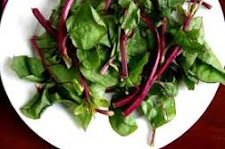
There are three common types of alugbati: Basella alba with green stem and oval to almost round leaves; Basella rubra with red stems and green, oval to round leaves; and a third type, which is a hybrid of the two.

Angie Tobias, author's niece, gathers alubati tops 
 at the Living with Nature Center, San Vicente, Ilocos Sur. 


Ginisang alugbati with pork is a popular dish among Filipinos. The easiest preparation is steamed salad with tomato, onions and a dash of salt.

At home, we cook alugbati with ground mungo, with pork or fish (roasted tilapia or hito).  "Ulam na, sabaw pa." 
 When conditions are pressing, ginisang alugbati with sardinas is a good alternative. There are other culinary preparations found in the cookbook, local and foreign. 

Alugbati (Basella rubra), is rich in Calories 19, Carbohydrate 3.4 gr, Fat 0.3 gr, Protein 1.8 gr, Vitamin A 160%, Magnesium 16%, Vitamin C 170%, Iron 6%, Vitamin B6 10%, Sodium 24 mg, Potassium 510 mg, and Calcium 10%

Here are 7 healthy benefits of Alugbati:
Healthy heart. Folate is essential to reduce the homocysteine level which is present in the blood. 
A review of the taxonomy, ethnobotany, phytochemistry and pharmacology of Basella alba (Basellaceae)
S. A. Deshmukh and D. K. Gaikwad*

Abstract

Basella alba L. is an important green leafy vegetables found commonly in the tropical regions of the world. The plant is used as a substitute for true spinach (i. e. Spinacea oleracea L.) and also has great ethnomedicinal importance. Different studies have proved that the plant is rich in vitamin A and vitamin C along with flavonoids, saponins, carotenoids, many amino acids and organic acids. Various in vivo and in vitro studies revealed that the plants is enriched with active substances/principles having medicinal potential. Major biological activities exhibited by Basella alba is androgenic, antidiabetic, anti-inflammatory, antimicrobial, antioxidant, antiulcer, antiviral, CNS depressant, hepatoprotective and wound healing, properties. Besides these all the plant possess a valuable ethnomedicinal importance and are used to cure digestive disorders, skin diseases, bleeding piles, pimples, urticaria, irritation, anemia, whooping cough, leprosy, aphthae, insomnia, cancer, gonorrhea, burns, headache, ulcers, diarrhea, liver disorders, bilious vomiting, sexual asthenia. ~ 
Acknowledgement with thanks: Internet photos, and article of SA Deshmukh and DK Gaikwad.

Author's Note: Basella alba and B. rubra are types of alugbati. A third type is a hybrid of the two.   Except for their distinctive coloration, they have the same nutritional and medicinal properties, botanical characteristics and horticultural requirements. Alugbati is a perennial climbing vine propagated by cuttings and seeds.  It requires a fairly fertile soil and moderate and stable soil moisture. Succulent leaves and tops are gathered directly from the backyard, trellis, plots and pots where it is raised.  Alugbati is virtually pest free and does not require spraying.  In case protection from insects is needed, simply crush a clove or two of garlic, crush and dilute with tap water.  Apply with sprinkler or hand sprayer. ~