Friday, September 26, 2025

A Little Corner of Eden

A Little Corner of Eden*
 "Paradise Lost and Paradise Regained – is undoubtedly 
one that resembles a tropical rainforest." - avr

“The Glory of the Garden was not in its unsullied beauty, its unfettered joy, or its bountiful provision. The Glory of the Garden was God Himself, His pretense, His care, His love.” ― Michelle Lesley

Painting and Verses by Dr Abe V Rotor


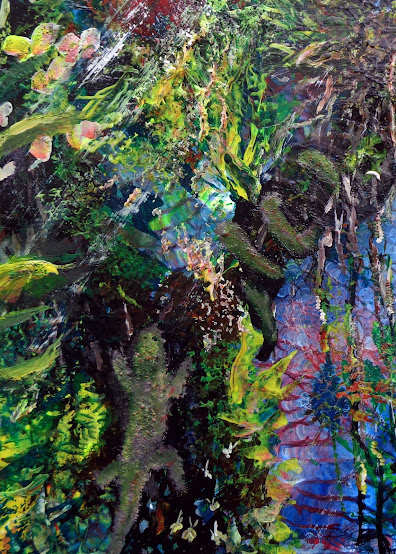
A Little Corner of Eden in acrylic, painted by Dr Abe V. Rotor (30" x 40") for the (Philippine College of Physicians) PCP Foundation Inc, founder and guardian of Dr Arturo B. Rotor Memorial Awards for Literature.

"Nature represents the idea of the entire universe in a state of perfection. Nature is one; it unites heaven and earth, connecting human beings with the stars and bringing them all together into a single family. Nature is beautiful; it is ordered. A divine law determines its arrangement - the subordination of the means to the end, and the parts to the whole. 

"I chose the tropical rainforest scenery since it is the richest of all ecosystems in the world. The Philippines, being one of the countries endowed with the natural wealth is a treasure, indeed. For this reason, I believe that, the tropical rainforest closely resembles the description of the biblical paradise. It is not only a living bank of diversity; it is the most important sanctuary of living matters on earth." - AV Rotor, The Living with Nature Handbook


"Birds sing not only for their own kind,
     but to the world that shares their joy,
in melodies notes may not capture,
     but the heart and spirit they buoy." -avr

"No one tires with the rhythm of nature – the tides, waves, flowing rivulets, gusts of wind, bird songs, the fiddling of crickets, and the shrill of cicada. In the recesses of a happy mind, one could hear the earth waking up in spring, laughing in summer, yawning in autumn and snoring in winter – and waking up again the next year, and so on, ad infinitum." - AV Rotor, Listen to the Music of Nature!

                              The Forest - Living World in Microcosm

“To see a world in a grain of sand,
     And heaven in a wild flower;
Hold infinity in the palm of your hand,
     And Eternity in an hour.”
                        - William Blake, Auguries of Innocence

"This verse captures the essence of the title, The Forest - Living World in Microcosm. It condenses the universe into its elemental symbols from which we take a full view of the world we live in. It reduces the complexities and vastness of both non- living and the living world into a microcosm that is complete in itself- a plantilla of creation all contained in the hand and experienced within a lifetime." - AV Rotor, Living World in Microcosm

 
Cryptobiology and Augury

"Call it pseudoscience, but it is gaining acceptance and support from scholars and people in general, with the discovery of strange creatures like the Coelacanth. The ancient Roman religion interpreted omens from the observed behavior of birds. A white dove means “peace”. A black dove means “war”. It could also pertain to matters of the heart, relationships, luck, misfortune, death, Remember the emissary bird in the biblical Noah's Ark?  With the breakthrough in cybercommunication, it is evident that soon we will be communicating with Nature more directly, over and above fantasy and imagination. Which leads to conscientization, in the pursuit of values, truth and the ideal in protecting Nature." - AV Rotor, Cryptobiology and Conscientization


A pair of lovely parrots perched up high,
higher than the flight of butterfly;
aimlessly below many a passerby
just let the world go with a sigh.

 
It is estimated that more than half the species of plants, animals and protists live in the tropical rainforests. Imagine a single tree as natural abode of ferns, orchids, insects, fungi, lichens, transient organisms - birds, monkeys, frogs, reptiles, insects and a multitude more that escape detection by our senses. 

  
Orchids, Family Orchidaceae, is one of the two largest families of flowering plants, with about 28,000 species, and with more constantly discovered. Orchids make up 6 to 11 percent of all species of seed plants, and are the most advanced in the Plant Kingdom, occupying the top position in the phylogeny and evolution of plants. 

Orchids:
white, delicate, immaculate, pure;
red, flaming, romantic, demure;

Orchids:
flowing, silky, translucent, queenly;
fiery, ascendant, stout, kingly.

Orchids:
endearing, fancy, coy, culpable;
ephemeral, magical, lovable.

* Verse and drawing in pastel by Anna Christina, author's daughter, an enthusiast in the arts, assisted in conducting summer art workshops for children during her student days. Cattleya, Dendrobium and Vanda are native orchids in the Philippines. These are representative images of Vanda and its variants, including Vanda merrillii var. rotorii,  named after Dr Arturo B Rotor in his honor as an orchid hobbyist. 

 
"Today, rather than defending himself against nature, 
man realized, he needed to defend nature against himself."
 - AV Rotor, Light from the Old Arch


Forest: Man's First home, Genesis' Final View

Richest in flora and fauna of all biomes,
     Big and small, in a common union,
Arranged in niches, divided by storeys,
     In competition and cooperation.

Heritage trees rise through the canopy,
     Living towers of the forest;
Divine columns of Nature's Parthenon,
     Cradle of harmony and rest.

Stories about the forest, queer but true,
     Seat of evolution, of biodiversity,
Ultimate of adventure, science laboratory,
     Man's first home, Genesis' final view.

Message of the Painting, A Little Corner of Eden 

"Quite often, images of nature enrapture us. These are reminiscences of childhood, a re-creation of a favorite spot we may have visited or seen, or products of the imagination greatly influenced by society we live in.

But the painting reflects a deep-seated biological longing to be part of nature. Putting it in the biblical sense, it is a natural searching for the lost paradise. The scenery represents a refuge from city living, a respite, and an escape from the daily grind.

But the scenery does not only tell us of what we are missing.  Rather, it reminds us of  what we are going to miss, perhaps forever, if we do not heed nature's signal towards a fast declining ecosystem.  If we do not change our way of life from too much dependence on consumerism, to one more closely linked to conservation of nature, we may end up building memories and future archives of a lost world. " - AV Rotor

          A Little Corner of Eden

If I were to return after the Fall
To where my forebears once lived;
If I were to trace back their footsteps
To their world of make believe.

What would I tell to my dear Creator
Whose open arms have waited so long
For man to return, to repent for his Sin -
And I, having also failed all along?

I would tell Him there is also a place,
A little green corner of grass and trees,
Of bees and flowers, rainbow and butterflies,
Where birds come and sing with the breeze.

An emerald river gently flowing,
Meandering between hills and on the plain,
Palms and trees bowing at its levees,
Its waters soothing the day's pain.

I would tell Him of this place also forgotten,
Abandoned by a bandwagon,
By those who nurture the Utopian dream,
Now orphaned and virtually alone.

Is forgetfulness also Your tool of creation
Where man shall be gone from here on?
Paradise is redeemed and once more born?
No wonder Nature triumphs when left alone.~

* Painting is a humble expression of thanks, from Dr Abe V Rotor and family, to the Philippine College of Physicians (PCP Foundation Inc., ), for establishing and conducting the yearly literary contest under the Dr Arturo B Rotor Memorial Awards for Literature. ~

Tuesday, September 23, 2025

Paradise Lost in Our Midst

Paradise Lost in Our Midst 

“All is not lost, the unconquerable will, and study of revenge, immortal hate, and the courage never to submit or yield.” ― John Milton, Paradise Lost

Dr Abe V Rotor

       The endangered Philippine deer enshrined in a fountain at UST, Manila. 
Photo by the author
Skull of whale (Museum of Natural History, UPLB Laguna); whole trunks 
of forest trees carried down by flood on Fuerte Beach, Ilocos Sur 
 Cattle ranch on a steep slope, ripped skin 
of Cordillera mountain, Santa, Ilocos Sur. avr
  Sunken town of Pantabangan, Nueva Ecija, resurfaces during 
an extreme drought in 1979.  Photo by the author on a helicopter
Sunken pier, Puerto Sto Domingo, Ilocos Sur, photo avr. 
                                           Shipwreck, Tacloban, Leyte. photo avr
 
 Ruin of Intramuros, Manila, left by WWII 60 years after. avr
 Death of trees and forests is happening all over the world. avr
 Berlin wall falls, Germany is united again in 1989, after 45 years. Internet
"The time has come now, when man must give up war. It is no longer rational 
to solve international problems by resorting to war."  - Albert Einstein

                     
Atomic bomb obliterates Hiroshima and Nagasaki cities on August 6 and 9, 1945, 
 ends WWII, kills more than 200,000 mostly civilians. Internet photos

“Long is the way and hard, that out of Hell leads up to light.”
― John Milton, Paradise Lost

Monday, September 22, 2025

Perk up your life with Wit and Humor

Perk up your life with Wit and Humor
Researched and organized by Dr Abe V Rotor

A little girl approached a great concert violinist after his performance as he was leaving the concert hall and asked him for an autograph.
“I’m sorry,” said the maestro, “but my hands are so very tired from playing.”
“My hands are tired, too,” said the little girl, “and they’re tired from applauding.”

The police sent out pictures of an escaped convict in six different poses. A constable sent the following wire: “Have captured five of them and on trail of the sixth.”

FISHERMAN: "I tell you it was THAT long!  I never saw such a fish."
FRIEND: "I believe you."  

Saint Peter stopped a man who knocked at the Gates of Heaven.
“You have told many lies to get in here,” said the Keeper of the Keys.
“Have a heart, Saint Peter,” said the new arrival. “You were a fisherman once yourself.”

HE: “What was the name of the hotel we stopped at in Detriot?”
SHE: “Wait, I’ll look through my towels.”

WIFE: “A letter came for you today marked ‘private and personal.’”
HUSBAND: “What did it say?”

Her husband can always find the liquor, no matter where his wife hides it. He has a fifth sense.

ANGRY WIFE: “What would you men have today if woman had never been created?”
PLACID HUSBAND: “One more rib.”

You should file your income tax, not chisel it. (Or cut it.)

“What do you mean, you have nothing to live for?” a wife asked her despondent husband. “The house isn’t paid for, the car isn’t paid for, the TV isn’t paid for…”

A father was telling a neighbor how he stopped his son from being late to high school. “I bought him a car,” he said.
“How did that stop him from being late?” the neighbor asked.
“Why, he’s got to get there early to find a parking place.”

Two little girls were in danger of being late for school.
“Let’s stop and pray for God to get us there on time,” said one.
“No, better than that,” said the other, “let’s run with all our might, and pray while we’re running.”

--------------
Acknowledgement with gratitude: Speaker's Encyclopedia of Humor by Jacob M Braude Prentice-Hill; Internet cartoon images

Saturday, September 20, 2025

Beginners' workshop: Let's paint a landscape

 Beginners' workshop: 
Let's paint a landscape
“Some painters transform the sun into a yellow spot, 
others transform a yellow spot into the sun.” Pablo Picasso

Dr Abe V Rotor
Art workshop instructor

 Waterfall  in acrylic AV Rotor 2025 

Yes, you can paint.
  1. Use simple and local materials and tools.
  2. Get from a hardware store brushes and latex paints.
  3. Stretch canvas on homemade frame, or use plywood or cardboard.
  4. You need only the 3 primary colors: yellow, blue, red.
  5. With white you can make all colors, hues and shades you need.
  6. Use water as medium - sprinkle or spray sparingly as needed.
  7. Have a handy mixing board, and save it for succeeding sessions.
  8. Blue and yellow makes green; yellow and red, orange; blue and red, brown.
  9. Blue and white, sky blue; red and white, pink; yellow and white, lemon.
  10. Secondary to tertiary colors: try green and white, brown and white, etc.
  11. Black is made by mixing the 3 primary colors in equal amounts.
  12. Work spontaneously and freely with these colors you produced.
  13. Paint light colors first, dark colors follow, based on your subject.
  14. Relax, rest when needed. Painting is a hobby, leisure, and not work.
  15. View your work, now and then, near and far. Paint independently. 

 Cumulus cloud turns nimbus. 

Be creative 
  1. On-the-spot painting is best at appropriate place and time.
  2. Art is creativity where imagination prevails over conventional attention.
  3. For example, clouds are everchanging.  Explore and capture the best scenery. 
  4. Art is theory, your work is subjective.  Art is freedom of expression.
  5. But be keen of the basic elements of art like perspective and balance.  
 
Rain falls on the watershed, in turn makes the waterfall alive.

Details 
  1. Details gradually give flesh and shape to your painting..
  2. A landscape you have visited or seen leaves an imprint.  
  3. Blend this with the present scene on the spot.
  4. Or recall it as impression, and try to reconstruct it.
  5. Details may be vivid or basic. Only you can tell your painting is finished
Waterfall - link of sky and stream, to sea

Impact and Message
  1. Art arouses the senses: a waterfall roars, stream talks as it flows, rocks fall and tumble, breeze whispers, birds sing, etc.
  2. Air is fresh, clouds are soft to the touch, water cool and pure.
  3. All these make your painting alive. You are conveying a message to your viewers.
  4. Make them read your mind, feel your feelings, share your philosophy of life. ~
Complete the scenery:
  1. Birds in the sky, migrating, hovering, roosting
  2. Signs of rain.  Where does a rainbow fit?
  3. Rays of light through the sky reach the ground.
  4. Kids fishing, hiking, climbing.  A family picnic.
  5. Trees and wildlife, far and closeup views. 
And more. 

What is commonly called ugliness in nature can in art become full of beauty.” - Auguste Rodin

Friday, September 19, 2025

Harmony of Nature and Human Music: Where there is Harmony, there is Peace.

         Harmony of Nature and Human Music

Where there is Harmony, there is Peace.

Dr Abe V Rotor

Singing cicadas.  How many are they in this photo? Only the male sings and attracts the female. A beautiful song brings in two or more potential mates such as the case in this photo. 

 
Katydid, (left) a long horned grasshopper (Phaneroptera furcifera), and the field cricket (Acheta bimaculata) are the world's most popular fiddlers in the insect world.

Identify the sounds of nature in this painting, translate them into notes. Arrange the notes into melody, and expand it into a composition. Try with an instrument - guitar, piano, violin, flute. This is your composition.

                                     The Sound of Nature in acrylic by AV Rotor

Ethnic music makes a wholesome life; it is therapy.

Have you ever noticed village folks singing or humming as they attend to their chores? They have songs when rowing the boat, songs when 
planting or harvesting, songs of praise at sunrise, songs while walking up and down the trail, etc. Seldom is there an activity without music. To them the sounds of nature make a wholesome music.

According to researcher Leonora Nacorda Collantes, of the UST graduate school, music influences the limbic system, called the “seat of emotions” and causes emotional response and mood change. Musical rhythms synchronize body rhythms, mediate within the sphere of the autonomous nervous and endocrine systems, and change the heart and respiratory rate. Music reduces anxiety and pain, induces relaxation, thus promoting the overall sense of well being of the individual.


         Can you hear the music of nature in each scene? Paintings by the author.
                                  Write the song and lyrics of each scene. 
                             
Music is closely associated with everyday life among village folks more than it is to us living in the city. The natives find content and relaxation beside a waterfall, on the riverbank, under the trees, in fact there is to them music in silence under the stars, on the meadow, at sunset, at dawn. Breeze, crickets, running water, make a repetitious melody that induces sleep. Humming indicates that one likes his or her work, and can go on for hours without getting tired at it. Boat songs make rowing synchronized. Planting songs make the deities of the field happy, so they believe; and songs at harvest are thanksgiving. Indeed the natives are a happy lot.

Farm animals respond favorably to music, so with plants.

In a holding pen in Lipa, Batangas, where newly arrived heifers from Australia were kept, the head rancher related to his guests the role of music in calming the animals. “We have to acclimatize them first before dispersing them to the pasture and feedlot.” He pointed at the sound system playing melodious music. In the duration of touring the place I was able to pick up the music of Mozart, Schubert, Beethoven and Bach. It is like being in a high rise office in Makati where pipe in music is played to add to pleasant ambiance of working. Scientists believe that the effect of music on humans has some similarity with that of animals, and most probably to plants.

Which brings us to the observation of a winemaker in Vienna. A certain Carlo Cagnozzi has been piping Mozart music to his grapevines for the last five years. He claims that playing round the clock to his grapes has a dramatic effect. “The grapes ripen faster,” he said, adding that it also keeps away parasites, fruit bats and birds. Scientists are now studying this claim to enlarge the limited knowledge on the physiological and psychological effects of music on plants and animals.

Once I asked a poultry raiser in Teresa, Rizal, who also believes in music therapy. “The birds grow faster and produce more eggs,” he said. “In fact music has stopped cannibalism.” I got the same positive response from cattle raisers where the animals are tied to their quarters until they are ready for market. “They just doze off, even when they are munching,” he said, adding that tension and unnecessary movement drain the animals wasting feeds that would increase the rate of daily weight gain. In a report from one of the educational TV programs, loud metallic noise stimulates termites to eat faster, and therefore create more havoc.

There is one warning posed by the proponents of music therapy. Rough and blaring music agitates the adrenalin in the same way rock music could bring down the house.

The enchantment of ethnic music is different from that of contemporary music.

Each kind of music has its own quality, but music being a universal language, definitely has commonalities. For example, the indigenous lullaby, quite often an impromptu, has a basic pattern with that of Brahms’s Lullaby and Lucio San Pedro’s Ugoy ng Duyan (Sweet Sound of the Cradle). The range of notes, beat, tone, expression - the naturalness of a mother half-singing, half-talking to her baby, all these create a wholesome effect that binds maternal relationship, brings peace and comfort, care and love.
Serenades from different parts the world have a common touch. Compare Tosselli’s Serenade with that of our Antonio Molina’s Hating Gabi (Midnight) and you will find similarities in pattern and structure, exuding the effect that enhances the mood of lovers. This quality is more appreciated in listening to the Kundiman (Kung Hindi Man, which means, If It Can’t Be). Kundiman is a trademark of classical Filipino composers, the greatest of them, Nicanor Abelardo. (PHOTO elow) His famous compositions are

· Bituin Marikit (Beautiful Star)
· Nasaan Ka Irog (Where are You My Love)
· Mutya ng Pasig (Muse of the River Pasig)
· Pakiusap (I beg to Say)

War drums on the other hand, build passion, heighten courage, and prepare the mind and body to face the challenge. It is said that Napoleon Bonaparte taught only the drumbeat of forward, and never that of retreat, to the legendary Drummer Boy. As a consequence, we know what happened to the drummer boy. Pathetic though it may be, it's one of the favorite songs of Christmas.

Classical music is patterned after natural music.

The greatest composers are nature lovers – Beethoven, Mendelssohn, Chopin, Rachmaninoff, and our own Abelardo, Molina, Santiago, and San Pedro. Beethoven, the greatest naturalist among the world’s composers was always passionately fond of nature, spending many long holidays in the country. Always with a notebook in his pocket, he scribbled down ideas, melodies or anything he observed. It was this love of the countryside that inspired him to write his famous Pastoral Symphony. If you listen to it carefully, you can hear the singing of birds, a tumbling waterfall and gamboling lambs. Even if you are casually listening you cannot miss the magnificent thunderstorm when it comes in the fourth movement.

Lately the medical world took notice of Mozart music and found out that the music of Wolfgang Amadeus Mozart PHOTO) music can enhance brain power. In a test conducted, a student who listened to the Sonata in D major for Two Pianos performed better in spatial reason. Mozart music was also found to reduce the frequency of seizure among coma patients, improved the interaction of autistic children, and is a great help to people who are suffering of Alzheimer’s disease. The proponents of Mozart’s music call this therapeutic power Mozart Effect.

What really is this special effect? A closer look at it shows similar therapeutic effect with many sounds like the noise of the surf breaking on the shore, rustling of leaves in the breeze, syncopated movement of a pendulum, cantabile of hammock, and even in the silence of a cumulus cloud building in the sky. It is the same way Mozart repeated his melodies, turning upside down and inside out which the brain loves such a pattern, often repeated regularly. about the same length of time as brain-wave patterns and those that govern regular bodily functions such as breathing and walking. It is this frequency of patterns in Mozart music that moderates irregular patterns of epilepsy patients, tension-building hormones, and unpleasant thoughts.

No one tires with the rhythm of nature – the tides, waves, flowing rivulets, gusts of wind, bird songs, the fiddling of crickets, and the shrill of cicada. In the recesses of a happy mind, one could hear the earth waking up in spring, laughing in summer, yawning in autumn and snoring in winter – and waking up again the next year, and so on, ad infinitum. ~

And, of course the Caruso PHOTO in the animal kingdom - the frog. Here a pair of green pond frogs, attracted by their songs which are actually mating calls, will soon settle down in silent mating that last for hours.~

“The earth has music for those who listen.”- George Santayana