Thursday, October 24, 2024

Old Folks' Science - or Superstition?

                 Old Folks' Science - or Superstition? 

Conceiving mothers eat twin bananas in order to give birth to a twin.
 Dr Abe V Rotor

Which is which? Find out the answer at the end of this test.
 
1. Kapre (ogre) lives on old trees; dwende (dwarf) lives among mushrooms.

2. Raining while the sun is out breeds insects.

3. You know how big ube (Dioscorea alata)  tuber is by its mound on the ground.


4.Karurayan na dumalaga (all white female fryer) is best food for a recuperating patient.

5. Swarming of winged termites and ants predicts siyam-siyam (18 days of uninterrupted rainfall)

6. Red sky in the west means a typhoon is coming.


7. When you break a drinking glass, take another and break it too, to break the omen.


8. Jackfruit or Nangka may bear fruit from its roots underground.
Fruit laden nangka.  Agoo, La Union

9.When a spoon is accidentally dropped, a female guest is coming. If fork, a male guest.


10. When buying watermelon, choose that which has wide spaces between the “ribs.” It is more fleshy and sweet.

11. Actually you can hear the earth breath on a quiet summer night.


12. Predominance of cogon grass (Imperata cylindrica) means the land is not suitable for  farming.


13. Snake means good luck; monitor lizard bad luck.


14. Oranges with indented bottom are sweeter.


15. Powdered rhino horn is medicine and aphrodisiac.


16. Worms (fly maggots) improve the taste of bagoong or patis. (fish sauce)


17. Just wipe kitchen table and sink with mild vinegar to drive ants away.


18. Large and round macopa contains seeds, so with lanzones (Lansium domesticum).


19. Prune standing corn plants of their tassel (male flower), in order to get fuller cobs.


20. There are people who cook ampalaya (Momordica charantia) which tastes more bitter.


21. A brooding animal, like snake, is ferocious.

22. Guava seeds may cause appendicitis


23. Ginseng increase human virility or has aphrodisiac property.


24. Cut the leaves (pruning) of rice seedlings before transplanting in the field to make them grow faster and bigger.


25. Conceiving mothers eat twin bananas in order to give birth to a twin.


26. During full moon crabs are lean.


27. Phases of the moons influence behavior (lunatic effect).


28. Gate must not face directly the dead-end of a road.


29. Planting cassava stem upturned will produce poisonous tuber.


30. Ring around the moon means a storm coming.


31. When you got a fishbone stuck in the throat, get the cat and gently rub its paws around the affected area.

32. Never allow a conceiving mother to get near a fruiting tree, else the fruits will fall prematurely.


33. Beware! Dogs can detect a dog eater. He is prune to dog bite or even a pack attack. 


34. Food offering at the family altar during festivals is homage to the spirits

35. Say tabi-tabi when entering a thicket.

36. Put sugar as fertilizer to get sweeter fruits.


37. Some people suffer body aches before a typhoon brews near.

38. When walking through a forest, wear a face mask backward to ward of tiger or lion attack.


39. When harvesting the first fruits, get an oversize basket and pretend that the harvest is heavy.


40. Expect rain if hordes of dragonflies hover low.


41. Size and shape of lips of a woman reflects her private organ.


42. Get male flower and introduce it into the female flower to enhance the fruit to develop.


43. Crickets are noisiest in summer.


44. When transplanting banana tiller take out the eyes (young tiller buds) arising on the corm.


45. Wet your navel with the first raindrops in summer.


46. Noisy hen layers are not productive layers.


47. Roosters do sometimes lay eggs which are very small and sterile.


48. Throw sand into axils of coconut leaves to prevent beetle attack


49. Black cat bring bad luck when you meet them on the corridor or street.


50. Salaksak or kingfisher means death.


ANSWERS: False answer to 7,8,9,11,13,16,22,25,28,29,31,32,34,35,36,39,41,45 and 47.
Reference: Living with Folk Wisdom by AV Rotor, UST Publishing House EspaƱa, Manila. Book available at National Book Store, and UST Publishing House.

RATING: 46-50 Outstanding. You must be one of the old folks.
41-45 Very Good . You must be living with old folks.
36-40 Good. You have a good grasp of tradition
31-34 Fair. You are not really moving away from tradition.
30 and below. Read more about old folks' science and superstitious beliefs.

Halloween: Mysterious hand reaches out for the moon

 Halloween: Mysterious hand reaches out for the moon 

Smog draws figures in the night sky, as clouds make images in the day sky.

 Dr Abe V Rotor

Photo by Marlo R Rotor, Halloween 2008

The sun has long bid goodbye.
A mysterious hand rises in the sky.
The moon is still. Darkness sets in.
It's the ghost of Halloween.~

Bromeliads form a unique aerial ecosystem

  Bromeliads form a unique aerial ecosystem

Dr Abe V Rotor

Bromeliads include the pineapple (Ananas comosus), 
the only edible member of Family Bromeliaceae.


Brightly colored false petals of bromeliad attract insects and other organisms to fertilize its shy, short-live flowers. The bright pseudo flowers serve as markers in the dense and vast forest high up in the trees. Here bromeliads form colonies with connecting rhizomes, and with other epiphytes - ferns, orchids and lianas - make a unique aerial ecosystem. 


Domesticated bromeliads are popular ornamental plants in gardens and around homes. One disadvantages though is that it becomes a breeding place of mosquitoes and other vermin. It is because we have detached them from their natural habitat where they are part of a complex food web. Here mosquito wrigglers are preyed upon by naiads of Odonatans (dragonflies and damselflies), while the adults are trapped in spider webs. Tree frogs have their fill of flies and other insects.  Fish live in the axil ponds and can even transfer to nearby bromeliads and even to the water below to hunt and to mate.  While reptiles occupy the top of the food pyramid, hawks and eagles come to prey on them. Like a chain, just one link broken, and the system fails. 


Bromeliads, which includes the pineapple (the only edible member in the family), are nature's reservoir of miniature ponds that provide abode to many organisms from insects to fish. The central receptacle collects water from dew and rain which spills over to the adjoining leaf axils, making a continuous pond. The sequence, like a series of terraces, makes water collection and retention efficient, giving chance for the various resident organisms to complete - and repeat - their life cycles. And for transient organisms to have their regular visit.

In this pond system, detritus accumulates and fertilizes the bromeliad as well as other plants around and below it, including its host tree, in exchange for its foothold and other benefits. And being epiphytic and colonial in growing habit on trunks and limbs of trees, bromeliads  form a unique aerial ecosytem other epiphytes, and the surrounding trees.~    

Monday, October 21, 2024

Treaty of Man and Nature

Treaty of Man and Nature
A proposed legal and governance framework that considers the interconnections between humans and nature. It's based on scientific and ethical advances about natural systems and species. The rights of nature concept is rooted in traditional indigenous knowledge.
Dr Abe V Rotor

Frantic exploitation of natural resources through illegal logging operations, followed by slash-and-burn agriculture (kaingin), has brought havoc to the Philippines in the past century. The detrimental results are measured not only by the denudation of once productive forests and hillsides, but also destruction through erosion, flood, drought and even death.

An example of this kind of ruination brought about by abuse of nature is the tragedy in Ormoc City where floodwaters cascading down the denuded watershed, killed hundreds of residents and countless animals. It took ten years for the city to fully recover. Ironically, before the tragedy, Ormoc, from the air, looked like a little village similar to Shangri-La, a perfect place for retirement.

Decline in Carrying Capacity

A land area designed by nature to sustain millions of people and countless other organisms, was touched by man and we are now paying the price for it. Man removed the vegetation, cut down trees for his shelter and crafts, and planted cereals and short-growing crops to get immediate returns. He hunted for food and fun, and in many ways, changed the natural contour and topography of the land.

Following years of plenty, however, nature reasserted itself. Water would run unchecked, carrying plant nutrients downhill. On its path are formed rills and gullies that slice through slopes, peeling off the topsoil and making the land unprofitable for agriculture. Since the plants cannot grow, animals gradually perish. Finally, the kaingero abandons the area, leaving it to the mercy of natural elements. It is possible that nature may rebuild itself, but will take years for affected areas to regain their productivity, and for the resident organisms once again attain their self-sustaining population levels.

There are 13.5 million square miles of desert area on earth, representing a third of the total land surface. This large proportion of land may be man-made as history and archeological findings reveal.

Lost Civilizations

Fifteen civilizations, once flourished in Western Sahara, Tunisia, Libya, Egypt, the Sinai desert, Mesopotamia, and the deserts of Persia. All of these cultures perished when the people of the area through exploitation, forced nature to react. As a consequence, man was robbed of his only means of sustenance.

History tells us of man’s early abuse of nature in the Fertile Crescent where agriculture began some 3000 years ago. Man-made parallel canals joined the Tigris and Euphrates Rivers to irrigate the thirsty fertile valley. In the process, the balance of Nature was overturned when the natural drainage flow was disturbed. Because the treaty was violated, nature revenged. The canal civilization perished in the swamps that later formed. The sluggish water brought malaria and other diseases causing untold number of deaths and migration to the hinterlands. Among its victims was Alexander the Great.

Carthage had another story. Three wars hit Carthage, known as the Punic Wars. On the third one, the Romans plowed through the city, ending reign of this erstwhile mercantile power, and removing the threat to the Roman economy. After the conquest, the Romans pumped salt-water inland and flooded the fertile farms. Today, Carthage exists only in history and in imagination of whoever stands atop a hill overlooking what is now a vast desert.

Omar Khayyam, if alive today, cannot possibly compose verses as beautiful as the Rubaiyat as written in his own time. His birthplace, Nishapur, which up to the time of Genghis Khan, supported a population of 1.5 million people, can only sustain 15,000 people today. Archeologists have just unearthed the Forest of Guir where Hannibal marched with war elephants. The great unconquerable jungle of India grew from waterlogged lowland formed by unwise irrigation management.

It is hard to believe, but true that in the middle of the Sahara desert, 50 million acres of fossil soil are sleeping under layers of sand awaiting water. Surveyors found an underground stream called the Albienne Nappe that runs close to this deposit. Just as plans were laid to “revive” the dead soil by irrigation, the French tested their first atomic bomb. Due to contamination, it is no longer safe to continue on with the project.

The great Pyramids of Egypt could not have been constructed in the middle of an endless desert. The tributaries of the Nile once surrounded these centers of civilization. Jerusalem appears today as a small city on a barren land. It may have been a city with thick vegetation. This was true of Negev and Baghdad.

Need of a Conservation Program

For the Philippines, it is high time we lay out a long-range conservation program to insure the future of the country. This plan should protect the fertility of the fields, wealth of the forests and marine resources, in order to bring prosperity to the people. As of now, the country is being ripped apart by erosion and floods due to unscrupulous exploitation by loggers and kaingeros.

It is only through proper management and effective conservation, such as reforestation, pollution control, erosion control, limited logging, and proper land use, that we can insure the continuity of our race. All we have to do is to keep ourselves faithful to the treaty between nature and man. ~ 
Acknowledgement: Internet photo

Sunday, October 20, 2024

Beware of Food Dyes

Beware of Food Dyes

(Original title: Beware of Food Colors)
Dr Abe V Rotor

Food dyes in drinks and food.

The case of jubos in tamarind sweet.

All of a sudden when answering the call of nature, I was alarmed to see the color of my urine bright red. I cried, Blood! I tried to compose myself to be able to reach the hospital in the earliest possible time. But what surprised me at the same time was that my fingers were also stained red. I examined the “tamarind sweet” I had eaten. I found the culprit - Jubos, the dye used in dying shoes. Jubos may be used to color local confectionery. How many food preparations are artificially colored for better presentation?

Since that time on I have been very careful with colored foods. Ube cake, anyone?

These are things to remember about food dyes, specially if you suspect of a food or drink to be colored artificially.

• Be familiar with the natural colors of fruits and other food products. There are rare ones though. For example, purple rice cake (puto) comes from a variety pirurutong or purple rice. Ordinary rice flour and ube flour produce the same color. This can be imitated with the use of purple dye.

• Processed foods like smoked fish and ham are colored, usually golden yellow, to be attractive.

• Confectionery products are made to appear like cocoa, coffee, orange, strawberry, grapes and the like, when in fact the ingredients are mainly sugar artificial flavors and food dyes.

• Fruit juices carry dyes to enhance their natural colors. Example, calamansi juice is made to appear like lemon or orange. Soft drinks would look dull and unattractive without artificial colors.

• Cakes and other bakery products may deceive the eye and even the palate. Cake decors are definitely made of food dyes of many colors and different color combinations.

• Artificial colors are filtered by our excretory system so that they appear in the urine. This is not the case of natural colors such as achuete or anatto (Bixa orellana), pandan (Pandanus odoratissimus), ube (Dioscorea alata), and mango (Mangifera indica).

Harmful effects of food dyes 
  • Neurotoxicity (damaging to nerve tissue)
  • Carcinogenicity (linked with cancer)
  • Genotoxicity (damaging to chromosomes)
  • Hyperactivity in children
  • Allergic reactions (such as hives and asthma)
  • Possible DNA damage
Reference: Living with Nature Book Series, AVRotor: Internet 
---------------------------


An Educational Tour at the Living with Nature Center, San Vicente, Ilocos Sur (9 Articles)

An Educational Tour at the Living with Nature Center
San Vicente, Ilocos Sur

Part 1 - Art Gallery and Museum
UNP Coeds Visit the Living with Nature Center
and San Vicente Botanical Garden

Dr Abe V Rotor

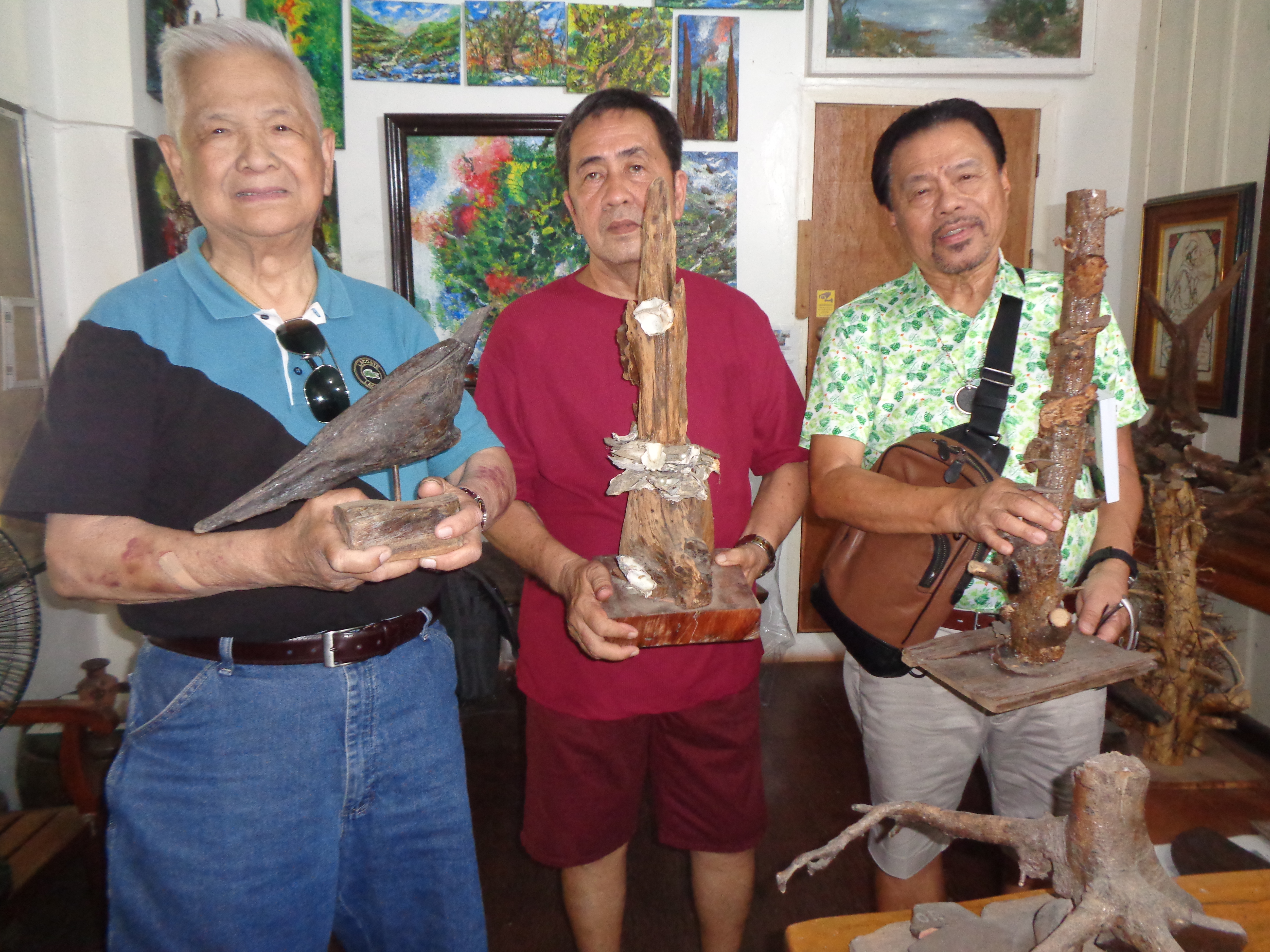
Nature's art. A driftwood in the shape of a blackbird,
reminiscent of Noah's Ark story - an emissary he sent to check the flood but didn't return. He sent another, this time a dove, the universal symbol of peace today.

Catch the fish if you can on the wall, painted into a mural depicting
the enigma of the bottom of the sea, for lack of knowledge seemingly
lifeless, yet full of life and challenge to the scientist.

 
Springs and waterfalls gently flowing open like curtain of a stage
revealing a beautiful landscape, subject of poetry, music, myths
and legends.

 
Painted broken jars given a second life, function to aesthetics, in our search for beauty and meaning of material things in our wastefulness and affluent living - brokenness after all is transformation, so with life.

 
Petrified wood of a primitive tree traces path of evolution and biodiversity; pyroclastic rock from Mt Pinatubo's 1991 eruption, link of past and present, reality and fantasy, nature and man.

 
A dragon emerges from a broken jar transforms into a myth in like manner dragons once walked the earth; burial jar fragments of an indigenous culture destined to the museum and archive.

 
UNP Coeds 5 trek the edge of the sea; frame a wall of cataract in
make-believe mural painted by the author. ~

Part 2 - The Living with Nature Center Library
Collection of Books and References


Part 3 - Rock Collection: Study and Hobby

Petrified or fossilized wood. Carbon dating process traces
the origin, age, and habitat of the specimen.

Resin, exudate of Pine tree undergoing metamorphism into amber

Aggregate rocks in various compositions and structures.

Unidentified layered rock, indicating geologic
history.

This is not a fossil, but broken glazed jar often used to store sacred
objects and remains, like an urn in earlier times.

Soft wood fossil broken into two to find out what is really its interior made of.

Not so perfectly round but it served as canon ball in early times.
Picked from a dry river bed, this specimen is a result of continuous
and even abrasion as it travelled downstream.


Limestone undergoing metamorphism into marble which
may take a very long time under favorable conditions.

Rock collection of a student attracted by the diversity of the specimens.

Brain coral in its early stage of fossilization.

Operculum of a large seashell undergoing erosion by the elements.
Note the counterclockwise spiral, a unique find.

Shades of opal and glitter often make this petrified wood look
valuable when cut and polished, and made into fancy jewelry.

This chalky fossil looks like elephant's task.
Did elephants roam the countryside in prehistoric times?

Early stone age tools, crude and unpolished,
but they served the purpose of hunting.

Mt Pinatubo's pyroclastic rock mounted for the museum.
The rock formed while still very hot, forming a porous texture. ~

 
Floral arrangement of stones gathered from Bacnotan, La Union beach.

A collection of rock samples at author's home.

Part 4 - Lectures, Workshops and Researches


Part 5 - Botanical Garden and Ecological Sanctuary


Part 6 - Icons in the Garden

 
Rizal in Dapitan Shrine
The national hero as biologist and naturalist while he was
on exile at Dapitan.

 
Apo Baket' Shrine
Holder of time-honored tradition and values, passed on
from generation to generation.

 
The Unknown Nanny Shrine
A nanny works with babies, toddlers, and young children, focusing on their basic care needs and supporting their development. Her role in wartime is crucial to orphaned children and widowed mother. Throughout history the unknown nanny who is also considered on a higher scale governess is considered guardian and second mother in the home. In times of war she is the unsung domestic hero so to speak, like the Unknown Soldier in the battlefield.

 
Emilio Aguinaldo Shrine Emilio Aguinaldo fought for a free and independent Philippines, first against Spain and then against the United States. When the Philippines declared itself an independent republic in 1898 and Aguinaldo became its president, a significant milestone was reached in the struggle against colonial rule in Asia.

 
Apparition of Mary before Bernadette at Lourdes
Our Lady appeared to 14-year-old Bernadette Soubirous in Lourdes, France, 18 times from February through July, 1858. During the apparitions she told Bernadette to dig a hole which later in the day produced a stream of water, bringing about thousands of spiritual and physical cures even to this day. Replica of the grotto dedicated to the 1917 Marian Apparition that took place in Fatima, Portugal, in loving memory of the author's sister, Sr Venie V Rotor, ofs.

Part 7 - Features of the Living with Nature Center
Rotor Family Home
San Vicente, Ilocos Sur
Contact: Dr Abercio V Rotor avrotor.blogspot.com

1. Renovated old home (survived typhoons, earthquakes, other calamities, WWII) for four generations.

2. San Vicente Botanical Garden – living gene bank, shrine, outdoor classroom.

3. Living with Nature (Center), advocacy, hands-on, on-site learning

4. Community-based (visits, tours, workshops, research, practicum)

5. Refuge (respite, retirement, recuperation, balikbayan, childhood experience)

6. EcoSanctuary - Wildlife habitat, orchard, open field, local ecosystems

7. Natural for healthy and happy living (food, air, herbals, pets, sense of freedom)

8. Family museum (library, archive, souvenirs, achievements, paraphernalia)

9. “The Morning After Syndrome” - preparedness for the worst upheaval (COVID-19)

10. Exodus from the City (reversal from traffic, congestion, high cost of living)

11. Right brain shift (creativity, hobbies, nature-friendly)

12. Integrated and holistic (The Humanities, back-to-basics, skills development)

13. You are not alone (“So far yet so near,” the world at the living room)

14. Ecological prayer (Love God through Nature, Nature is God’s greatest gift)

15. Don’t be a victim of Instant Syndrome (DiY, home garden, cookbook)

16. Save, save from impulse buying, planned obsolescence, ostentatious living.

17. Be simple and practical (countryside living, bayanihan, kamag-anak)

18. The golden years of life (It’s not too late, you are missing life itself)

19. Yes, you can paint, cook, build your home, do the things you dreamed of.

20. Search for the meaning of life (Learn from Victor Frankl, Schweitzer, Rizal)

Globally linked on the Internet avrotor.blogspot.com in 5000 articles to date. Search topic, download, print for your educational use in your school, community, and organization. Linked with 12 books written by AV Rotor, Bannawag magazine, (Okayka Apong), other websites. Welcome to the Living with Nature Center and San Vicente Botanical Garden. Contact - 09954672990

Part 8 - Research Topics for Thesis, Dissertation, Special Problem, and Practicum


1. Displaced People and Communities
2. Post-Modernism in Philippine Context
3. "To conserve Nature, leave Nature alone."
4. Green Wash: Ecology's Mask
5. Globalization and Sunset of Nationalism

6. Sex tourism - how widespread is it?
7. Depression and suicide claim more affluent victims than ordinary citizens. Is this true?
8. The Disappearing Rainforest and Lost Knowledge
9. Talipapa - People's Mall
10. Changing Image of the Filipina

11. “Rent-a-uterus” (Surrogate Mothers)
12. NSTP - has it achieved its purpose?
13. Opposition to Technology
14. Reviving the Indigenous games and Sports in the Philippines
15. Pornography on the Internet

16. Divisoria - Bagsakan Capital
17. Body Beautiful trends
18. Scavengers - their Hopes and Dreams
19. The Fine Art of Propaganda
20. Homogenization and Loss of Cultural Diversity

21. Social Change and the Natural Environment
22. Age of Robotics
23. Wireless Technology: Impact on school children
24. Endangered Ecosystems
25. Social and Pandemic Human Diseases

26. High rise buildings around UST and other schools -
There ought to be a law.
27. Neocolonialism in the corporate world
28. Sari-sari store, no corner has without. So with the talipapa
29. Tricycle world - a Sub-culture. So with the korong korong
30. Phaseout the Jeepney - Rolling Coffin

31. Working students: Joys and Travails
32. Plastics are banned - ways to make the campaign effective?
33. Wanted Kidney
34. Made in China – Anticipated obsolescence
35. Unsolved killing of media men in the Philippines.

36. The problem of the new general curriculum
37. Gene Therapy: Frontier of Today’s Medicine
38. Vatican and Conservatism
39. Born to Buy (Bilmoko)
40. Natural food is in

41. China: Socialism to Capitalism
42. Relocating Marginal Communities
43. The Expanding Field of Bioethics
44. Unsung heroes
45. Philippines dubbed Rip Van Winkle of Asia?

46. Philippines tops crime rate, graft and corruption, in Asia.
47. Autotoxicity: We are poisoning ourselves
48. Natural Farming: A Return to Tradition
49. Obesity now an epidemic
50. Mind Benders (Brain Drugs)

51. One-dish Meal vs Fast Food
52. Aftermath of the Cold War
53. Unsolved Murders of Philippine Journalists
54. Life under the bridge
55. Herbal medicine – a Thing of the Past

56. Longevity Trends - Effects on Society
57. Single parenthood: Planned or Circumstance
58. Effects of TV and Computers on child development
59. The Sunset of Fine Arts
60. Sustainable Environment - what is it really?

61. Fish Kill in Laguna Bay and Taal Lake 
62. Frankenfood
63. Threatened and Endangered Species
64. Pollution-Related Diseases
65. Effect of the Ozone Hole

66. Whatever happened to Piso sa Pasig
67. Can genetic engineering save man from hunger?
68. Can man conquer aging?
69. Will man become immortal?
70. Are we in our sunset as a species?

71. Computer Addiction
72. Giant billboards - freedom of expression or violation of human rights?
73. Can man live alone, like in Castaway?
74. How many people can Metro Manila accommodate?
75. Allergy - global epidemic

76. Confession of a drug addict
77. Overcrowded prisons.
78. Child Labor: Chinese and Filipinos compared
79. Electricity is most expensive in the Philippines
80. Golden Years and Post-retirement

81. Cryonics - Man's Hope of Resurrection
82. Pet therapy
83. Third sex in the entertainment world
84. Bad advertisements in the Philippines
85. Rolling Billboards on buses

86. Tiangge and UK2
87. The New UST Campus
88. Longevity and Early Death
89. Effects of Telenobela
90. University without Walls

91. Flower shops at Dangwa, Dimasalang
92. NLEX Clover, Balintawak: bagsakan of farm products
93. Quiapo - where miracles happen, from herbal healing
to fortune telling
94. Anticipating the Big One (Earthquake Intensity 7 Plus)
95. Buhay sa Bahay Kubo


96. The Controversial K to 12 Education Program
97. Political Dynasty - A Social Hydra
98. ISIS - Radical Concept of New Nation
99. Racism is Alive
100. Deadly COVID-19, MERS-CoV, HIV and Ebola PHOTO

*Dr Rotor is a former professor UST, DLSU-D, SPU-QC, UPH-LP. He also served as research adviser and critic, and panel member in these and other institutions.

            Part 9 - Earth Day Celebration at the Garden                                      Ecology in the Unifying Element of World Peace 

Over the past decades, over 193 countries have observed the Earth Day celebration—empowering local communities, students, and governments to create a positive change for the planet, charging forward with the popular slogan, think globally, act locally. Internet
 
 
Ecological Ecumenism through Children's Art Workshop 
in expressing love and reverence in God and Nature.
Living with Nature Center, San Vicente Ilocos Sur


Art Workshop for Children before a wall mural by the author in his family
residence (Living with Nature Center) in San Vicente Ilocos Sur, 2017,