Sunday, June 19, 2022

The Lighter Side of Human Nature. The Power of STILLNESS

  The Lighter Side of Human Nature

The Power of STILLNESS

"The sun sets with the Angelus,
as creatures go to their lair,
stillness reigns in the night
until the return of light. " - avr
*
Dr Abe V Rotor

Tranquility in a Forest in acrylic by the author.

1. Stillness and Meditation
Silence, oh elusive silence,.
take me to your realm divine
where good and evil part,
that I may find a new start,
that begins in the heart.

2. Stillness and the Loving Heart
Throb oh heart, throb the magic of love,
lest desire may turn into lust,
blinding the senses in Freudian ido;
Browning, Ben Jonson, come
with your art of love on hand.

3. Stillness and the Arts
Soar into the heavens for peace and quiet,
let imagination rule over reason,
creativity reigns supreme in stillness,
spawning the great masterpieces.

4. Stillness and Scholarship
Fishing not for fish but ideas,
the rod bends, the line quivers -
a big fish bites, pulls, rages,
oh stillness, tool of the sages.

5. Stillness and the Longing Heart
When the heart throbs for someone far away,
of a place you can't go for the moment or nevermore,
of things lost and can no longer be found,
or wishing the good old days were here,
stillness, stillness must reign,
in fullness and profound.

6. Stillness and the Weary Heart 
When doubt clouds the mind and shrouds the view,
which road to take of the two,
take the less trodden, more so the fresh path;
stillness – but never the heart to a halt.

7. Stillness and the Grieving Heart
In the dark hours of life the night is long,
the dawn comes late or seems it never comes,
grief and pain they are inseparable:
the mind, body and spirit;
stillness brings back the joy and wit.

8. Stillness and the Raging Heart
When rages the heart cascading wild,
chartless in a sea of tempest,
seeing the shore no more,
stillness shall give you rest.

9. Stillness and Nature
Calm is the sea but a sleeping volcano,
the sky is blue, the river meandering to the sea,
a child of creation I'm from the stillness of the womb,
to the stillness of hereafter.

10. Stillness and Angelus
The sun sets with the Angelus,
as creatures go to their lair,
stillness reigns in the night
until the return of light. ~



Let's Develop the Less Popular Fruits in the Philippines

 Let's Develop the Less Popular Fruits in the Philippines

The truth is that, the fruit stand is a poor showroom of Philippine fruits. 

Dr. Abe V. Rotor
Living with Nature School on Blog
Visit a fruit stand. There are many kinds of fruits coming from different parts of the Philippines. They have unique characteristics in taste, which can't be compared with imported fruits. They take us to a travelogue to their indigenous sources.

Lanzones from Paete, marang from South Cotabato, pomelo from Davao, manggang kalabao from Zambales, strawberry from Baguio, "Formosa" piña from Bicol, durian from Maguindanao, dalangita from Cavite, pakwan from Candaba.

 
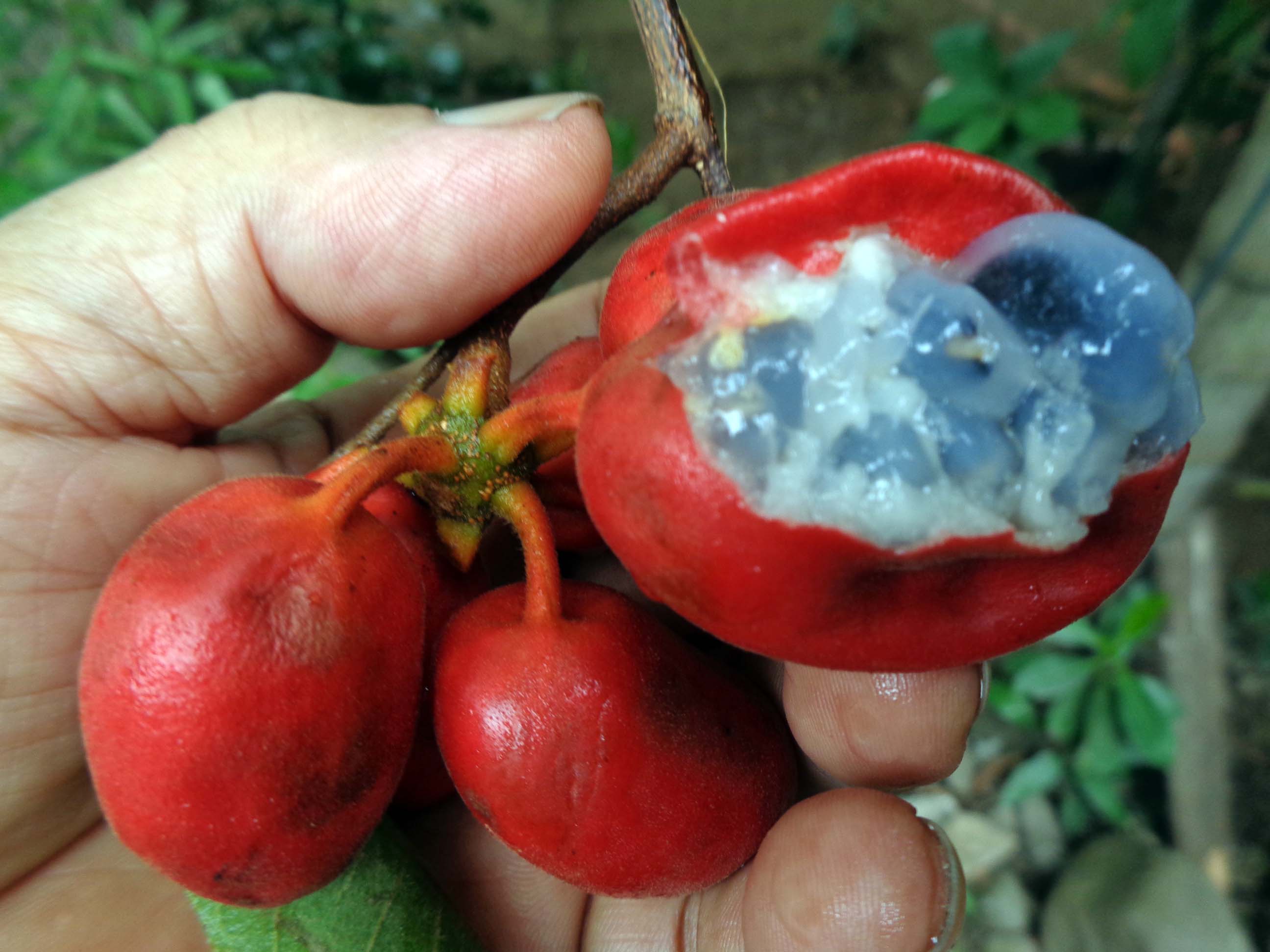
           Alagat (carabao teat fruit) - Uvaria rufa); bignay (Bugnay Ilk) - Antidesma bunius


Horticulture may have succeeded in acclimatizing several of these fruits outside of their indigenous origins, but these are inferior in taste and yield.

Lubeg (Syzygium lineatum), locally known as Malubeg and Alebadu, Family Myrtaceae

Today there is a proliferation of introduced fruits or fruits developed through hybridization. They have displaced many of our native varieties. But native chico is still sweeter than the ponderosa, native guava is sweeter and more aromatic than the guapple. The aroma of the apple mango is hardly traced to our carabao mango. And you can't make jams, jellies, pickles, wine and vinegar from them. Or it would be quite expensive to do so.

The truth is that, the fruit stand is a poor showroom of Philippine fruits. There are a lot of fruits that are not so popular for certain reasons, among them their seasonal nature and "uneconomic" market value. Simply others have not been fully explored of their potential significance.

Here is a list of the minor fruits of the Philippines, often referred to as “promising fruits” because of their great potential in agriculture and industry, for both domestic and foreign markets.

1. Atis (Anona squamosa)
2. Avocado (Persia americana)
3. Balimbing (Averrhoa carambola)
4. Kamias (Averrhoa balimbi)
5. Caimito (Chrysophyllum cainito)

6. Cashew (Anacardium occidentale)
7. Chico (Manikara zapota syn., Achras zapota)
8. Duhat (Syzygium cumini)
9. Durian (Durio zibethinus)
10. Grapes (native) (Vitis vinifera)

               Macopa - Syzygium samarangense (Family: Myrtaceae)

11. Guava (Psidium guajava)
12. Guyabano (Anona muricata)
13. Jackfruit (Artocarpus heterophyllus)
14. Lanzones (Lansium domesticum)
15. Mangosteen (Garcinia mangostana)
16. Pili (Canarium ovatum)
17. Rambutan (Nephalium appaceum)
18. Rimas (Artocarpus altilis)
19. Kamansi (A. camansi)
20. Santol (Sandoricum koetjape)

21. Siniguelas (Spondias purpurea)
22. Strawberry (Fragaria chiloensis)
23. Tamarind (Tamarindus indica)
24. Tiessa (Poteria campechiana)


Here are other noteworthy fruits.

25. Bago (Gnetum gnenum)
26. Bignay (Antidesma bunuis)
27. Biriba (Rollina deliciosa syn R. orthopetala)
28. Chico-Mamey (Pouteria sapota syn., Calocarpum sapota)
29. Datiles (Muntingia calabura)
30. Kalumpit (Terminalia microcarpa)

31. Kamachili (Pithecolobium dulce)
32. Kayam (Inocarpus eduluis)
33. Mabolo (Diospyrus blancoi)
34. Makopa (Syzygium samarangense)
35. Manzanitas (Ziziphus jujuba)


Top Left clockwise: Pomegranate, passion fruit, caimito or star apple,
 mulberry, limonsito*, bignay

36. Marang (Artocarpus pdoratoissima)
37. Passion fruit (Passiflora edulis)
38. Granadilla (Punica granatum)
39. Tampoy (Syzygium jambos), relative of duhat and macopa
40. Fig (Relative of Smyrna fig)

Many native fruits await inclusion in this list. There are those known only in a particular place, likely after their dialect names. There are species in the endangered list such assapote, anonang (a relative of the atis), karamay and batocanag. Others are growing in the wild such as paho, a wild species of mango, awaiting to be discovered.

For entrepreneurs, it is an opportunity to popularize these fruits. To the environmentalists, help save them before they finally disappear. ~

*Triphasia trifolia is a species of Triphasia in the family Rutaceae, native to tropical southeastern Asia in Malaysia, the Philippines and possibly elsewhere. Triphasias are very close relatives of citrus. 

Reference: Promising Fruits of the Philippines by Dr. Roberto E. Coronel, UPLB, Laguna.

Lesson on former Paaralang Bayan sa Himpapawid (People's School-on-Air) Dr Abe V Rotor and Ms Melly C Tenorio. 738 DZRB AM Band, 8 to 9 evening class Monday to Friday

Anecdote: Career and Patriotism

 Career and Patriotism

Researched by Dr Abe V Rotor

It is customary to conduct an informal survey on what courses senior students would pursue in college. Schools take pride of their graduates, especially their outstanding alumni.

As the school year was about to end and the members of the graduating class were very eager to enter college, the teacher a kindly old lady, asked each one what career he or she will pursue. It was a sort of open forum and the teacher emphasized the zeal of patriotism and nationalism. She premised on what one can do to a fellowman.

The first respondent, one among the top students, rose, “Ma’am, I’ll be a doctor, a physician.” To which the teacher asked the reason, “to take care of the health and to heal my sick fellowman.” The teacher smiled and nodded.

Came a hand up from behind. “And what will you become Henry?” asked the teacher.

“I’ll be a soldier, ma’am – and become a general - if I can.” “And… ,” “Ma’am, I’ll defend my fellowman, even to die for him.”

No sooner did Ma’am Lapeña see so many hands vying for the next to share. “Ma’am I’ll be an engineer. I ‘ll build farm-to-market-roads so that my fellowman would not be walking to town.”

Ma’am Lapeña was thrilled by the eagerness of her students. Wouldn’t you if you were in her shoes? They have their dreams – lofty, too. Pharmacist, pilot, scientist, biologist, meteorologist, architect, businessman, even astronaut.

Except one at a corner. His thoughts seemed very far. “How about the young man over there?” Ma’am Lapeña pointed at Juan. All heads followed.

Scratching his head he stood up, look at Ma’am Lapeña. “Yes?”

“Ma’am, simple lang, po. I like to be that fellowman.” The whole class burst into raucous laughter. The school principal who was passing by peeped and grimed, wondering.

“OK, class sit down, please everyone take your seat. Write an essay.”

“About our future careers, Ma’am? “

“No, no, about Juan, the fellowman.”

Juan Tamad is a comic character, likened to, if not worst than Rip Van Winkle who slept for twenty long tears. But we have accepted him - myth and real – erasing the guilt of pointing a person like him. To an extent, Juan Tamad jolts one from his lazy bench. One good thing about him is that, he is assumed to have no other vices. ~

Friday, June 17, 2022

Fish - Favorite Subject of Art and Philosophy

Fish - Favorite Subject of Art and Philosophy 

Dr Abe V Rotor

I walked the bridge to its far end and beyond,
And down the river to the sea I cast my pole.
It was a fight I fought, it was no longer game, 
And it was neither fish nor dream I caught.

- A V Rotor, Sunshine on Raindrops 2000

Fish Impression, acrylic on canvas by AV Rotor 

“Many men go fishing all of their lives without knowing that it is not fish
 they are after.” - Henry David Thoreau.

 
Art Workshop's  interpretation 

“Fishing is much more than fish. It is the great occasion when we may return to the fine simplicity of our forefathers.” Herbert Hoover

 
Children's interpretation with pastel colors

“Sharing the fun of fishing turns strangers into friends in a few hours.”- Eugenie Clark.

 
“Great fish do not swim in shallow waters.” -  Matshona Dhliwayo.

Thursday, June 16, 2022

I love the Hornbill (Kalaw)

I love the Hornbill (Kalaw)

"I love the hornbill for being the subject of art of the young, reborn in the heart of the new generation." - avr

Dr Abe V Rotor

Hornbill by a stream (detail of a wall mural) by the author 2015

I love the hornbill for its colorful plumage, prominent in the distance,
breaking the monotony of green foliage;

I love the hornbill for its huge bill from which it got its name - tough,
powerful, bright red with yellow and green;

I love the hornbill for its thunderous, resonating call, vibrating through
the forest, echoing on cliffs and giant trees;

I love the hornbill for its gregarious nature, faithful to its family and clan,
protective of its kind, and niche its home;

I love the hornbill for being a guardian of the forest, sentinel at all times,
and early rouser each day;

I love the hornbill for its presence - ultimate reference of an unspoiled
landscape spared from human;

I love the hornbill for being the subject of art of the young, reborn
in the heart of the new generation. ~

A pair of hornbill in pastel by Anna Christina Rotor

Wednesday, June 15, 2022

Children, Children! Love the Children

 Children, Children!  Love the Children

Children are our most valuable resource.
 — Herbert Hoover, 31st President of the United States

Photographs by Dr Abe V Rotor

“Children are great imitators. So give them something great to imitate.” — Anonymous

“Children need models rather than critics.” — Joseph Joubert, French moralist

 
“It is easier to build strong children than to repair broken men.” 
— Frederick Douglass, abolitionist and statesman

  
“The greatest legacy one can pass on to one's children and grandchildren is not money or other material things accumulated in one's life, but rather a legacy of character and faith.”   — Billy Graham, evangelist

 
Children are not things to be molded, but are people to be unfolded.”  — Jess Lair, author

“There can be no keener revelation of a society’s soul than the way in which it 
treats its children.”  — Nelson Mandela, Former President of South Africa

 
“Children must be taught how to think, not what to think.”  

— Margaret Mead, cultural anthropologist

“Children make your life important.” — Erma Bombeck, American humorist

The 7 Rs in Waste Management (Poster)

 The 7 Rs in Waste Management

Dr Abe V Rotor


1. Reduce - plan to limit potential waste
2. Replace with environment-friendly materials
3. Regulate with effective governance
4. Recycle - re-use in original or new form.
5. Replenish - “Pay back” what you get from nature.
6. Reserve for tomorrow, next generation, posterity.
7. Revere - reverence for life, respect Creation.

*Make this article into POSTER